
Ask most Americans to picture Rwanda and, if they picture anything at all, it’s probably 1994. What they’re missing is the country Rwanda has spent the last three decades building instead: one of the safest, cleanest, and most tightly organized nations on the African continent – and, almost improbably, one of the best conservation stories on Earth.
A Country That Decided to Clean Up, Literally
Landing in Kigali, the first thing many visitors notice is what’s missing: litter. Rwanda banned single-use plastic bags back in 2008 – years ahead of most of the world – and enforced it seriously; travelers can have plastic bags confiscated at customs.
But the plastic ban is really just the visible layer of something deeper. On the last Saturday of every month, the entire country pauses for Umuganda, a mandatory morning of community labor in which citizens – from ordinary residents up to senior government officials – turn out to clean streets, plant trees, build schools, or repair local infrastructure together.
The practice, whose name translates roughly to “coming together in common purpose,” has made Kigali widely regarded as the cleanest capital city in Africa, and violent crime is rare enough that police presence at intersections reads more as order than menace, according to travel guides including Fodor’s.
That same culture of collective discipline – order, planning, long-term thinking – turned out to be exactly what an endangered, extremely picky great ape needed to survive.
The Gorillas That Almost Didn’t Make It
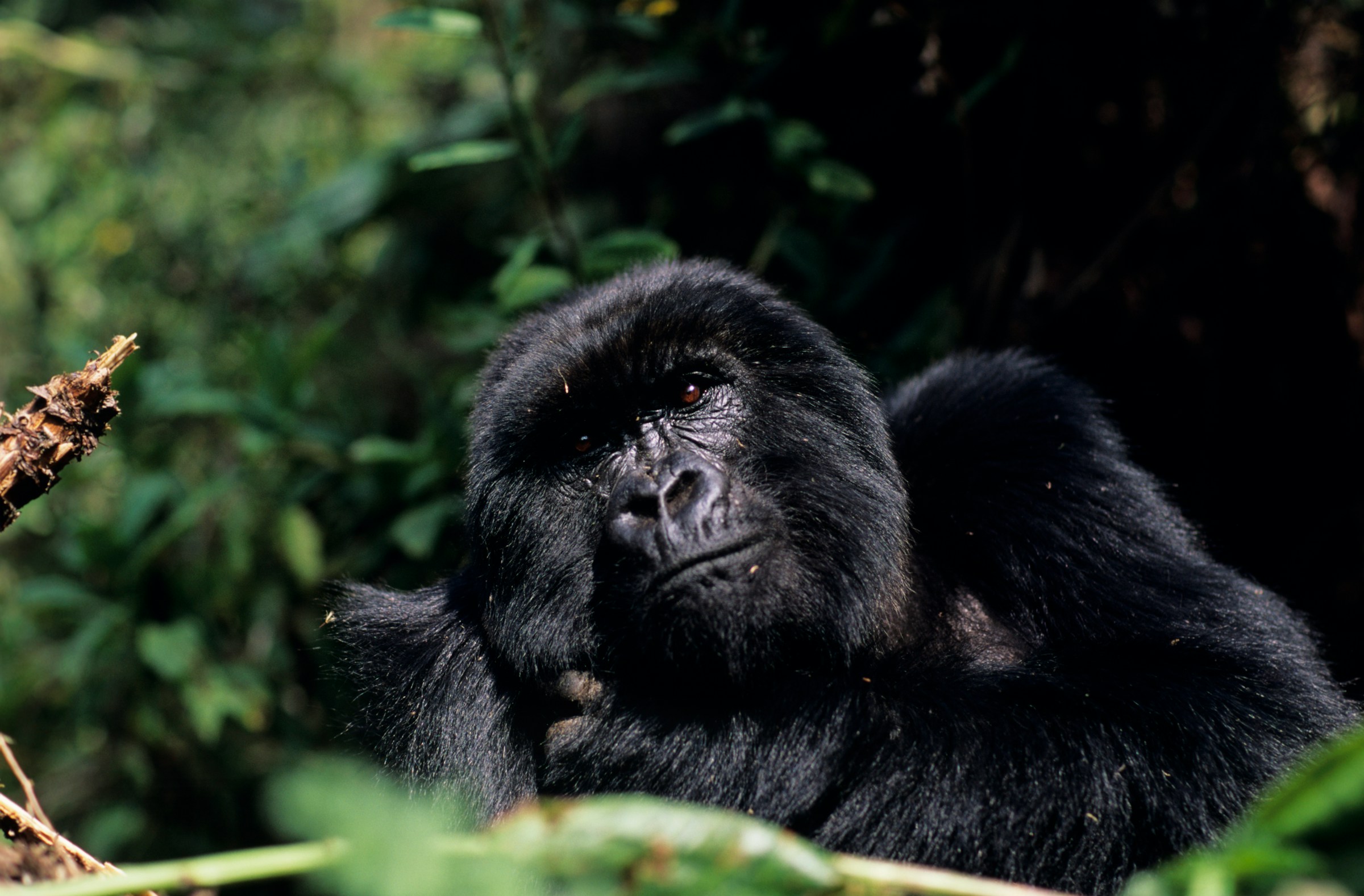
Mountain gorillas came startlingly close to disappearing entirely. By the 1980s, hunting, habitat loss, disease, and years of regional conflict had pushed the population down to roughly 250-400 individuals – a number small enough that extinction within a generation looked plausible.
Today, thanks to decades of sustained conservation work across Rwanda, Uganda, and the Democratic Republic of Congo, the global wild population has climbed back to roughly 1,063 individuals, according to the most recent transboundary censuses – making mountain gorillas one of the only great ape populations on the planet that’s currently growing rather than shrinking.
Mountain gorillas exist in exactly two isolated populations in the entire world, and nowhere else. One lives in Uganda’s Bwindi Impenetrable National Park, with roughly 459 individuals.
The other occupies the Virunga Massif, a chain of dormant volcanoes straddling the borders of Rwanda, Uganda, and the DRC, home to around 600 gorillas split across three adjoining national parks.
Rwanda’s share of that population – living in Volcanoes National Park, on the slopes of the Virunga volcanoes at elevations between roughly 2,300 and 4,500 meters – has itself more than doubled over the past few decades, and now numbers several hundred gorillas across more than a dozen habituated family groups.
Life on the Volcano
Mountain gorillas are built for cold, wet, high-altitude bamboo and rainforest, not the steamy lowland jungle most people imagine when they hear “gorilla.”
Their thicker, longer fur – an adaptation unique among gorilla subspecies – helps them handle temperatures that can dip close to freezing at night on the Virunga slopes.
They’re almost entirely herbivorous, spending much of each day working through a diet of bamboo shoots, wild celery, thistles, nettles, and vines; an adult silverback can eat over 18 kilograms of vegetation daily.
Groups are organized around a single dominant silverback male, who leads and defends a family that can range from a handful of individuals to more than 20, including females, juveniles, and younger males.
They build fresh nests of bent branches and foliage to sleep in every single night, rarely reusing the same spot twice – one of several behavioral traits, alongside individually distinguishable nose prints, that researchers use to track known family groups over generations.
Much of what the world knows about these animals traces back to American primatologist Dian Fossey, who established the Karisoke Research Center in Rwanda’s Volcanoes National Park in the 1960s to study them.
Her research – and the international attention it drew to the species’ collapse – helped lay the foundation for the conservation model the region now runs on.
How You Actually See One – Carefully
Gorilla tourism in Rwanda is deliberately expensive and deliberately small-scale. A trekking permit runs about $1,500 per person, among the highest wildlife-viewing fees anywhere in the world, and each habituated gorilla family can be visited by a maximum of eight tourists per day, for a strictly limited one hour once the group is located.
Treks begin with a briefing and a guided hike – anywhere from 30 minutes to several hours through cloud forest and volcanic terrain, depending on where the family is ranging that day – accompanied by trackers and armed rangers whose job is as much about protecting the gorillas from disease exposure as protecting visitors.
Rules are strict: masks are sometimes required, a minimum distance is enforced, and anyone visibly sick is turned away, since mountain gorillas share enough DNA with humans to be vulnerable to human respiratory illnesses.
The pricing isn’t just about exclusivity. It’s a funding mechanism. Under Rwanda’s Tourism Revenue Sharing Programme, a share of all national park revenue – the government raised the allocation to 10% of park earnings in recent years – is reinvested directly into the communities living around the parks, funding schools, health clinics, and infrastructure.
The logic is straightforward: when a family living beside Volcanoes National Park earns more from a living gorilla than they ever could from the land the gorilla occupies, protecting that gorilla stops being a favor to conservationists and starts being an obvious economic choice.
It’s a model credited with turning former poachers into park employees and has become a case study cited by organizations including the World Economic Forum for how tourism revenue can directly fund both wildlife recovery and rural development.
The project began hiring former poachers and paying them regular salaries as rangers, trackers, and mountain guides. Their knowledge of the forest, previously used to track and kill animals, suddenly became the most valuable tool in their protection.
A Blueprint, Not Just a Beauty Spot
None of this happened by accident. Rwanda deliberately built a tourism identity around exclusivity and conservation rather than volume – high permit prices, small daily visitor caps, and reinvestment structures designed to make protection profitable – and it’s paid off.
Gorilla trekking, along with parks like Nyungwe Forest and Akagera, has become one of the country’s most important economic engines, drawing travelers willing to pay a premium for a tightly managed, high-value experience rather than a mass-market safari.
For a continent still frequently defined in Western media by instability and poverty, Rwanda has quietly become something else: proof that strict environmental policy, national discipline, and high-end conservation tourism can work together, and that a small, landlocked, densely populated country with a brutal recent history can rebuild itself into one of the most orderly, and most unexpectedly wild, places on Earth.
/Sources: World Economic Forum; United Nations Development Programme (UNDP); Fodor’s Travel Guide to Rwanda; Rwanda Development Board; International Union for Conservation of Nature (IUCN) mountain gorilla population data; Dian Fossey Gorilla Fund; Uganda Wildlife Authority/Institut Congolais pour la Conservation de la Nature transboundary gorilla census (Virunga Massif and Bwindi-Sarambwe surveys)./


