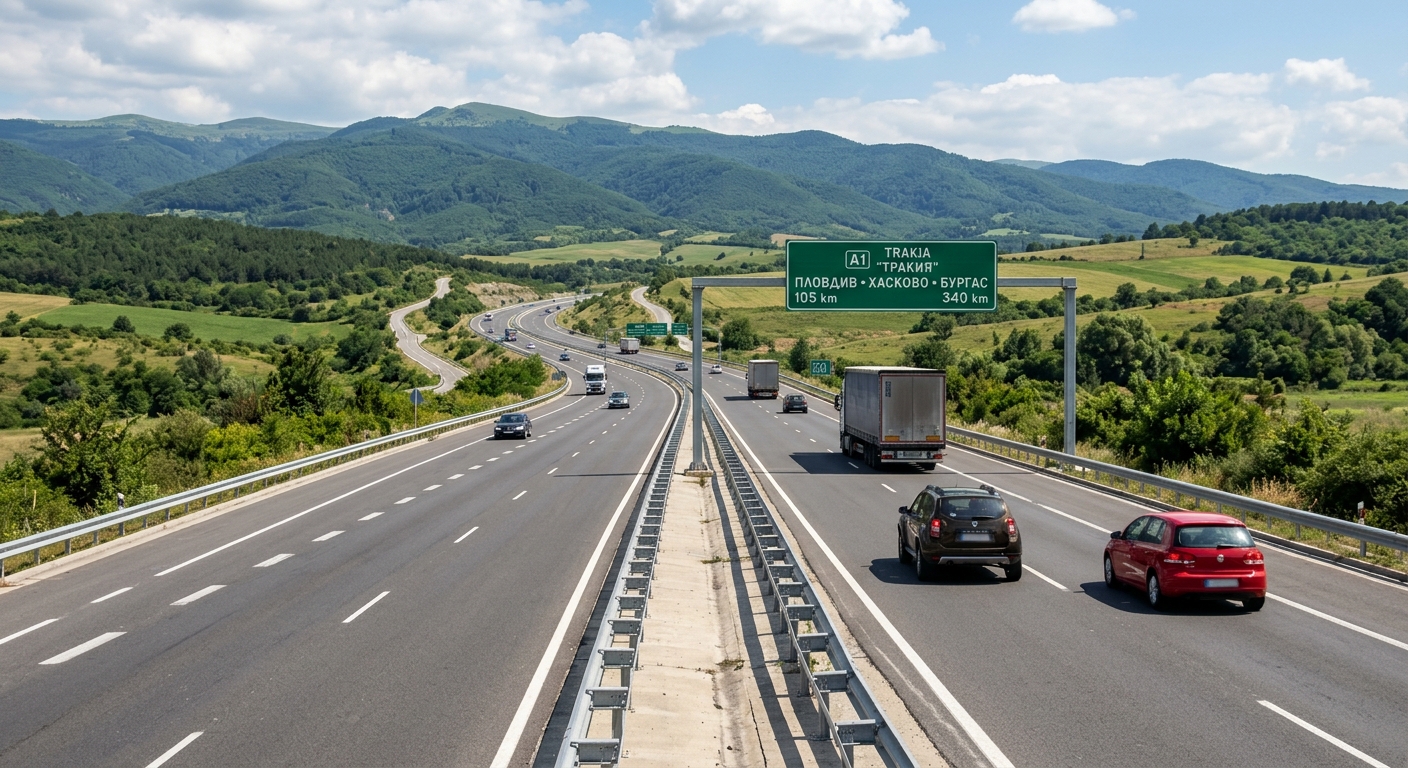
Thirteen people died in a devastating motorway pile-up in November 2026. It was one of the darkest reminders of a problem that has haunted Bulgaria for decades: road travel remains far more dangerous here than in most of the European Union.
Europe is often associated with a high quality of life, social stability, personal freedom and relatively safe everyday surroundings.
For the most part, these expectations are justified. Across much of the continent, people can travel, work and raise families within societies that have invested heavily in public infrastructure and safety.
But even within the European Union, there are places where everyday life carries risks that are easy to overlook.
On the western shore of the Black Sea lies Bulgaria, a country known for its mountains, historic towns, Black Sea beaches, rose oil and distinctive culinary traditions.
It is also a country with a much darker reality: its roads remain among the deadliest in the European Union.
For years, Bulgarians have used a particularly striking expression to describe the situation – the war on the roads.
It is not a war in the traditional sense. There are no front lines, military objectives or declared enemies. Yet people continue to lose their lives in circumstances that, in many cases, could have been prevented.
And unlike an armed conflict, this crisis does not arrive as one dramatic national emergency. It unfolds every day, often in isolated incidents, gradually becoming part of the background of ordinary life.
November 10, 2026: A Tragedy on the Trakia Motorway
On the morning of November 10, 2026, Bulgaria experienced one of its most devastating motorway accidents in recent memory.
Two massive chain-reaction collisions occurred on the Trakia Motorway near the Zimnitsa interchange in the southeastern region of Yambol. A total of 86 vehicles – 63 travelling towards Burgas and 23 towards Sofia – were involved.
The first emergency call was received at approximately 7:10 a.m. Dense fog had severely reduced visibility in the area, creating extremely dangerous conditions for drivers travelling along the motorway.
The consequences were catastrophic. Eleven people were initially reported dead, while more than 50 were taken to hospital. In the days that followed, two more victims died from their injuries, bringing the confirmed death toll to 13.
Emergency teams from several neighbouring regions were involved in the rescue operation. The scale of the incident required extensive coordination between firefighters, police officers, medical personnel and hospitals.
The motorway was closed in both directions, and November 11 was declared a national day of mourning.
Investigators are examining the circumstances surrounding the collisions, including visibility, road conditions, vehicle speeds and whether drivers maintained appropriate distances. The precise sequence of events remains a matter for the investigation.
The tragedy was particularly shocking because of its scale. However, it was not an isolated reminder that travelling on Bulgarian roads can be dangerous. It was part of a much longer and more troubling pattern.
Why Do Bulgarians Call It a War on the Roads?
The expression war on the roads has become deeply embedded in Bulgarian public discourse. It is frequently used by journalists, politicians, road safety campaigners and ordinary citizens when discussing serious traffic accidents.
The phrase became particularly prominent around the turn of the century, as Bulgaria experienced a period of high road mortality amid rapid changes in car ownership, traffic and infrastructure.
During the 1990s and early 2000s, the country underwent a profound economic and social transformation. Private car ownership expanded, the vehicle fleet changed, and traffic volumes increased. At the same time, road infrastructure, enforcement and road safety practices faced significant challenges.
The human cost was enormous. In 1990, 1,567 people were killed in road accidents in Bulgaria – one of the highest annual figures in the country’s recorded road safety statistics. In 2008, the number was still 1,061.
The expression became a convenient way to describe a seemingly endless sequence of deaths and injuries. It also reflected a sense of public frustration: people were losing their lives on ordinary journeys, often while travelling to work, visiting relatives or going on holiday.
There is, however, a serious argument against using the term.
Describing road accidents as a war can create the impression that the deaths are inevitable, as though they were the result of an uncontrollable force.
In reality, road safety depends on factors that societies can influence: infrastructure design, speed limits, enforcement, vehicle standards, driver behaviour and emergency response. The problem is not an unavoidable war. It is a persistent public safety challenge.
The Numbers: A Long History of Road Deaths
The historical figures show that Bulgaria has made progress, but they also reveal how deeply rooted the problem is.
According to official Bulgarian statistics, 1,567 people were killed on the country’s roads in 1990. In 2008, the figure was 1,061. More recently, annual fatalities have fallen considerably.
The European Commission’s final figures for 2025 recorded 456 road deaths in Bulgaria, compared with 478 in 2024.
That is a substantial improvement compared with the worst years of the 1990s and 2000s. Yet the figures remain troubling when measured against the country’s population.
The most useful way to compare road safety between countries is to look at fatalities per million inhabitants.
| Country or region | Road deaths per million inhabitants, 2025 |
| Bulgaria | 71 |
| Romania | 68 |
| Croatia | 65 |
| European Union average | 43 |
| Denmark | 24 |
| Sweden | 19 |
Bulgaria recorded one of the highest road mortality rates in the EU in 2025, alongside Romania and Croatia. Its rate was substantially above the European average and several times higher than that of Sweden.
The figures are especially striking when considering that Bulgaria is an EU member state, subject to the same broad European road safety framework and standards.
There has been progress. The European Commission reports that Bulgaria reduced road deaths by 27% between 2019 and 2025. Nevertheless, the country continues to face one of the most serious road safety challenges in the Union.
The statistics also show why looking only at the annual number of deaths can be misleading. A country with a smaller population may have fewer fatalities in absolute terms but a much higher risk for each resident.
A Peacetime Death Toll on the Scale of a War
Perhaps the most disturbing way to understand the scale of Bulgaria’s road safety problem is to look at the cumulative number of lives lost over time.
According to historical figures published by Bulgaria’s Ministry of Interior, approximately 31,000 people (the population of an average-sized town) have been killed in road traffic accidents in the country since 1990. Between 2000 and 2025 alone, the number is estimated at around 19,500 – an average of roughly 750 deaths every year over a period of 26 years.
To put these figures into a broader historical perspective, the Soviet Union lost approximately 13,000 military personnel during its decade-long intervention in Afghanistan between 1979 and 1989, according to estimates cited by the US Congressional Research Service.
The comparison is not a direct statistical equivalent. One figure represents road deaths involving civilians and other road users over several decades, while the other refers to military fatalities during an armed conflict. The circumstances are entirely different.
Nevertheless, the comparison offers a striking sense of scale. Over 26 years of peacetime, Bulgaria has lost considerably more people on its roads than the Soviet Union lost military personnel during its entire war in Afghanistan.
And this is not a single historical tragedy that ended with a ceasefire or a peace agreement. It is a continuing pattern of loss, with new victims every year.
The difference is also psychological. Military conflicts usually concentrate public attention on a clearly defined period of national crisis. Road deaths, by contrast, are spread across thousands of separate incidents.
One accident happens on a motorway, another on a rural road, and another at an urban intersection. Each receives attention for a short time before the next tragedy takes its place in the news.
Over the years, this repetition can make an extraordinary level of loss seem almost ordinary.
Perhaps that is one of the most troubling aspects of Bulgaria’s road safety crisis: the number of lives lost is enormous, yet the deaths are dispersed across time and space, making their cumulative impact easy to underestimate.
What Makes Bulgarian Roads So Dangerous?
There is no single explanation for Bulgaria’s road safety record. The problem involves several overlapping factors, and their relative importance varies depending on the type of road and the circumstances of individual accidents.
The European Commission’s 2026 country overview identifies several areas of concern.
Speed and road conditions
Speed is one of the most important factors in the severity of road accidents. At higher speeds, drivers have less time to react, stopping distances increase, and collisions are more likely to result in fatal or life-changing injuries.
Bulgaria’s maximum motorway speed limit is 140 km/h, among the highest in the EU. This does not mean that the speed limit itself explains the country’s accident statistics, but it makes appropriate enforcement and road conditions particularly important.
Rural roads also deserve attention. According to the European Commission, Bulgaria has a relatively high proportion of road fatalities occurring outside urban areas.
These roads can present a combination of challenges: inconsistent road surfaces, limited lighting, dangerous intersections, insufficient separation between traffic directions and unexpected obstacles.
Seat belts and vehicle safety
The European Commission’s country profile also points to lower seat-belt and child-restraint usage in Bulgaria compared with the EU average.
Seat belts do not prevent collisions, but they significantly reduce the risk of death and serious injury when one occurs. The same principle applies to properly installed child safety seats.
Vehicle safety has improved dramatically over the past few decades, but the benefits of modern technology depend on the condition of the vehicles on the road and whether drivers use basic safety equipment.
Driver behaviour and enforcement
Speeding, dangerous overtaking, driving under the influence of alcohol or drugs, distraction and failure to maintain a safe distance are among the behaviours that increase the risk of serious collisions.
These are not uniquely Bulgarian problems. They occur across Europe. The difference lies partly in how consistently they are prevented, detected and penalised.
Effective enforcement is not simply about issuing fines after an offence. It is about creating a credible expectation that dangerous behaviour will be detected and that the rules will be applied consistently.
Infrastructure and emergency response
Road design can either reduce the likelihood of a collision or make its consequences more severe.
Modern safety measures include central barriers, properly designed junctions, clear road markings, adequate lighting, safe pedestrian crossings and protective roadside barriers.
Even when a driver makes a mistake, a well-designed road can prevent that mistake from becoming fatal.
The time it takes for emergency services to reach an accident scene also matters. In serious collisions, rapid medical intervention can make the difference between survival and death.
The Human Cost Behind the Statistics
Numbers can describe the scale of a problem, but they cannot fully explain its human consequences. Every fatal accident leaves behind families, friends and communities.
A person who does not return home after an ordinary journey can leave children without a parent, partners without the person they built their lives with, and parents grieving a son or daughter.
The consequences extend far beyond those who die. Thousands of people survive serious road accidents but suffer injuries that can permanently change their lives. Some face years of rehabilitation, chronic pain, reduced mobility or an inability to return to work.
The European Commission recorded 1,888 people seriously injured in road crashes in Bulgaria in 2024. These are not simply additional entries in a statistical report. They represent lives that may never return to what they were before the accident.
There is also a wider economic cost. Medical treatment, emergency services, rehabilitation, lost productivity and long-term care place a substantial burden on families and society. The real cost of unsafe roads is therefore much greater than the annual number of fatalities.
Could Bulgaria Have the Same Road Safety as Sweden or Denmark?
The difference between Bulgaria and some of Europe’s safest countries is difficult to ignore. In 2025, Sweden recorded approximately 19 road deaths per million inhabitants, while Denmark recorded 24. Bulgaria’s rate was 71.
This does not mean that Bulgaria could immediately achieve the same results by copying a single policy. The countries differ in geography, population distribution, traffic patterns, infrastructure and many other respects.
However, the experience of countries with low road mortality demonstrates that road deaths can be reduced through sustained investment and consistent policies.
The European approach to road safety increasingly follows the principles of Vision Zero – the idea that no loss of life on the road should be accepted as an inevitable price of mobility.
It does not assume that human error can be eliminated. Instead, it seeks to ensure that mistakes do not automatically result in death.
That requires safer roads, safer vehicles, appropriate speeds, responsible road users and effective post-crash care.
Bulgaria has made measurable progress, and the European Commission’s 2025 assessment even lists the country among the five EU members considered on course to meet the 2030 target for reducing road deaths.
This is encouraging, but it should not obscure the fact that Bulgaria still has one of the highest fatality rates in the Union.
A Problem That Should Never Become Normal
Perhaps the most disturbing aspect of Bulgaria’s road safety crisis is not any single accident, however tragic. It is the way repeated tragedies can gradually become familiar.
A serious crash dominates the news for a few days. Politicians issue statements, investigations begin, families mourn, and public attention eventually moves elsewhere.
Then another accident happens.
The expression war on the roads captures the sense of a continuing national tragedy, but it should not make the situation seem inevitable.
Road deaths are not simply bad luck, and they should never be treated as an unavoidable consequence of modern life.
Bulgaria is a beautiful country, with much to offer visitors and residents alike. Its roads connect historic towns, mountain landscapes, seaside resorts and communities that are often far apart. But those journeys should not come with an unusually high risk of death.
The tragedy on the Trakia Motorway in November 2026 is a painful reminder of what can happen when dangerous conditions and multiple risk factors converge. It is also a reminder that road safety is not a technical issue reserved for transport specialists. It is a basic measure of how well a society protects the people who live in it.
A road should be a way to get somewhere. It should not become the place where an ordinary day ends in tragedy.
Sources:
- European Commission – Road safety statistics for 2025
- European Commission – Bulgaria Road Safety Country Profile 2026
- European Commission – Road Safety Statistics 2025
- World Health Organization – Global Status Report on Road Safety 2023
- BTA – November 10 Trakia Motorway Tragedy Toll Rises to 13
- Anadolu Agency – 86 Vehicles Involved in Bulgarian Motorway Pile-Ups
- Bulgarian Ministry of Interior – Historical Road Fatality Statistics
- Wikipedia – Soviet – Afghan War


