When a group of sport fishermen dropped their lines off Costa Rica in August 2024, they were expecting the usual surprises of a day on the Caribbean. They were not expecting an orange shark.
The fishermen were fishing near Tortuguero National Park, off Costa Rica’s Caribbean coast, when they hooked a nurse shark roughly 37 meters, or 121 feet, below the surface.
The animal was about 6.5 feet long and looked unlike any nurse shark the fishermen had seen before: its body was an intense yellow-orange, while its eyes appeared almost completely white.
They photographed the shark, measured it and released it back into the ocean. At first, the photographs seemed almost too strange to be real.
But when marine biologists examined the images, they realized they were looking at something considerably more unusual than an oddly colored shark.
The animal appeared to have a rare combination of pigmentation disorders known as albino-xanthochromism.
The discovery was subsequently documented in Marine Biodiversity, where researchers described it as the first scientifically documented case of total xanthism in a nurse shark and the first such record from the Caribbean.
And the most interesting part may not be the color. It is the fact that the shark was alive, apparently healthy and already an adult.
Why Was the Shark Orange?
Color in wild animals is rarely just decoration. For a bottom-dwelling predator such as a nurse shark, ordinary brown and yellow-brown coloration provides camouflage against sand, rock and the dimly lit seafloor. A bright orange body would seem to throw that advantage away.
The Costa Rican shark appears to have had two unusual pigmentation conditions at once. Xanthism, or xanthochromism, involves unusually strong yellow or golden pigmentation.
Instead of the subdued brownish tones normally associated with nurse sharks, the condition can produce a striking yellow or orange appearance.
The shark also showed signs consistent with albinism, which involves a reduction or absence of melanin. In this case, the most obvious clue was its unusually pale eyes, with no visible dark iris.
Together, the two conditions produced something that looked almost unreal: a normally camouflaged bottom-dwelling shark turned vivid orange, with pale eyes.
Researchers stress that the precise biological cause of the abnormal pigmentation remains uncertain.
Genetic alterations are a leading possibility, but environmental and physiological factors can also influence pigmentation in animals.
The study therefore stops short of claiming a single definitive cause. What scientists do know is that this particular combination is extraordinarily rare.
How Did It Survive?
This is where the orange shark becomes more than a curiosity. If camouflage helps a predator avoid detection and approach prey, losing that camouflage should theoretically be a disadvantage.
The Costa Rican shark, however, had already made it to adulthood. That does not mean scientists have solved the mystery of how it survived.
One plausible explanation involves the shark’s habitat. Nurse sharks often live close to the seafloor, where they spend much of their time searching for prey among sand, rocks, reefs and crevices.
The area where the orange shark was found is also influenced by river systems, creating relatively murky coastal waters.
Daniel Arauz Naranjo, a Costa Rican marine biologist involved in the investigation, suggested that poor visibility around river mouths could have helped conceal the unusually colored animal.
Other possibilities include behavior, habitat selection and the availability – or absence – of predators in the area.
In other words, the shark may not have needed to hide perfectly. It may simply have been living in a place where being highly visible was less of a problem than it would have been in clear offshore water.
And there is another important detail: nurse sharks are not built like great whites.
Meet the Nurse Shark
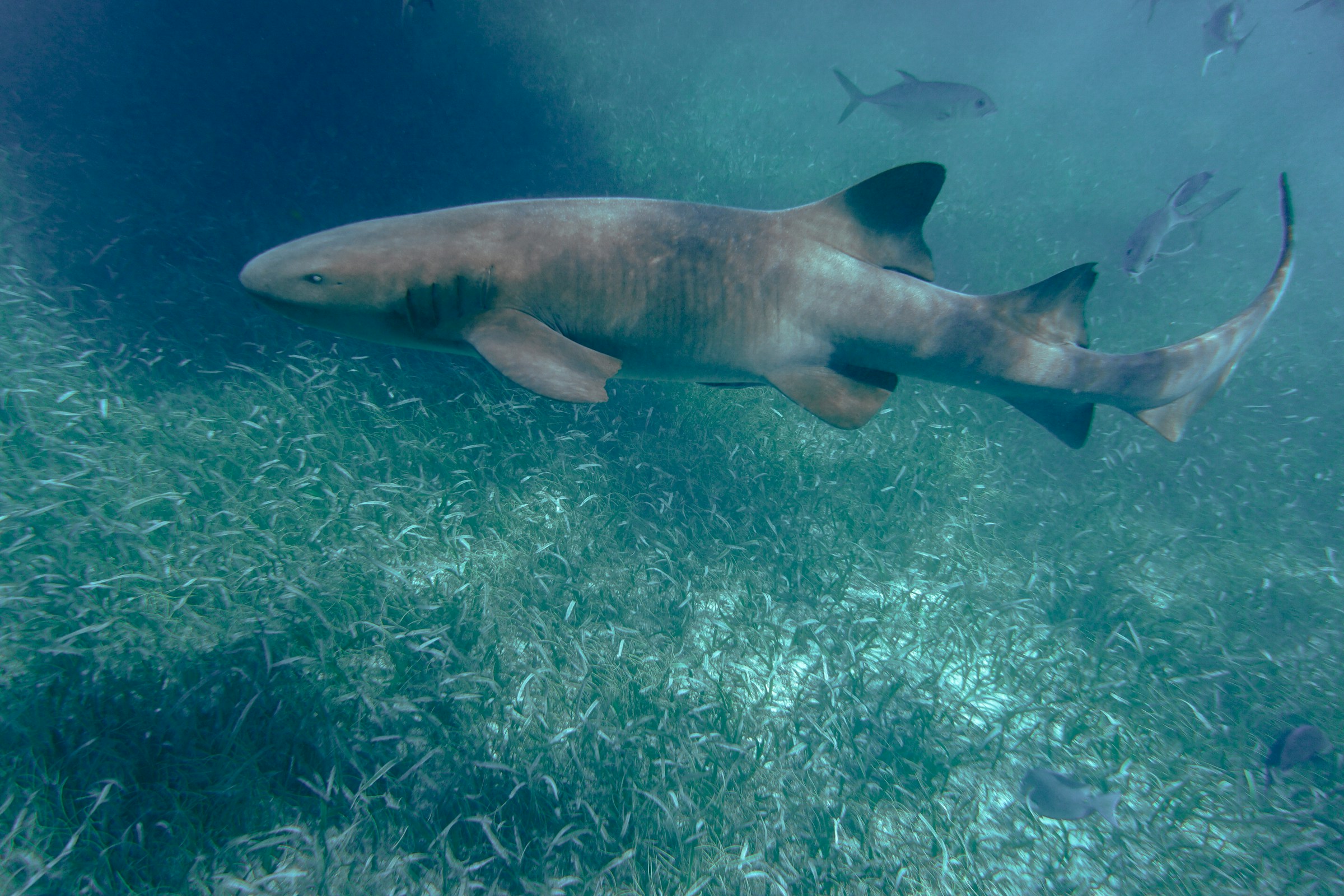
The species is Ginglymostoma cirratum, commonly known as the nurse shark.
Despite belonging to the same broader group of animals that includes some of the ocean’s most formidable predators, nurse sharks have a remarkably different lifestyle.
They are slow-moving, bottom-dwelling and primarily nocturnal. During the day, they can spend long periods resting on the seafloor, sometimes sheltering beneath ledges or in crevices. They have also been observed resting together in groups.
Adults typically reach around 7 to 8 feet, although larger individuals have been recorded. The Costa Rican specimen, at roughly 6.5 feet, was therefore already close to typical adult size.
And unlike many sharks, nurse sharks do not need to keep swimming simply to breathe. They can use a mechanism known as buccal pumping, actively drawing water into their mouths and forcing it across their gills while remaining stationary.
That ability allows them to spend long periods resting on the bottom – something that would be impossible for sharks that depend entirely on forward motion to ventilate their gills.
It is one of the reasons the species can appear almost unusually relaxed for an animal that is, technically, a predator.
The Shark With a Built-In Vacuum Cleaner
Nurse sharks also have a peculiar way of eating. Their mouths are relatively small, but they can generate powerful suction.
Instead of relying on a dramatic chase, they often forage along the bottom and use suction to pull prey from the sand, rocks and crevices.
That menu includes crustaceans, mollusks, squid, octopuses, sea urchins and small fish, among other bottom-dwelling animals.
Their pair of fleshy barbels, located near the nostrils, are another distinctive feature and help them investigate their surroundings close to the seafloor.
The result is a shark that behaves less like the stereotypical torpedo-shaped predator of popular culture and more like a slow-moving vacuum cleaner working its way across the ocean floor.
That lifestyle may also help explain why an unusually colored individual could survive long enough to become an adult.
Should Swimmers Be Afraid?
Generally, no. Nurse sharks are widely regarded as relatively docile, and most documented incidents involving people have occurred when the animals were disturbed, stepped on or otherwise provoked.
That does not make them harmless – they are still large wild predators with powerful jaws – but they are very different from the aggressive image associated with some other shark species.
Their calm reputation is also part of why they are frequently encountered by divers and snorkelers in tropical waters.
But the orange shark off Costa Rica is a reminder that even a species scientists know relatively well can still produce surprises.
Nurse sharks have been documented across tropical and subtropical parts of the Atlantic and eastern Pacific, including the Caribbean and Central American coastlines. Their normal coloration, behavior and ecology are well established.
What happened in Costa Rica was different. A species that normally disappears into its surroundings produced an individual that looked almost impossible to miss.
The Ocean Still Has Plenty of Exceptions
The orange shark is not evidence of a new species, nor does its unusual coloration necessarily indicate that the population is changing.
It is something more interesting in a different way: a single animal that demonstrates just how much variation can exist within a species.
Scientists do not yet know whether another shark with the same combination of traits is swimming somewhere in the Caribbean.
They do not know exactly what caused the pigmentation abnormalities, or precisely how this individual managed to reach adulthood despite losing much of the camouflage that normally helps a bottom-dwelling shark blend into its surroundings.
What they do know is that the shark survived long enough for a fishing line to find it. The fishermen then did something equally important: they photographed it, recorded its measurements and put it back.
That decision turned a bizarre fishing catch into a scientific observation. For now, the orange nurse shark remains a one-of-a-kind sighting – a bright flash of color in an environment where evolution usually rewards the opposite. And perhaps that is the most fitting lesson from the discovery.
The ocean does not have to produce a new monster to surprise us. Sometimes it only has to take an animal we thought we understood, change its color, and let it grow to adulthood anyway.
Sources and Further Reading:
- Marine Biodiversity, “First record case of free-living xanthism in the nurse shark Ginglymostoma cirratum from Caribbean Sea” – the peer-reviewed study documenting the Costa Rican specimen, its size, location and unusual pigmentation.
- National Geographic, “One-of-a-kind golden shark discovered in Costa Rica” – reporting on the discovery and expert explanations for the shark’s survival in the wild.
- NOAA Fisheries, Nurse Shark identification guide – species identification, typical coloration and maximum size.
- Florida Museum of Natural History, Nurse Shark species profile – behavior, habitat, diet and interactions with humans.
- Smithsonian Ocean, Sharks – explanation of buccal pumping and why nurse sharks can breathe while resting on the seafloor.
- FishBase, Ginglymostoma cirratum – distribution, size, diet, reproduction and general biology.