Paleontologists have identified a new, extinct species of long‑snouted crocodile from fossils embedded in the very limestone formation that ancient Egyptians quarried to build the Great Sphinx of Giza.
The species, named Herugavialis cairensis, lived about 45 million years ago in a warm, shallow sea that once covered what is now northern Egypt.
The Discovery: A Gavial in the Sphinx’s Bedrock
The fossil in question is a nearly complete skull, missing only the tip of its snout, recovered decades ago from the Mokattam Formation, the same Eocene‑age limestone used for the Sphinx and nearby pyramids.
For years it was tentatively assigned to another gavial species, but new analyses using modern palaeontological methods led researchers to reclassify it as a distinct genus and species: Herugavialis cairensis.
The study, published in Royal Society Open Science, places Herugavialis within the gavials – a group of crocodilians characterized by extremely long, narrow snouts adapted for catching fish.
At the time Herugavialis swam in Egypt’s ancient sea, the region was part of a broader Mediterranean‑Tethys marine environment that supported multiple gavial species simultaneously.
From Global Giants to a Single Survivor: The Gavial Story
Gavials are today represented by just a handful of living species, restricted mainly to the Indian subcontinent and parts of Southeast Asia.
But their fossil record tells a very different story: for more than 100 million years, gavial‑like crocodilians were nearly global, inhabiting coastal and riverine ecosystems across what are now Europe, Africa, Asia, and the Americas.
In the Mediterranean region alone, diverse crocodilian faunas – including several gavial lineages – flourished through much of the last 50 million years, waxing and waning with shifts in global temperature and sea level.
Around six million years ago, major environmental changes, including the drying of the Mediterranean during the Messinian Salinity Crisis, helped wipe out crocodilians from this region entirely.
Herugavialis cairensis is thus a snapshot of a once‑rich crocodilian diversity in Egypt, long before the Nile Valley became the arid landscape we know today – and long before humans carved the Sphinx from the very rock that preserved its bones.
What About Crocodiles in Egypt Today?
Modern Egypt has only one native crocodilian: the Nile crocodile (Crocodylus niloticus). Historically, this species ranged throughout the Nile Valley and Delta, but by the mid‑20th century it had been virtually eradicated from the Egyptian Nile due to hunting and habitat change.
After the construction of the Aswan High Dam and the creation of Lake Nasser, Nile crocodiles re‑established a population in Upper Egypt, where they remain today.
Occasional reports of crocodiles farther north, including near Cairo, are generally attributed to escaped or released individuals rather than natural, self‑sustaining populations.
Gavials, Nile Crocodiles and Other Crocodiles: What Sets Them Apart?
The Nile crocodile is Africa’s most widespread and iconic crocodilian, yet it differs in key ways from other major crocodile species, as well as from gavials such as Herugavialis.
Probably the most important difference lies in snout shape and diet. The Nile crocodile has a broad, powerful snout suited for taking a wide range of prey, from fish to large mammals.
Most other large crocodiles, such as the saltwater crocodile, also have robust snouts adapted to very large prey and diverse habitats.
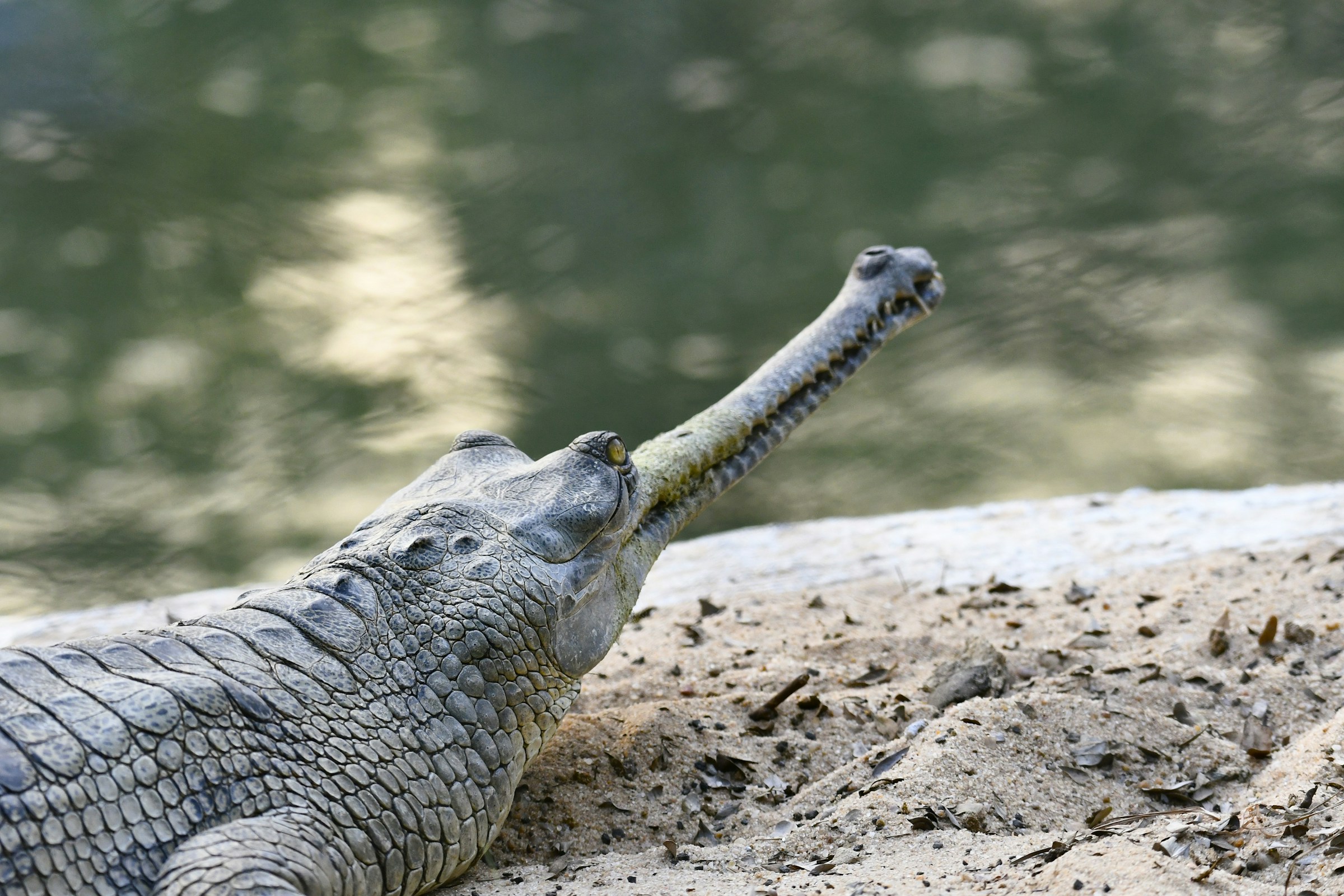
Gavials, including Herugavialis, are different – they have extremely long, narrow snouts specialized for catching fish.
There are also significant differences in size. The Nile crocodile is among the largest crocodilians, commonly reaching 4-5 meters in length, with exceptional individuals growing even larger.
Modern gharials – the other name for gavials – are long but more slender, typically smaller in bulk than the largest Nile or saltwater crocodiles.
As for Herugavialis, exact size estimates depend on the specimen, but as a gavial it likely had a long, slender build optimized for aquatic hunting.
Their habitats and ranges today are also very different. The Nile crocodile lives in freshwater lakes, rivers, swamps, and some brackish systems across sub-Saharan Africa, and historically extended into the Levant and along parts of the Mediterranean coast. The modern gharial (gavial), by contrast, is restricted to a few river systems in India and Nepal.
Finally, their evolutionary histories diverge sharply. The Nile crocodile as a living species appeared in the Late Miocene-Early Pliocene, around 7-5 million years ago, in East Africa, with close fossil relatives found in the same strata.
Gavials, on the other hand, represent a much older lineage, with a fossil record spanning over 100 million years and a once near-global distribution.
Herugavialis cairensis Tells Us the Story of a Long-Vanished World
The identification of Herugavialis cairensis does more than add a name to a museum skull: it rewrites part of Egypt’s deep natural history, showing that the rocks behind one of humanity’s most famous monuments also preserve evidence of a lost world of marine reptiles.
It underscores how the Mediterranean region, now largely devoid of crocodilians, was once a hotspot of crocodilian diversity – long before humans, pyramids, or the Sphinx.
Source:
- Ancient crocodile species discovered in the same stone that built the Great Sphinx | CNN edition.cnn.com
- New crocodile species found in rocks of Egypt’s Great Sphinx popsci.com
- New crocodile species found fossilized in stone used to build Egypt’s Great Sphinx news.mongabay.com
- Egypt archaeology: Great Sphinx rocks reveal new species of ancient crocodile thenationalnews.com
- Distribution & Habitat – Nile Crocodiles ielc.libguides.com
- Nile Crocodile (Crocodylus niloticus) – Species Profile – USGS NAS nas.er.usgs.gov
- NDF WORKSHOP CASE STUDIES conabio.gob.mx