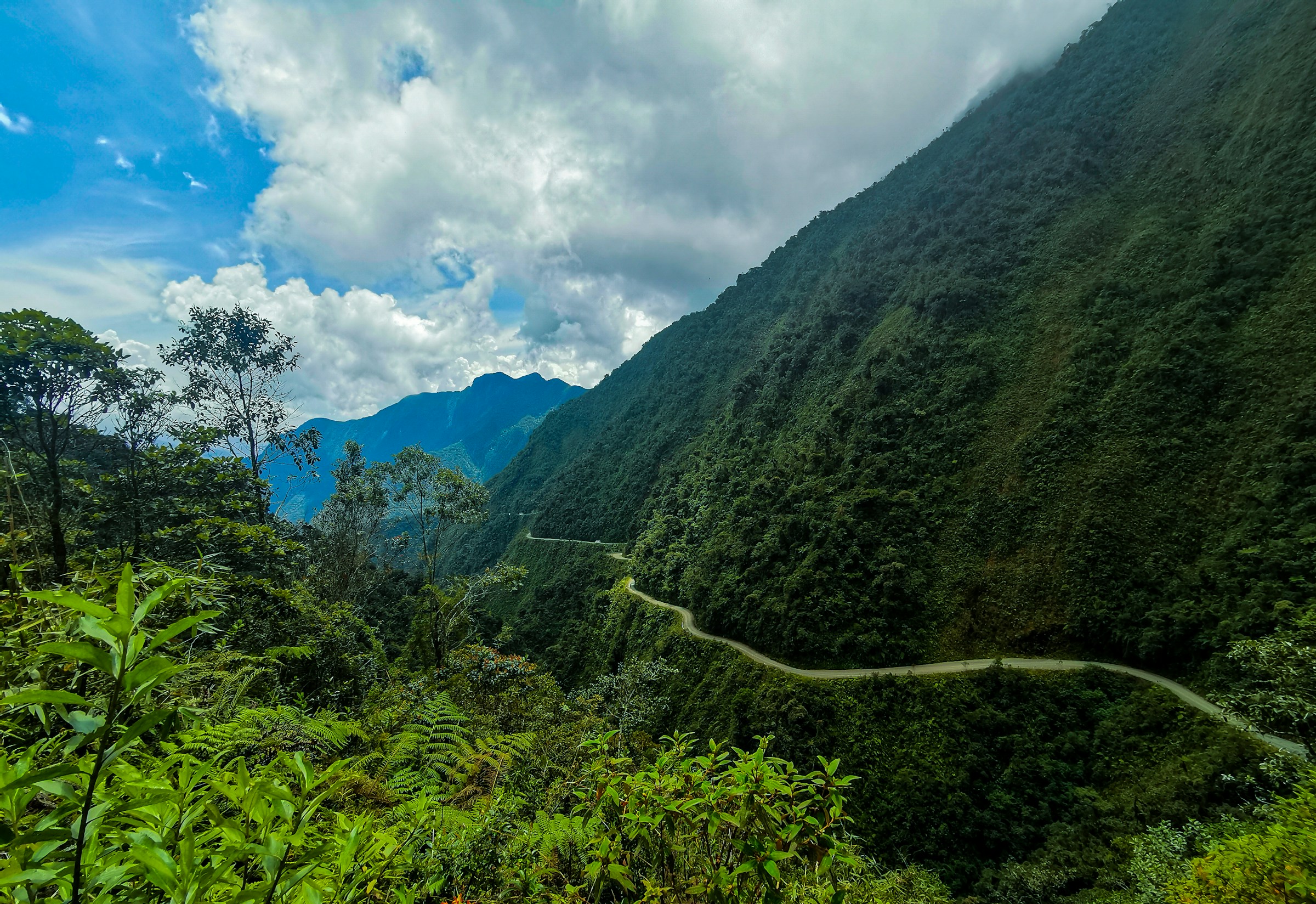
High above Bolivia’s cloud forest, a narrow ledge of gravel once killed hundreds every year. Today, the world’s most dangerous road has found a strange second life.
Somewhere above the clouds outside La Paz, the asphalt ends. What follows is a ribbon of gravel carved into a mountainside, barely wide enough for two vehicles to pass.
On one side rises a wall of rock and dripping moss. On the other there is nothing at all, just air, fog, and a long fall into the green. This is the North Yungas Road, known across Bolivia and the world as El Camino de la Muerte, the Death Road.
A Road Built for a War
The route links the Andean highlands with the Amazonian lowlands. Until 2006, it was the only option for traveling from Coroico to La Paz.
It climbs out of the capital to a pass at roughly 4,650 meters, then descends to the small jungle town of Coroico at around 1,200 meters. The route runs approximately 64 kilometers (about 40 miles).
Its origins are as grim as its reputation. According to Dutch broadcaster BNNVARA, in the 1930s Bolivia fought a war with neighboring Paraguay over an oil-rich territory, and Paraguayan prisoners of war were forced to build the road.
The Chaco War left Bolivia with many captives, and the road was built largely by hand, on a mountainside that was never meant to hold a road.
Why It Kills
The danger comes from a cruel combination of geography, weather and traffic.
The width and the drops. In places the road narrows to about 3 meters, and there are no guardrails. Some stretches are as narrow as 10 feet, with drops of 1,000 feet straight down to the rainforest. Other accounts put the deepest drops at around 600 meters.
The weather. The road crosses several climate zones in a single day. Rain and fog can make visibility precarious, the surface muddy, and loosen rocks from the hillsides above. Landslides and rockfalls are a constant threat, and the road has claimed even careful travelers: in 2018 an Israeli woman died after a falling rock hit her during a bicycle tour.
The left-hand rule. In a country that drives on the right, traffic on this road keeps left. A driver on the left has a better view of the edge of the road. When two trucks meet on a ledge this narrow, the driver on the outside must see exactly how much road remains beneath his wheels.
The cargo. Overloaded buses, trucks and minibuses carried food, goods and passengers along the route for decades. When one went over the edge, the result was catastrophic. On July 24, 1983, a bus veered off the road and into a canyon, killing more than 100 passengers, in what is said to be Bolivia’s worst road accident.
The Label
The road’s international notoriety dates to 1995. It gained its infamous nickname that year, when the Inter-American Development Bank dubbed it “the world’s most dangerous road.”
The bank’s figure, repeated in countless articles ever since, was an estimate of between 200 and 300 deaths a year.
That number deserves some caution. It is an estimate, and it is difficult to verify. Other accounts cite lower averages, such as 209 accidents and 96 deaths annually. What no one disputes is that the road was deadly enough to earn its name many times over.
The Road Today
In 2006-2007, Bolivia opened a new paved highway. It diverted most vehicle traffic, including buses, off the so-called Death Road, leaving the original narrow dirt route to guided bike tours and individual drivers. One traveler’s account says traffic dropped by 90% after the safer road was built.
The old road has since become an attraction. Downhill mountain biking tours began in the late 1990s, and Gravity Assisted Mountain Biking, established in 1998, was the first company to promote this type of activity; today, dozens of companies operate in this business. The company says it has safely guided more than 100,000 clients down the road, and estimates of annual visitors run into the tens of thousands.
The Risk Still Exists
The road’s extreme character – steep gradients, narrow single-track sections and sheer drops – carries inherent risks, and over the years, some tourists have tragically lost their lives.
A 56-year-old American tourist who lost control of his bike and fell off a cliff was the 12th cyclist to die on the road in a decade. Later victims include a New Zealander who in January 2019 fell 100 meters down a cliff.
One tourist blog’s account holds that 18 cyclists have fallen to their deaths since organized tours began.
Excessive speed and loss of control are among the frequent causes of accidents on this demanding, high-adrenaline route, where personal caution matters as much as experience.
Compared with the era of overloaded trucks and buses, the road is dramatically safer. A modern tour operator’s guide puts it plainly: deaths are now rare but have occurred. A figure that once ran into the hundreds a year has fallen to just a fraction of that over several decades.
A Road That Outlived Its Reputation
The Death Road is a strange kind of monument. It is a piece of infrastructure that once killed people by the hundreds, and it is now sold to the people it might have killed. Visitors pay for the privilege of descending it, and its name sells T-shirts. The fog still comes in, the rocks still fall, and the drop is as deep as it ever was. The difference is that now almost no one is forced to drive it.
Sources
- Wikipedia, “Yungas Road” (overview, history, 2006 bypass): en.wikipedia.org/wiki/Yungas_Road
- NBC News / Travel + Leisure, “World’s scariest roads”: nbcnews.com/id/wbna26676112
- NBC News, “‘Death Road’ claims life of U.S. mountain biker”: nbcnews.com/news/amp/wbna24242530
- Atlas Obscura, “North Yungas Road”: atlasobscura.com/places/north-yungas-road
- BNNVARA 3 op Reis (construction by Paraguayan prisoners, 1995 IDB title): bnnvara.nl/3opreis/artikelen/north-yungas-road-death-bolivia-honderden-doden-per-jaar
- Yahoo News / NZ Herald, “Kiwi cyclist dies after sliding off edge of ‘Death Road'”: au.news.yahoo.com/kiwi-cyclist-dies-sliding-off-edge-death-road-040034688.html
- Jewish News / JTA, “Falling rock kills Israeli cyclist”: jewishnews.co.uk/falling-rock-kills-israeli-cyclist-riding-on-bolivias-death-road
- Bolivia Hop, “Death Road Bolivia Guide 2026”: bushop.com/bolivia/guides/death-road-bolivia-guide-is-it-safe-and-worth-doing
- Mercedes-Benz Trucks Roadstars (left-hand traffic): roadstars.mercedes-benz-trucks.com


