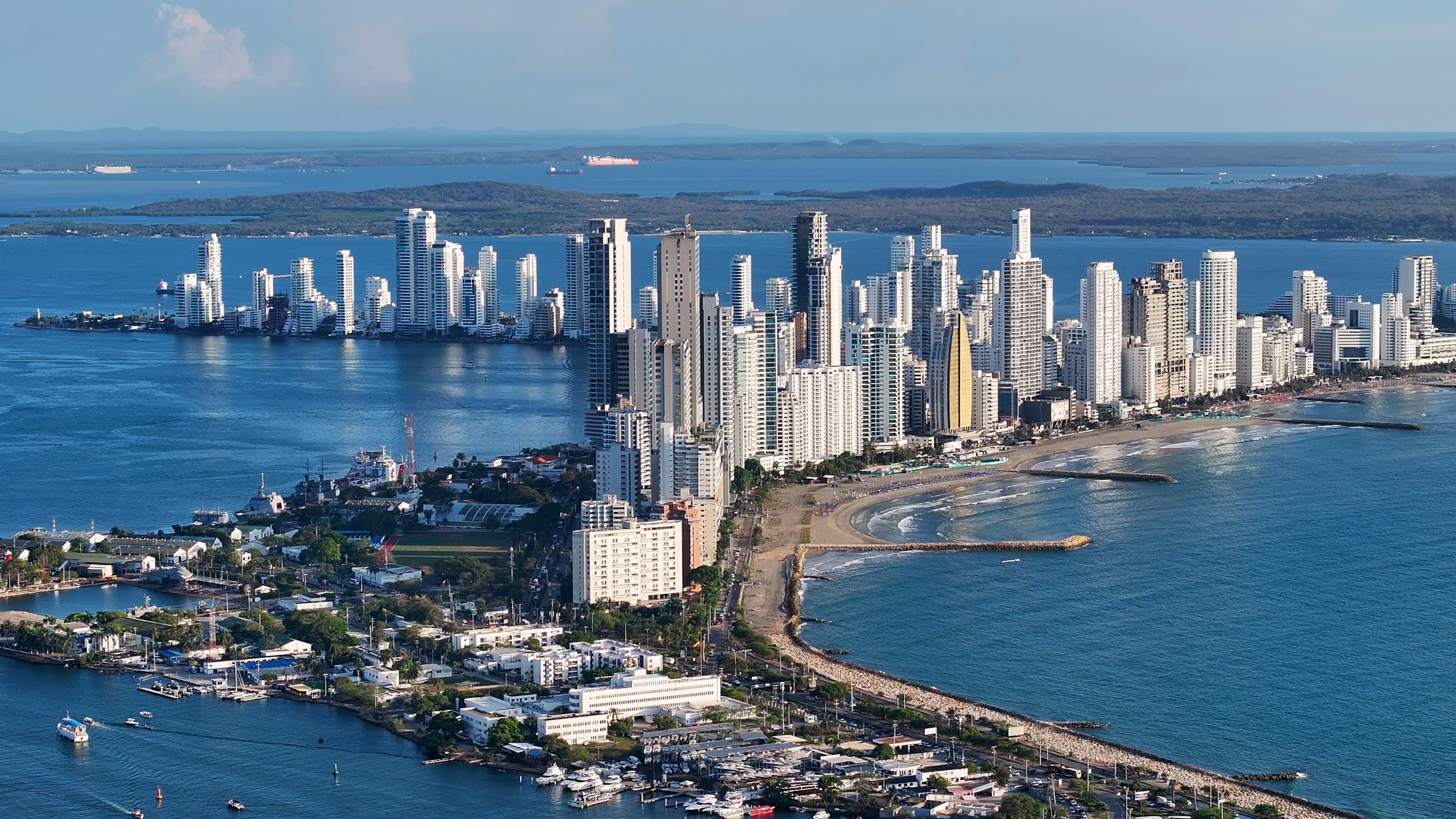
Cartagena, Colombia’s most visited city, is built on land that is itself sinking while the sea rises around it. Scientists say the combination makes it one of the Caribbean’s most vulnerable places.
A City Built to Repel Invaders
Walk the top of Cartagena’s old city wall at sunset and it is easy to see why visitors call it the “Jewel of the Caribbean.” The walled city, a maze of colonial plazas, balconies and cathedrals, was recognized by UNESCO as a World Heritage Site in 1984.
The wall itself, around 400 years old, is considered one of the best-preserved in the Americas. It was built, along with the vast Castillo de San Felipe de Barajas, to protect the city from pirates and the enemies of the Spanish crown.
Just outside the walls is Getsemaní, a bohemian neighborhood known for its street art and nightlife, while boats leave for the Rosario Islands and nearby beaches.
The Irish Times recently called the Old Town one of the most visited destinations in Latin America. In 2019, the city welcomed more than 2.5 million tourists, about 40 percent of them international.
Roughly a million people live in the city, which also holds some of Colombia’s busiest ports and its largest coastal industrial sector. Tourism, the port and daily life all sit at the edge of the sea.
Two Problems, One coastline
The first problem is well known: global sea levels are rising. The second is less well known. Many of the world’s coastal cities are also sinking, a process called subsidence, caused by factors such as sediment compaction and movement of the earth’s crust.
When you add the two together, you get what scientists call relative sea-level rise, the rate at which the water climbs against the land.
A 2021 study in the journal Scientific Reports looked at Cartagena using tide gauges, GPS and satellite radar. It found that the long-term rate of relative sea-level rise was about 6 millimeters a year, and that over the past two decades the rate had climbed to about 7 millimeters a year, higher than the global average for climate-driven sea-level rise.
Cartagena had the highest trend of 19 tide gauge stations in the Caribbean, almost three times that of the nearest station in Panama. The study estimated that natural vertical movements of the land account for about 41 percent of the change.
If the land keeps sinking at the measured rates, the researchers estimated, it would add 83 millimeters of relative sea-level rise by 2050 and 225 millimeters by 2100.
Standard projections, which don’t consider subsidence, suggest about 9.4 inches of rise by 2050 and 20.5 inches by 2100 under a moderate emissions scenario. Factoring in subsidence, the authors said, the figures could reach 14 inches and 33.5 inches.
Is Cartagena Really Worse Off Than Miami?
Cartagena is often compared with Miami, and for good reason, since both are low-lying tourist cities on warm coastlines. Bocagrande, Cartagena’s strip of high-rises, is even compared with Miami Beach.
On one measure, there is a clear difference. A separate analysis by researchers at IHE Delft, a water-education institute, estimated Cartagena’s average subsidence at 6.9 millimeters a year, accounting for 70 percent of its relative sea-level rise.
For Miami Beach, it estimated the subsidence rate at about 2 millimeters a year, or about 40 percent of the total. Its authors argued that in Cartagena, measures to slow the effects of subsidence should be prioritized before flood protection.
The comparison has limits, though. The two studies measured subsidence differently (41 versus 70 percent for Cartagena), and “risk” is more than a rate.
Miami has far more property at stake and lies in the path of Atlantic hurricanes, which add storm surge and wind on top of rising seas.
Cartagena is largely spared from direct hits: Hurricane Iota in 2020, the first Category 5 storm to strike Colombia, hit the island of Providencia, not the mainland.
But the city is not spared from storms entirely. When hurricanes pass far away or cold fronts cross the Caribbean, they send powerful swells onto the coast, known locally as mar de leva.
A Colombian study found that marine floods of this kind hit the Bocagrande and Castillogrande peninsulas almost every year.
During Iota, storm surge flooded Bocagrande, Castillogrande and El Laguito, and in October 2025 Hurricane Melissa did not hit Cartagena directly, but its effects reached the city through the same kind of swell.
What scientists say is that Cartagena’s land is sinking faster than the global rise of the sea, and that each of these events now starts from a higher baseline.
What Is Already Happening
So far, flooding has occurred mainly because of storm surges, according to one of the study’s authors, but as the sea rises and the land sinks, he expects more frequent floods.
In February 2024, a sudden flood hit Tierra Bomba, an island in Cartagena’s bay, and destroyed an old cemetery. In the past decade, rising seas have already forced hundreds of people in nearby villages and islands to relocate.
The study authors also point to a tension at the heart of the city’s economy: a UNESCO-commissioned study had already warned that the intensive use of tourism threatens the city’s preservation, and subsidence adds another threat to its heritage and infrastructure.
The Response
Cartagena is not standing still. The city became the first coastal city in South America to produce guidelines for adapting to climate change, which assessed its vulnerability and recommended measures.
On the ground, a coastal protection project is building ten groynes to reduce the impact of waves, while a breakwater and a drainage system have been built in Bocagrande, one of the most vulnerable areas.
The scientists’ advice is to measure subsidence consistently across the city and to include it in planning. As one of the authors said, humans can’t stop subsidence, but they can slow the rise of the sea by cutting carbon emissions.
A Slow-Motion Test
Despite the alarming headlines that have circulated, no credible study says Cartagena will vanish. What the data show is a city whose historic center, port and neighborhoods will face rising flood risks over the coming decades.
A few millimeters a year may not sound like much, but over a lifetime it adds up to something a city has to plan for. Cartagena survived centuries of pirates and sieges. Its next test is slower, quieter, and harder to defend against with walls.
Sources:
- Restrepo-Ángel et al., “Coastal subsidence increases vulnerability to sea level rise over twenty first century in Cartagena, Caribbean Colombia,” Scientific Reports (2021): https://www.nature.com/articles/s41598-021-98428-4
- Florida International University, “Satellite data points to land subsidence in Cartagena” (Nov 2021): news.fiu.edu/2021/satellite-data-points-to-land-subsidence-in-cartagena
- Phys.org, “Satellite data points to land subsidence in Cartagena”: phys.org/news/2021-11-satellite-subsidence-cartagena.html
- The Invading Sea, “From Florida to Colombia, coastal cities face dual challenge of rising sea levels and sinking land”: theinvadingsea.com/?p=10077
- The Invading Sea, on subsidence and flooding in Miami Beach and Cartagena (Aug 2023): theinvadingsea.com/2023/08/08/cartagena-colombia-miami-beach-sea-level-rise-climate-change-ihe-delft/
- ColombiaOne, “Colombia’s Cartagena de Indias Slowly Sinking as Sea Level Rises” (June 2025): colombiaone.com/?p=21194
- CDKN, “Embedding climate change resilience in coastal city planning: Early lessons from Cartagena de Indias”: cdkn.org/resource/embedding-climate-change-resilience-in-coastal-city-planning-early-lessons-from-cartagena-de-indias-colombia
- The Irish Times, “Cartagena travel guide: Colour and history meld in eclectic Pearl of the Caribbean” (May 2025): irishtimes.com/life-style/travel/2025/05/04/colour-and-history-meld-in-eclectic-cartagena-pearl-of-the-caribbean
- Live the World, “Seductive Cartagena: the Colombian historical beauty”: livetheworld.com/post/seductive-cartagena-the-colombian-historical-beauty-fgyd
- Hellotickets, “Best Things To Do in Cartagena”: hellotickets.com/colombia/cartagena/things-to-do-cartagena/sc-269-5020
- Pelecanus, “Cartagena Travel Guide (2026)” (2019 tourism data): pelecanus.com.co/en/cartagena-travel-guide/
- Wikipedia, “Cartagena, Colombia”: en.wikipedia.org/wiki/Cartagena,_Colombia
- Academia, “Assessment of extreme wind and waves in the Colombian Caribbean Sea for offshore applications”: https://www.academia.edu/91014541/Assessment_of_extreme_wind_and_waves_in_the_Colombian_Caribbean_Sea_for_offshore_applications
- Orejarena-Rondón et al., “Coastal Impacts Driven by Sea-Level Rise in Cartagena de Indias,” Frontiers in Marine Science (2019): frontiersin.org/article/10.3389/fmars.2019.00614/full
- El Universal, “DIMAR alerta sobre condiciones marítimas por avance del huracán Melissa” (Oct 29, 2025): eluniversal.com.co/cartagena/2025/10/29/dimar-alerta-sobre-condiciones-maritimas-por-avance-del-huracan-melissa/
- El Universal, “Así quedaron las calles del norte de Cartagena tras el paso del huracán Eta” (Nov 2020): eluniversal.com.co/cartagena/2020/11/04/en-fotos-asi-quedaron-las-calles-del-norte-de-cartagena-tras-el-paso-del-huracan-eta/
- Al Jazeera, “‘Everything’s been destroyed’: Iota hits Providencia island”: https://www.aljazeera.com/news/2020/11/17/everythings-been-destroyed-iota-hits-providencia-island


