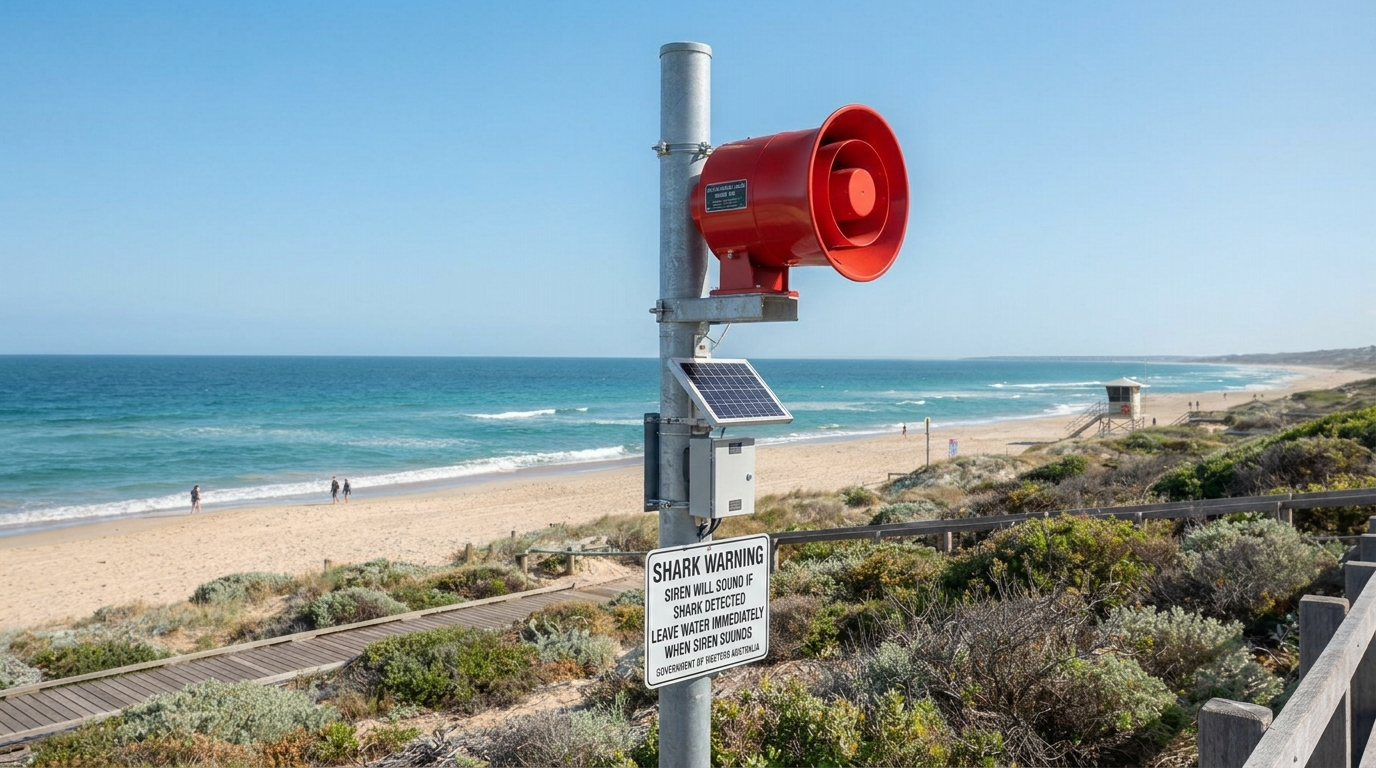
Australia is famous for its spectacular beaches, turquoise waters and world-class surfing. But in some coastal communities, a day at the beach can be interrupted by a sound that most international visitors would never expect: a powerful warning siren telling everyone to get out of the water because a shark has been spotted nearby.
Few places in the world capture the imagination of beach lovers quite like Australia. From the golden sands of Bondi Beach in Sydney to the extraordinary white silica sand of Whitehaven Beach in Queensland, the country’s coastline offers some of the most spectacular seaside landscapes on Earth.
Surfers head to Bells Beach in Victoria, families enjoy the calm waters around Noosa, and visitors travel to Western Australia to experience the breathtaking beauty of Turquoise Bay and Cable Beach.
For millions of people, an Australian beach holiday means sunshine, swimming, surfing and spending long hours in the ocean. But there is something that can make the experience rather different from a typical European beach holiday.
Imagine lying on the sand on a beautiful summer afternoon, watching surfers ride the waves, when suddenly a loud siren begins to sound. A warning message follows, telling everyone to leave the water immediately because a shark has been detected nearby.
For a European tourist unfamiliar with Australia’s coastal safety systems, the experience could be genuinely surprising, perhaps even frightening. Yet in certain parts of Australia, this is a familiar part of beach safety.
Specially installed warning towers, flashing lights, loudspeakers and other alert systems are designed to notify swimmers and surfers when potentially dangerous shark activity has been detected. Their purpose is simple: give people on the beach as much time as possible to leave the water before a potentially dangerous encounter occurs.
But how widespread are these systems? Does every Australian beach have a shark alarm? And is Australia the only country where beachgoers may hear such a warning?
What Exactly Happens When a Shark Alarm Sounds?
Australia’s shark warning systems are not all identical. Different states and local authorities use different technologies, depending on the coastline, the local shark population and the resources available.
One of the most recognizable examples can be found in Western Australia, where dedicated Shark Warning System towers have been installed at selected beaches and popular surfing locations.
When activated, a tower emits a warning siren, followed by a recorded voice message informing beachgoers about nearby shark activity. Red or orange warning lights flash simultaneously, providing a visual signal for people who may not hear the announcement.
The instructions are straightforward: anyone in the water should leave immediately and remain out until authorities determine that it is safe to return.
These systems can be activated following a reported shark sighting or through automated detection when a tagged shark enters the monitored area.
The combination of sound, flashing lights and spoken instructions is particularly important because beaches can be noisy environments. Waves, wind, music and crowds can make it difficult for swimmers to hear an ordinary announcement. A dedicated warning tower provides a much more noticeable signal.
How Many Australian Beaches Actually Have Shark Alarms?
This is where the picture becomes particularly interesting. Although shark monitoring and warning programs operate across several Australian states, fixed shark-warning sirens are not installed at every beach.
Western Australia has developed one of the country’s most recognizable networks of dedicated shark-warning towers.
According to information presented to the Western Australian Parliament in August 2024, the state had 17 shark-warning towers positioned at strategic locations along its coastline and in areas around Perth and Esperance.
The official SharkSmart Western Australia website identifies several locations where these systems operate.
They include:
- Bunker Bay, near Busselton.
- West Beach, Twilight Beach and Kelp Beds Beach in the Esperance region.
- North Point, South Point, Lefthanders and Surfers Point in the Margaret River area.
- North Cottesloe and Cove Surf Break near Perth.
- Port Beach in Fremantle.
- Ocean Reef, Mullaloo North, Mullaloo South and Sorrento Beach in the City of Joondalup.
These locations are particularly relevant to surfers, swimmers and other people who regularly use the ocean.
In addition to the dedicated shark-warning towers, Western Australia has introduced another type of beach safety installation known as the Surf Alert Module, or SAM.
These devices combine electronic information displays, warning lights, sirens and audio announcements. They can also provide beachgoers with direct access to emergency assistance through an intercom.
Surf Life Saving Western Australia reported seven operational SAM units in its 2025-26 annual report. The units recorded 26 shark-alert activations during that season.
It is important to distinguish between these seven modules and the 17 dedicated shark-warning towers.
They are separate categories of equipment, and their numbers should not simply be added together to suggest a total number of different beaches.
The figures nevertheless demonstrate that Australia has invested in a fairly sophisticated network of coastal warning technology, even though its coverage remains concentrated in particular regions rather than extending to every beach.
Australia Uses Much More Than Sirens to Detect Sharks
A warning tower is only one part of a much broader coastal safety strategy. In New South Wales, for example, authorities operate an extensive network of shark-monitoring equipment designed to detect tagged sharks and notify the public.
The state’s SharkSmart program currently lists 37 tagged shark listening stations along the NSW coastline.
These stations detect tagged target sharks, including great white sharks, tiger sharks and bull sharks, when they swim within approximately 500 metres of a receiver.
When a detection occurs, an alert is distributed through the SharkSmart mobile application and social media channels.
This does not necessarily mean that a siren will sound at the nearest beach. Rather, the information allows beach authorities and the public to respond to the potential presence of a shark.
Australia also makes increasing use of aerial surveillance. Queensland’s SharkSmart drone program monitors selected beaches from above, allowing trained operators to identify sharks in coastal waters. If a potentially dangerous shark is spotted, lifeguards can evacuate swimmers and temporarily close the beach when necessary.
In New South Wales, helicopters have also been used to monitor coastal waters. When a potentially dangerous shark is identified close to beach users, a siren can be sounded from the aircraft, accompanied by a public-address announcement.
Other technologies include acoustic tracking receivers, satellite-linked monitoring equipment, SMART drumlines and public shark-sighting databases.
Together, these measures illustrate how Australian beach safety increasingly combines traditional lifesaving practices with real-time technology.
Why Might the Experience Shock a European Tourist?
For someone visiting Australia from Europe, the sound of a shark alarm may be an entirely unfamiliar experience.
European beach culture generally places considerable emphasis on warning flags, lifeguard supervision, information boards and announcements about changing weather or dangerous sea conditions.
Shark-related warnings certainly exist in European coastal waters, but dedicated public siren networks specifically designed to announce nearby sharks are not a standard feature of most European beaches.
Consequently, a visitor unfamiliar with Australian coastal safety procedures might initially struggle to understand what is happening.
The contrast can be particularly striking in places where the beach atmosphere is otherwise completely relaxed. One moment, people are swimming, children are playing in the shallows and surfers are waiting for the next wave.
Moments later, lifeguards are directing everyone out of the water while flashing warning lights and loudspeaker announcements make the situation unmistakable. For Australian residents, however, these alerts are part of a wider culture of ocean awareness.
The message is not necessarily that a shark is about to attack someone. It is that a potentially dangerous animal has been identified in the area and that the safest response is to avoid entering the water until the risk has been assessed. That distinction is important.
Sharks are a natural part of Australia’s marine ecosystems, and most encounters do not result in aggression towards humans.
Warning systems are designed to reduce the possibility of dangerous interactions, not to suggest that every shark sighting represents an imminent attack.
Are Shark Warning Sirens Unique to Australia?
Not entirely. Australia is particularly well known for its combination of shark monitoring, beachside warning towers and public alert systems, but other countries have also developed ways of warning swimmers when sharks are spotted.
The United States provides an interesting example. At Torrance Beach in Los Angeles County, California, authorities have developed the Beach Emergency Evacuation Lights System, known as BEELS.
The system is designed to alert beachgoers during different types of emergencies. It uses flashing LED lights, sirens and spoken evacuation announcements in English and Spanish.
Importantly, one of the programmed emergency messages specifically concerns a shark sighting, instructing people to leave the water immediately.
Unlike Australia’s dedicated shark-warning towers, however, the Californian system is a multi-hazard evacuation installation rather than a nationwide network of shark-specific alarms.
Hawaii also has established procedures for warning beachgoers about shark sightings. Lifeguards and coastal authorities communicate warnings to people in the affected area, supported by beach signage and safety information. The exact response depends on the circumstances and the location.
South Africa: A Warning Siren on Some of the World’s Most Famous Beaches
Another particularly interesting example can be found in Cape Town, South Africa. The city’s Shark Spotters program uses trained observers positioned at strategic locations along the coastline to monitor shark activity.
When a shark is spotted close to water users, the observers communicate with beach authorities and activate a warning system involving sirens and coloured flags.
The system uses four main flag signals to communicate different levels of information about shark activity and visibility.
When a shark is identified in the vicinity of swimmers and surfers, a warning is issued and people are temporarily evacuated from the water.
The program is especially associated with beaches such as Fish Hoek, where shark monitoring has become an important element of local coastal safety.
It is an interesting comparison with Australia because it demonstrates that effective shark warnings do not necessarily depend on sophisticated electronic towers. Human observers, clear communication procedures and a recognizable warning signal can also play an important role.
What About Europe? Are There Shark Alarms on European Beaches?
Europe is a different case. Sharks are present in European waters, including the Mediterranean, the Atlantic and the waters surrounding the British Isles.
However, the presence of sharks does not mean that European beaches generally require the same kind of permanent warning infrastructure found in selected Australian coastal communities.
Shark-related incidents and sightings are normally handled through local lifeguard services, maritime authorities, beach closures, warning flags and public announcements where necessary.
There is no established Europe-wide network of dedicated shark-warning sirens comparable to the systems operating in parts of Western Australia.
This does not mean that a siren could never be used on a European beach. Local authorities can employ emergency warning equipment when circumstances require it.
However, dedicated permanent shark-alarm installations are not a widely established feature of European beach management. For an international visitor, this makes the Australian approach particularly distinctive.
Do Shark Alarms Mean Australian Beaches Are Dangerous?
Not necessarily. The presence of shark-warning systems should be understood in the context of Australia’s extensive coastline, its rich marine biodiversity and the enormous popularity of ocean-based recreation.
Millions of Australians and international visitors swim, surf, dive and enjoy the country’s beaches every year.
Surf Life Saving Australia has previously estimated that the country has around 12,000 beaches, many of them located in areas where sharks naturally occur.
The likelihood of a shark encounter that results in an attack remains very low, although the risk varies according to location, species and environmental conditions.
It is also important to remember that sharks are not the only, or necessarily the greatest, danger facing beachgoers. Rip currents, dangerous surf conditions, sudden changes in weather and drowning represent major coastal safety concerns. Shark alarms are therefore one component of a much wider public safety system.
Their presence should not discourage visitors from enjoying Australia’s extraordinary coastline. Instead, it highlights the importance of understanding local beach safety procedures and following the instructions of lifeguards.
A Different Kind of Beach Culture
Australia’s shark warning sirens reveal something interesting about the relationship between people and the natural environment.
For many international visitors, the Australian coastline initially represents an idyllic escape: beautiful beaches, warm sunshine, spectacular waves and an extraordinary variety of marine life.
But the ocean is also a powerful natural environment that requires awareness and respect.
In some coastal communities, a siren and a flashing warning light have become part of the everyday language of beach safety.
For a visitor hearing one for the first time, it may be an unforgettable moment. For local swimmers and surfers, it is a reminder to leave the water, pay attention and wait until authorities give the all-clear.
And perhaps that is the most interesting aspect of Australia’s shark alarms: they are not simply a response to the presence of sharks, but an example of how modern technology and public awareness can help people share the ocean more safely with the wildlife that naturally inhabits it.
Sources:
- Surf Life Saving Western Australia – Shark Warning System
- Western Australian Parliament – Parliamentary Hansard, August 2024
- Surf Life Saving Western Australia – 2025-26 Annual Report
- NSW Government – SharkSmart – Current Shark Management Program
- Queensland Government – SharkSmart Drone Surveillance
- Parliament of Australia – Shark Mitigation and Public Safety Measures
- Los Angeles County Department of Beaches and Harbors – Beach Emergency Evacuation Lights System
- City of Cape Town – Shark Spotters Programme