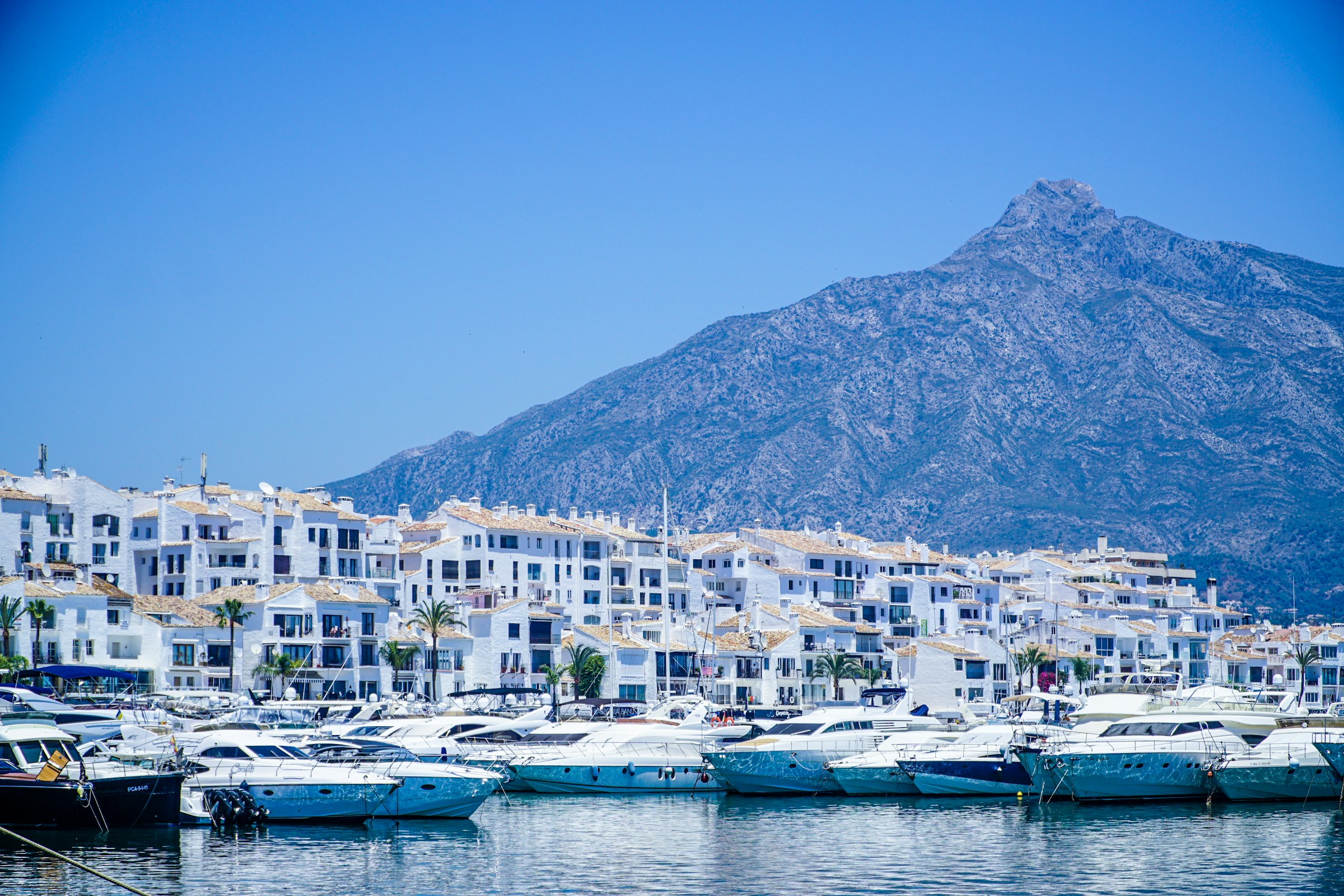
Marbella’s transformation into one of the world’s most exclusive addresses didn’t happen overnight, and it didn’t happen by accident.
It’s the result of a very specific, seven-decade chain of events – a chance car breakdown, an aristocrat’s whim, a yacht marina built on pure ambition, and a flood of petrodollars – layered on top of something the town could never have manufactured on its own: one of the most forgiving climates anywhere in Europe.
The Village Before the Fame
Before any of that began, Marbella was exactly what its name suggests to no one anymore: a small, unremarkable Andalusian fishing and farming town on Spain’s southern coast, home to barely 900 people in the mid-1940s.
Residents made a living from fishing, olive cultivation, and local iron-ore mining. Nothing about it suggested a future as a playground for royalty, oil sheikhs, and Hollywood celebrities.
The Accidental Discovery That Started Everything
According to a long-standing local story, the chain of events that transformed Marbella began with a broken-down Rolls-Royce.
In the 1940s, Prince Maximilian von Hohenlohe was visiting his cousin Ricardo Soriano when his car reportedly broke down near Marbella.
Struck by the dramatic Sierra Blanca mountains, the Mediterranean coastline and the area’s unusually mild climate, he saw possibilities in what was then an obscure corner of southern Spain.
His son, Prince Alfonso von Hohenlohe-Langenburg, would soon take that interest much further. In 1946, Alfonso began exploring the area as a possible Mediterranean retreat.
A year later, he purchased the Finca Santa Margarita, a coastal estate that would become the foundation of Marbella’s transformation. In 1954, he opened the first 20 rooms of what became the Marbella Club Hotel.
The hotel was unlike anything Marbella had seen before. Rather than presenting itself simply as a conventional luxury resort, the Marbella Club was conceived as an intimate private retreat, attracting European aristocrats, diplomats, artists and an increasingly international circle of celebrities.
Audrey Hepburn, Cary Grant, Ava Gardner, Grace Kelly and the Duke of Windsor were among the famous names associated with its early years.
The effect was profound. Within a single decade, Marbella had begun to acquire a new identity: not just a quiet Andalusian town beside the Mediterranean, but a discreet, sun-soaked refuge for the wealthy and famous.
Puerto Banús and the Arrival of Serious Money
If the Marbella Club introduced international aristocracy to the Costa del Sol, Puerto Banús brought something even more powerful: serious money.
The marina opened in 1970, transforming the coastline west of Marbella into a playground for royalty, celebrities and the international jet set. Its developer, José Banús, had envisioned more than a port for yachts.
He wanted an entire luxury enclave, and the grand opening attracted more than 1,500 guests, including Prince Rainier and Princess Grace of Monaco, members of the Spanish royal family and a young Julio Iglesias.
The event announced that Marbella was no longer simply a secluded Mediterranean retreat. It was becoming an international destination.
Luxury yachts filled the harbour, while designer boutiques, restaurants and nightclubs created a new kind of Riviera atmosphere.
Puerto Banús quickly became part of the same glamorous circuit as Saint-Tropez and Monte Carlo, attracting a clientele for whom Marbella was not simply somewhere to spend a holiday, but somewhere to display a new level of wealth.
Then Came the Gulf
In the 1970s, Saudi Crown Prince Fahd became a regular visitor to Marbella. His presence reflected the town’s growing appeal among wealthy Gulf families, whose lavish stays helped broaden Marbella’s clientele far beyond European aristocracy and Hollywood celebrities.
Fahd eventually took his relationship with Marbella to an extraordinary scale. In 1982, he built a vast private summer residence on the Golden Mile, later known as Mar-Mar Palace.
The sprawling estate was described as a replica of the White House and included several villas, swimming pools, a helipad, a private clinic and a mosque.
It was designed less like a conventional holiday home than a self-contained royal compound capable of accommodating a huge entourage.
The palace became one of the most striking symbols of Marbella’s transformation. What had once been a small Andalusian town attracting European aristocrats was becoming a destination capable of accommodating the immense wealth and private worlds of the global elite.
Puerto Banús had helped change the scale of Marbella’s ambition. The town was no longer simply selling sunshine, beaches and Mediterranean charm.
It was selling access to a lifestyle – one built around yachts, villas, privacy, exclusivity and the ability to move through the world without leaving the comforts of home behind.
The Building Boom and the Golden Mile
The stretch of coastline connecting central Marbella with Puerto Banús – soon known simply as the Golden Mile – became the epicenter of a major development boom during the 1980s and 1990s.
Private villas, gated communities and prestigious golf resorts multiplied along the corridor, transforming what had once been a relatively undeveloped coastal landscape into one of Spain’s most recognizable luxury addresses.
Growth accelerated further under the controversial local leadership of the 1990s, when Marbella underwent rapid infrastructure development and an extraordinary expansion of its property market, even as the period later became closely associated with allegations of corruption, controversial urban planning and political scandal.
Whatever its complications, the boom fundamentally reshaped Marbella. It established the Golden Mile as a global luxury enclave and helped cement the city’s reputation among international property buyers – a reputation that has continued to attract wealthy residents and investors from around the world.
The Climate That Makes All of It Possible
None of Marbella’s engineered glamour would have taken root without the one asset nobody built: its weather.
Tucked beneath the Sierra Blanca mountain range, which blocks cold northerly winds, and warmed by the Mediterranean Sea, Marbella enjoys what local residents and real estate agents alike simply call the microclimate – roughly 320 days of sunshine a year, according to regional weather data, with winter daytime temperatures typically holding between 16°C and 19°C (61-66°F) even in January, the coldest month, and summer highs settling in the high 20s to low 30s Celsius (mid-80s to high-80s Fahrenheit) without the extreme heat spikes that hit much of inland Spain.
The comparison to Southern California, which Marbella’s marketing has leaned on for decades, holds up better than most tourism taglines: Los Angeles typically logs under 300 sunny days a year on average, meaning Marbella’s mountain-sheltered stretch of coastline arguably delivers more consistent sun than its American equivalent, without California’s wildfire season or the wide day-to-night temperature swings common across the U.S. Sun Belt.
It’s the kind of quiet, structural advantage that no amount of marina-building or celebrity patronage could substitute for – the reason the Marbella Club was built here in the first place, and the reason everything that followed had somewhere durable to grow.
Marbella Today: The Art of Living, Refined
Seven decades on, Marbella’s population is dramatically more international than its fishing-village past – a permanent, multinational community of British, Scandinavian, German, Middle Eastern, and increasingly American residents living alongside its Andalusian core.
The lifestyle built around that population is less about any single landmark than a whole ecosystem of daily rituals: private villas with infinity pools overlooking the Mediterranean, beach clubs that function as all-day social hubs rather than simple restaurants, championship golf courses threaded through the hills above town, and a restaurant scene anchored by a growing number of Michelin-recognized kitchens.
Puerto Banús remains the theatrical center of it all – superyachts, luxury boutiques, and a steady procession of sports cars along the marina – while the Golden Mile and the surrounding hills of Nueva Andalucía and La Zagaleta offer the quieter, gated version of the same lifestyle.
What’s changed most since Prince Alfonso’s era isn’t the fundamental appeal, but its scale: Marbella has gone from a discreet hideaway for European aristocrats to a full-fledged global address, built layer by layer on top of a climate, and a coastline, that made the whole project possible in the first place.
Sources & Further Reading:
• Historical archives of Diario SUR and El País (1954-1985 coverage of Marbella’s urban evolution and royal visits);
• The Daily Telegraph & The Times (Historical obituaries and profile of Prince Alfonso von Hohenlohe-Langenburg);
• The New York Times Archives (Reporting on King Fahd’s Mar-Mar Palace and Gulf investments in Southern Spain);
• Agencia Estatal de Meteorología (AEMET) – Official Andalusian coastal microclimate and sunshine data;
• “The Marbella Club: 50 Years of Style” (Official retrospective and archival photography collection);
• Archives of the Town Hall of Marbella (Ayuntamiento de Marbella) & Puerto Banús History Repository.


