Bansko has become one of Europe’s most talked-about destinations, attracting a new generation of travelers seeking escape from the chaos of big cities. And just outside its door, a small train is still running – and it runs on a different kind of time entirely.
Pirin Mountains, Bulgaria · April 2026
There is a version of Bansko that belongs entirely to the present tense. Modern co-working spaces with reliable fibre broadband, specialty coffee roasted three time zones away, a Nomad Fest that draws remote workers from Austin to Seoul.
Then there is another Bansko – the one you reach not by motorway or budget airline, but by boarding a small, rattling train that has barely changed since the mid-twentieth century and letting it take you somewhere time appears to have largely left alone.
Both versions are real. Understanding that is the beginning of understanding why Bansko has become the thing it currently is: not just a ski resort, not just a nomad hub, but a place where the twenty-first century and something much older occupy the same valley and, remarkably, do not seem to bother each other.
The New Bansko: A Global Village at 925 Metres
A decade ago, Bansko was known primarily in two ways: to skiers, who appreciated its long season and affordable lift passes, and to Bulgarians, who had always known it as a town of cobblestone streets, carved wooden ceilings and a food culture rooted in the kind of dishes that take all day to make. The transformation since then has been striking.
Bansko is now consistently ranked among Europe’s top destinations for digital nomads – people who work remotely and choose where to live based on quality of life, cost, internet connectivity and community.
The annual Bansko Nomad Fest, which draws hundreds of location-independent workers from across the world, has helped embed the town in a global conversation about where and how people want to live.
Property buyers from the United States, Australia, Germany and, increasingly, Japan and South Korea have discovered that €60,000 can buy a mountain apartment that in Western Europe would cost four times that amount. Co-working spaces have opened alongside the old mehanas. Specialty coffee and rakiya coexist without apparent tension.
What makes Bansko unusual among nomad hubs – which tend to be urban coastal environments – is the landscape it sits within. Pirin National Park, a UNESCO World Heritage site, begins effectively at the edge of town. Summer hiking trails give way in winter to some of the most reliable snow in southeastern Europe.
There are thermal pools in Dobrinishte, ten minutes away. Jazz and opera festivals animate the old square in summer. The mountain is not a backdrop; it is the reason.
“The whole experience was like going back 50 years – though the ride was very comfortable and extremely enjoyable through mountains and several tunnels.”
TripAdvisor review, Rhodope Narrow-Gauge Railway
The Other Journey: A Train Born in 1921
When the skiing is done, or the laptop closed, or the afternoon simply asks for something other than productivity, Bansko’s most quietly remarkable offering is a short walk from the centre: a small, cream-coloured station that is the penultimate stop on one of the most extraordinary train journeys in Europe.
The Septemvri-Dobrinishte narrow-gauge railway did not arrive quickly. Construction began in 1921, driven largely by the vision of a single parliamentarian – Stoyan Maltchankoff, a teacher and former voivode from the Nevrokop region – who believed the mountain communities of southwestern Bulgaria deserved a rail connection to the rest of the country.
The work was gruelling, interrupted by wars and economic crisis, undertaken by hand through some of the most challenging terrain in the Balkans. The first sections opened gradually through the 1920s and 1930s.
Tsar Boris III himself rode a ceremonial train on the occasion of one opening in 1939. The final six kilometres, from Bansko to Dobrinishte, were completed on 9 December 1945 – the last stretch built in large part by the residents of Dobrinishte themselves, who volunteered their labour out of a desire to be connected to the world beyond their valley.
The result was a 125-kilometre line threading through three mountain ranges (the Rhodopes, Rila and Pirin) crossing six rivers, passing through more than 35 tunnels and negotiating gradients that required an engineering solution found on very few railways anywhere on earth: four complete spiral loops, where the track turns back on itself in a tight helix to gain altitude, almost like a corkscrew driven into the mountainside.
THE ROUTE – 125 KM · 5 HOURS · 760 MM GAUGE
Septemvri→Velingrad→Avramovo ▲ 1,267m→Yakoruda→Razlog→Bansko→Dobrinishte
760mm track gauge – barely half the width of a standard European railway
35+ tunnels along the route, several cut by hand through solid rock
1,267m – Avramovo station (the highest railway station on the Balkan peninsula)
~€3.30 Ticket price, one direction, full length of the line (BGN 6.50)
What the Stations Look Like: A Country That Did Not Renovate
This is where the journey becomes something more than picturesque. It becomes genuinely strange, in the best sense – the strangeness of encountering a thing that the modern world simply forgot to change.
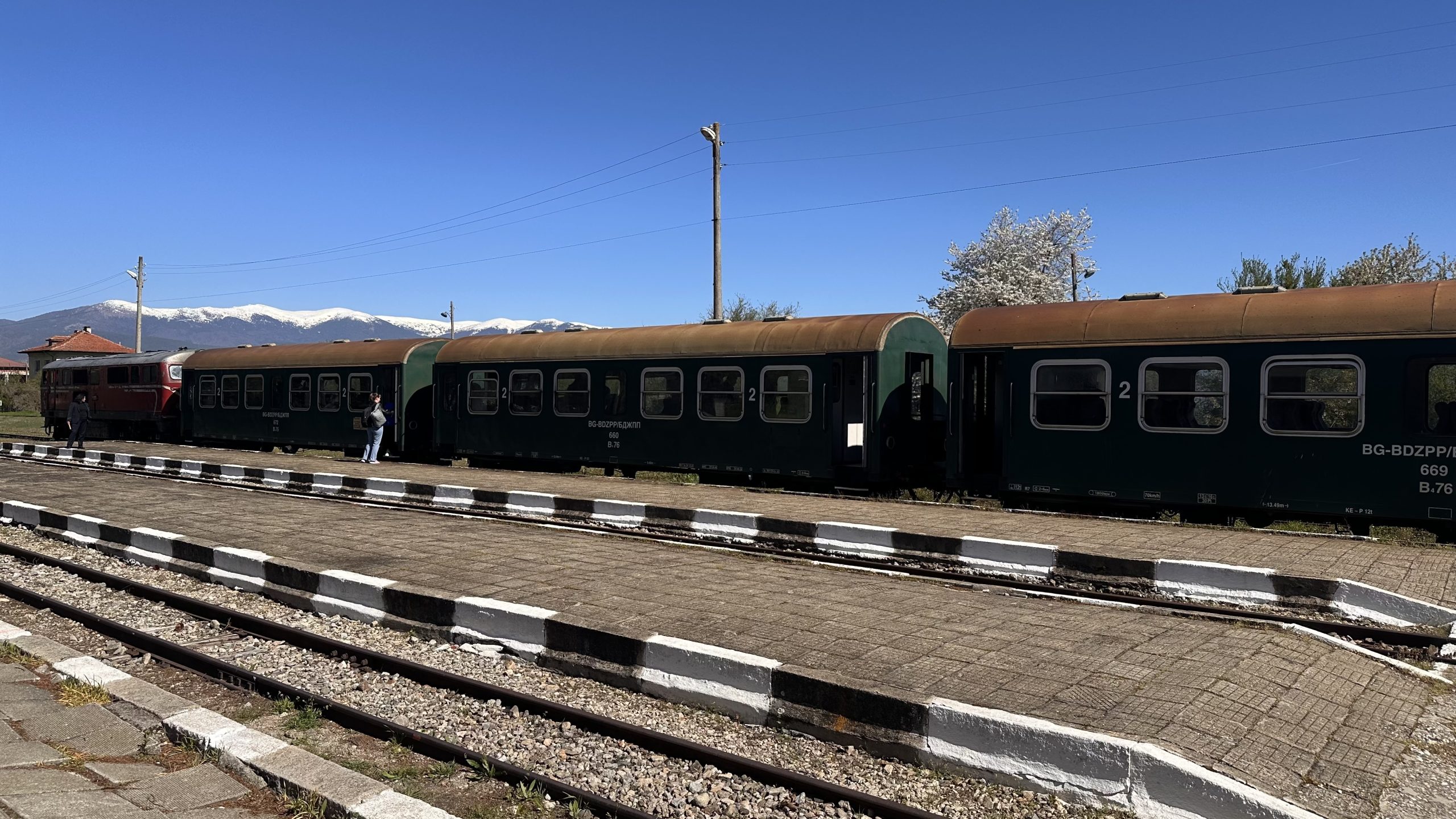
Every station along the line is painted in the same colour scheme: white walls, black-and-white kerbing along the platform edges, the letters of the station name set in a utilitarian sans-serif against a plain board.
The scheme dates from the socialist period – the decades when Bulgaria maintained its railways with institutional seriousness, when every station master wore a formal uniform and the kerbing was repainted every spring without fail.
Across the rest of the Bulgarian rail network, that aesthetic has been overlaid by decades of renovation, neglect and graffiti in roughly equal measure. On this line, almost nothing has changed.
The platforms look exactly as they did in photographs from the 1960s and 1970s. The station buildings are the same yellow-cream render. The destination boards still carry names of trains – Rila, Rodopi – in a lettering style that belongs entirely to another era.
At larger stations, uniformed staff still emerge onto the platform to usher passengers aboard, a ritual that has largely disappeared from European rail travel but persists here with a quiet formality that feels less like performance than simple continuity.
The Guardian, when it listed the line among Europe’s ten best scenic rail journeys in 2020, described exactly this quality: station masters in suits, the spartan interior of the carriages, the open-air passages between coaches where passengers stand and let the mountain air arrive unfiltered.
FROM THE GUARDIAN – TOP 10 EUROPEAN RAIL JOURNEYS, 2020
“Time moves slow on the Septemvri-Dobrinishte railway in south-west Bulgaria. Two weeks into a fairly austere trip in the Balkans, we found ourselves whisked away by the slow, narrow-gauge train… winding its way through narrow gorges and idyllic river valleys for five hours. The line features suited station-masters ushering families into the spartan carriage: it was a rare treat to stand in the open-air passages between them.”
The Journey Itself: 25 km/h as a Philosophy
The train travels at an average of 25 kilometres per hour. At its fastest – on the flattest sections near the start – it manages perhaps 35. This is not a deficiency. It is the point.
From Septemvri, the line follows the gorge of the Chepinska river northward into the Rhodopes, climbing along a narrow stone embankment that at points feels almost precarious – the river below, the rock face above, the track threading between them with what seems like insufficient clearance.
The first tunnels arrive early and repeatedly, bored through limestone in conditions that engineers of the early twentieth century tackled without modern drilling equipment.
Between them, the gorge opens briefly and the views are theatrical: sheer rock, pine forest beginning above the treeline, the occasional stone bridge over a ravine that carries no road and connects no village visible from the train.
If you start your trip from Septemvri, then Velingrad (Bulgaria’s spa capital, a town of mineral springs and therapeutic baths) is roughly the midpoint of the first half.
From here the line begins its most technically demanding section, gaining height through the four spirals that define the railway’s engineering identity.
Watching the train describe a complete 360-degree loop on a hillside, then emerge from a tunnel to begin the next one, produces a mild disorientation that experienced passengers learn to simply enjoy.
At the top of the spirals lies Avramovo, the highest station on the Balkan peninsula – a small, neat building with its black-and-white kerbing perfectly maintained, sitting at 1,267 metres in a valley where the air carries a different quality than anything you breathe in the towns below.
From Avramovo, the line follows the river Mesta down through Yakoruda and Razlog, the mountains shifting from Rhodope limestone to the granite faces of Rila, before the distinct profile of Pirin begins to define the horizon.
Bansko arrives at something like the four-hour mark – and the traveller who boards here for the last section to Dobrinishte will travel those final few kilometres knowing they are completing a journey that the residents of that town once volunteered their labour to make possible.
THE PEOPLE ON THE TRAIN
What makes the line more than a tourist attraction is its continued daily use by the people who live along it. For villages and small settlements in the western Rhodopes without road access, this train is not a nostalgic experience – it is how you get to the doctor, the market, the friends, the school.
It is common to share a compartment with an elderly man transporting a crate of live pigeons to sell at a mountain market, or a family from a village whose name appears on no tourist map, travelling to Bansko for a weekday errand.
The railway is, in the language of infrastructure policy, a lifeline service. In practice it is something older and harder to name: a place where the lives of remote mountain communities become briefly, quietly visible to people who would otherwise never encounter them.
THE STEAM ENGINE THAT STILL RUNS
On certain weekend services, Bulgarian State Railways deploys the line’s only working steam locomotive – number 609.76, built in 1949 at a factory in Chrzanów, Poland, and maintained in operating condition as a living piece of railway history.
Paired with two restored vintage carriages, it covers the Septemvri-Velingrad section on selected Saturdays and Sundays. If your timing aligns: board it without hesitation.
The Contrast That Makes Bansko Itself
Somewhere between the co-working space with the standing desks and the narrow platform at Bansko station where the black-and-white kerbing has been painted exactly the same way for sixty years, there is something worth dwelling on about what Bansko has actually become.
Most places that reinvent themselves for a new generation of travellers do so by erasing what came before. The coffee shop replaces the hardware store; the boutique hotel occupies the former post office; the old market becomes a food hall.
The mechanism of tourism gentrification is almost always the same: new money overwrites old meaning. Bansko has, so far, avoided the worst of this. The old town is still the old town.
The mehanas still serve the same bean soup they always have. And ten minutes from the most connected square in the Pirin mountains, a train built on a gauge of 760 millimetres – almost half the width of the standard European track – departs on a journey that takes five hours to cover 125 kilometres and carries, in every carriage, the unhurried feeling of a world that the twenty-first century has not yet managed to accelerate.
The Deutsche Bahn Guide of European Railway Timetables recognised it as one of the most interesting railway lines on the continent before The Guardian made it famous.
Both assessments are correct, and both miss the thing that repeated visitors describe most consistently: the sense, somewhere around the second spiral above Velingrad, that you have genuinely left the present behind – not as escapism, but as a small, slow act of perspective.
The train does not hurry. This is not because it cannot. It is because the landscape it moves through was never built for hurrying, and somewhere along the line’s hundred-year history, the railway understood that and adjusted accordingly.
Bansko will give you fibre broadband and excellent natural wine. But if you want the thing that no other destination in its weight class can offer, the actual, embodied sensation of time moving at a different speed, you need to walk to the small station at the edge of town, buy a ticket for €3.30, and wait for the train.
PRACTICAL INFORMATION – SEPTEMVRI-DOBRINISHTE NARROW-GAUGE RAILWAY
Ticket price: BGN 6.50 one way (approx. €3.30); BGN 11.70 return. Tickets are sold only at station windows – they are not available online. Pay in cash at the station.
Journey time: Approximately 5 hours for the full length (Septemvri to Dobrinishte or vice versa). Four services run daily in each direction. The Rodopi express is fastest at around 4.5 hours; all-stations services take closer to 5.
From Bansko: The station is a short walk from the old town centre. Direct services to Dobrinishte take under 15 minutes. For the full journey toward Septemvri and Velingrad, board at Bansko heading west.
Steam locomotive services: The 1949 Polish-built steam engine (no. 609.76) runs on selected Saturdays and Sundays, usually on the Septemvri-Velingrad section. Check the BDZ website closer to your travel date.
Avramovo station: Highest railway station on the Balkan peninsula, at 1,267 metres. Worth timing a window seat on the right side of the train (heading from Septemvri) for the approach through the spirals.
→Timetables: bdz.bg – Bulgarian State Railways official website. Note that Sofia’s main station is currently under reconstruction; connections from Sofia to Septemvri may involve changes or delays.
SOURCES:
- Bulgarian State Railways (BDZ) – Official history of the Septemvri–Dobrinishte line
- The Guardian – “10 of Europe’s best rural train journeys,” January 2020 – theguardian.com
- Wikipedia – Septemvri–Dobrinishte narrow-gauge line – technical and historical data
- TheMayor.EU – “Bulgarian narrow-gauge line listed among Europe’s 10 best rural train journeys”
- Bulguides Outdoor Activities – Route guide and traveller notes
- RailwayWorld.net – “Autumn colours in the Rhodope Mountains”, October 2024 – first-hand journey account
- Deutsche Bahn Guide of European Railway Timetables – recognition of the line as one of the most interesting in Europe