When Budapest Begins to Boil
There is something magical about Budapest in summer – but when temperatures climb above 35°C (95°F), even magic starts to shimmer in the heat.
The elegant boulevards radiate warmth long after noon, the stone façades of historic buildings store the sun’s energy like giant ovens, and the air above the Hungarian Parliament seems to dance in a haze. Walking through the city center on a hot July afternoon can feel like stepping across an endless sea of heated asphalt.
Yet locals know a secret.
When the city begins to overheat, they head toward the middle of the Danube, where a ribbon of green stretches for 2.5 kilometers between Buda and Pest. Margaret Island is far more than a beautiful park – it is Budapest’s natural refuge, a place where centuries-old trees, flowing water, and carefully designed gardens create a noticeably cooler world.
Why Is Margaret Island Cooler? The Science Behind the Shade
Margaret Island offers more than psychological relief from the summer heat. It demonstrates one of the most fascinating principles of urban climatology: the Urban Heat Island Effect.
Cities become significantly warmer than their surrounding countryside because concrete, brick, and asphalt absorb enormous amounts of solar radiation during the day. After sunset, these materials slowly release the stored heat, preventing the city from cooling efficiently. As a result, central Budapest can be several degrees warmer than nearby green spaces.
Margaret Island works in the opposite way.
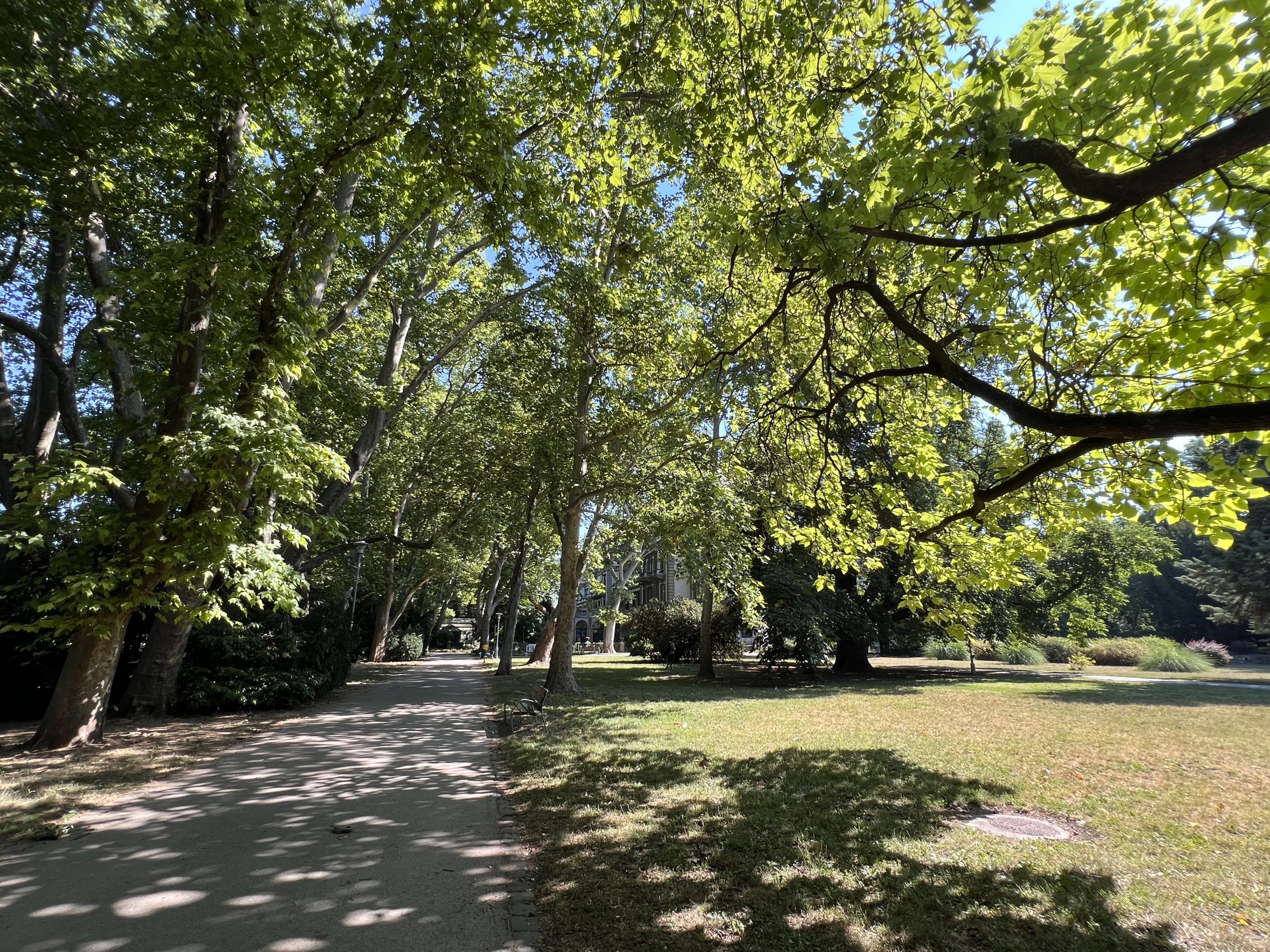
Its vast canopy of mature plane trees, oaks, chestnuts, and other species intercepts much of the incoming sunlight before it reaches the ground. Instead of scorching pavement, visitors walk beneath living umbrellas that create deep, cooling shade.
Even more important is the process of evapotranspiration. Trees continuously release water vapor through their leaves, naturally cooling the surrounding air. Combined with the evaporation from ponds, fountains, and the nearby Danube, the island develops its own refreshing microclimate.
On particularly hot afternoons, temperatures beneath the dense tree canopy can feel 3 to 5°C (5 to 9°F) cooler than in the open squares around Kossuth Lajos Square or other heavily built-up parts of central Budapest. While humidity is slightly higher near the water, the shade and gentle river breeze make the heat far more comfortable.
Margaret Island is, quite literally, Budapest’s natural air conditioner.
Leaving the City Behind
Crossing Margaret Bridge is like walking through an invisible doorway.
One moment, cars rush past in constant streams, trams rumble across the bridge, and the city pulses with its usual energy.
A few minutes later, the traffic noise fades into birdsong, cyclists glide silently beneath towering trees, and the air suddenly feels lighter.
Near the entrance, the famous Musical Fountain welcomes visitors with choreographed jets of water dancing to classical music and modern melodies. Fine droplets drift through the warm air while children laugh and chase the mist, finding instant relief from the afternoon sun.
Beyond the fountain, wide tree-lined avenues invite visitors to slow down. Some of the magnificent plane trees have stood here for well over 150-200 years, creating one of the city’s most impressive natural canopies.
The pace of life changes almost immediately.
Joggers share the paths with cyclists, families spread picnic blankets across the grass, readers disappear into hammocks strung between trees, and couples stroll without any particular destination. Margaret Island is one of those rare urban places where nobody seems to be in a hurry.
The Hidden Jewel: The Japanese Garden

The island becomes even quieter as you continue north.
Eventually, the pathways lead into one of Budapest’s most peaceful corners – the Japanese Garden (Japánkert). Here, the atmosphere changes completely.
Small wooden bridges cross gentle streams, bamboo sways softly in the breeze, miniature waterfalls provide a constant soundtrack of flowing water, and carefully arranged stones create an unmistakable sense of harmony. Even the soundscape contributes to the feeling of coolness; psychologists have long noted that flowing water can make people perceive temperatures as more comfortable.
At the heart of the garden lies a tranquil pond covered with floating green leaves and elegant blossoms.
This is where the real stars appear.
The flowers are water lilies, not lotuses – a distinction many visitors happily overlook. Unlike lotus flowers, water lilies rest directly on the water’s surface, their colorful blooms opening like floating stars among the broad circular leaves.
Looking carefully, the pond reveals even more life.
Large turtles bask lazily on warm rocks before slipping silently into the water at the slightest disturbance. Bright orange goldfish weave beneath the lily pads, using the floating leaves as natural umbrellas against the summer sun.
Everything here moves at a slower rhythm.
The city feels wonderfully far away.
More Than a Tourist Attraction
Margaret Island is often described as one of Budapest’s most beautiful parks, but that description barely scratches the surface.
It functions as a vital green lung for the Hungarian capital, improving air quality, reducing temperatures, supporting biodiversity, and offering thousands of residents and visitors a place to recover from the intensity of urban life. As climate change brings increasingly frequent and intense heatwaves across Europe, spaces like Margaret Island become not only desirable but essential.
Its value cannot be measured simply by the number of tourists who visit each year. It is an example of how thoughtful urban planning and abundant green space can transform a city’s resilience to extreme weather.
A Summer Tip for Visitors
If you’re planning to visit Budapest during the warmer months, explore the museums and historic landmarks in the morning, when the city is still fresh. Save the hottest hours of the afternoon for Margaret Island.
Walk beneath its ancient trees, cool off beside the Musical Fountain, and finish your day in the peaceful Japanese Garden, watching water lilies float gently across the pond while turtles bask in the fading sunlight.
Sometimes the best way to experience a great city is not by rushing from monument to monument, but by discovering the quiet green sanctuary where the city itself comes to breathe.