
There are mountain towns that are beautiful. There are mountain towns that are historic. And then there is Telluride.
Tucked into a dramatic box canyon in Colorado’s San Juan Mountains, Telluride looks almost improbably cinematic: a small Victorian town framed by enormous peaks, waterfalls, dense aspen forests and some of the most rugged scenery in the American West.
The town has been attracting attention for years, but the current fascination with Telluride feels particularly well timed. Autumn is approaching – and this is when the landscape undergoes its most spectacular transformation.
For a few short weeks, the mountains around Telluride turn gold. And suddenly, the entire town looks as if someone has increased the saturation on the Colorado landscape.
A Mountain Town at the End of the Road
Telluride sits in southwestern Colorado, at an elevation of about 8,750 feet, surrounded by the San Juan Mountains. The town occupies a remarkably narrow valley at the end of a box canyon, with peaks rising dramatically on three sides.
It is a setting that is difficult to reproduce anywhere else in the United States. The town itself is tiny – only a few blocks wide and roughly a dozen blocks long – but its surroundings are enormous.
Peaks reaching 13,000 and 14,000 feet rise beyond the valley, while hiking and biking trails lead almost immediately into high-alpine country.
That unusual geography is one reason Telluride feels different from many of America’s better-known mountain resorts. It isn’t simply a resort town with mountains behind it. The mountains are everywhere.
From Mining Boomtown to One of America’s Most Distinctive Destinations
Telluride’s history is considerably rougher than its current image of boutique hotels, fine dining and mountain luxury might suggest.
The town was established as a mining settlement after silver was discovered in the surrounding region in the 1870s. By the late 19th century, Telluride had become an important center of the San Juan mining district.
Its historic core is now a National Historic Landmark District – a designation reflecting both the town’s importance in the history of the American West and the remarkable survival of its 19th-century architecture.
The district contains hundreds of historic buildings representing the architecture of a Western mining boomtown. And Telluride has its share of Old West mythology.
On June 24, 1889, Robert LeRoy Parker – better known as Butch Cassidy – and several accomplices robbed the San Miguel Valley Bank in Telluride.
The robbery, Cassidy’s first major bank robbery, helped launch the career of one of the most famous outlaws of the American West. The Library of Congress identifies the Telluride robbery as his first major crime.
Today, the atmosphere could hardly be more different. The horses are gone. The bank robbers are gone. The silver boom is long over. But the buildings remain. And that is part of Telluride’s magic.
The Town That Refused to Become Just Another Ski Resort
Telluride is now internationally known as a ski destination, but its identity is not limited to winter. Unlike newer resort developments built largely around skiing, the town’s historic center still feels like an actual Western community.
Wooden storefronts, Victorian-era buildings and narrow streets sit directly beneath the mountains. The National Park Service describes the historic district as an unusually intact representation of a 19th-century frontier mining town.
That authenticity is increasingly valuable in an era when many resort destinations can begin to look remarkably similar.
Telluride doesn’t. Its Main Street does not need a mountain backdrop to create atmosphere.
The mountain backdrop simply makes everything else look even better.
Then Comes the Gold
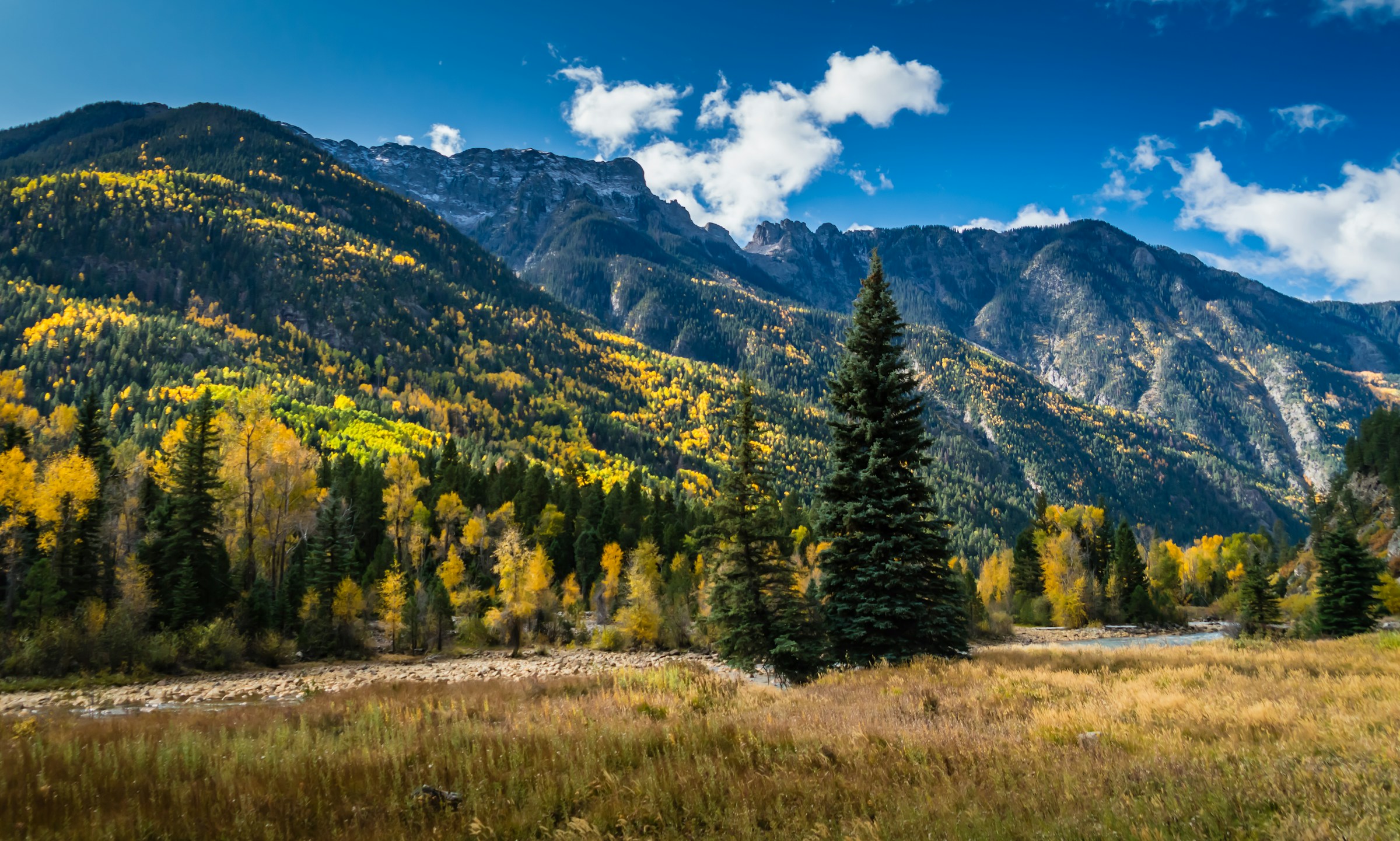
If there is one season when Telluride becomes almost unfairly photogenic, it is autumn. The surrounding slopes contain enormous stands of quaking aspen.
As summer gives way to fall, their leaves turn from green to brilliant yellow and gold, creating enormous ribbons of color across the mountainsides.
Behind them are the darker, more rugged San Juan peaks. In the foreground are the historic buildings of Telluride. And above everything is the high-altitude Colorado sky.
The effect is extraordinary. Locals and visitors sometimes refer to this period as the town’s “Gold Season.”
It is also one of the reasons autumn has become a particularly popular time for photographers, hikers and travelers looking for the classic Colorado fall landscape.
The exact timing, however, is never guaranteed. Normally, the aspens begin changing around mid-September, with peak color often arriving during the final week of September and extending into early October. But weather can shift the timing considerably from one year to another.
For 2026, Telluride’s tourism authorities say the foliage is expected to arrive somewhat earlier because of drought conditions.
Their September 21 update reported patches of color already appearing around the town, Mountain Village, Last Dollar Road, Dallas Divide and Trout Lake. In other words, the window is short. And that may be part of the attraction.
The Gondola That Turns a Commute Into a Scenic Ride
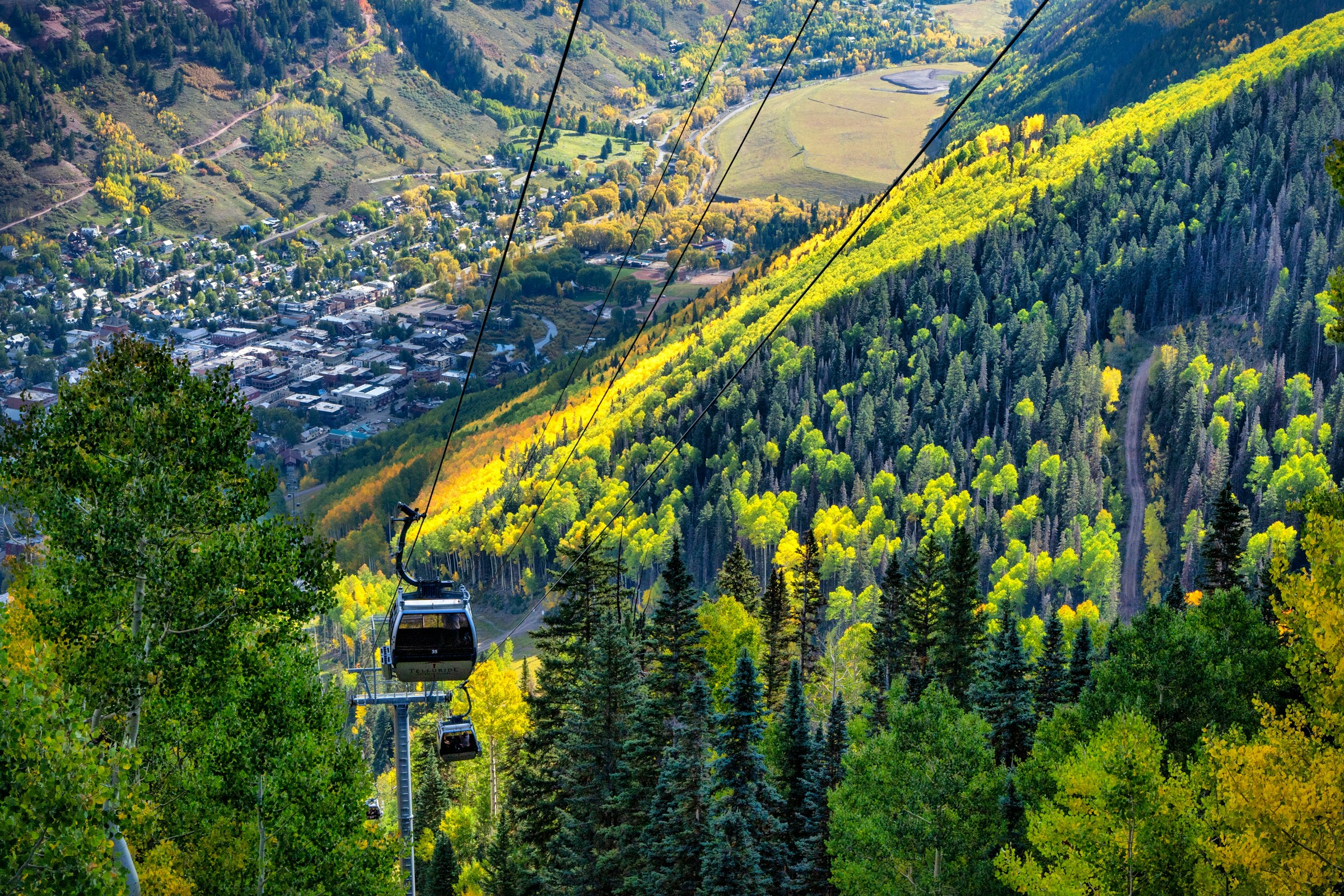
Telluride has another feature that feels almost too perfect for the setting. A free gondola connects the town with neighboring Mountain Village, carrying passengers above the forest and across the mountainside.
The journey takes about 12 minutes from Telluride to Mountain Village, with a stop at San Sophia along the way.
The gondola rises to more than 10,500 feet and provides sweeping views of the San Juan Mountains and the aspen-covered slopes below.
It is not merely a tourist attraction. The gondola is part of the local transportation network – and Telluride describes it as the first and only free public transportation system of its kind in the United States.
In autumn, however, it becomes something else entirely. Imagine boarding a gondola in a historic mountain town, climbing above a forest that has turned bright yellow, and watching the entire canyon unfold beneath you. For a few minutes, the commute is the attraction.
Hollywood Comes to the Mountains
Telluride’s cultural reputation is almost as strong as its outdoor credentials. Every Labor Day weekend, the town becomes a temporary capital of the international film world for the Telluride Film Festival.
The festival has a long-standing reputation for showcasing major films and filmmakers in an unusually intimate setting. The 2026 edition, its 53rd, ran from September 4-7 and presented more than 60 feature films, shorts and revival programs.
The festival’s appeal is partly the cinema and partly the setting. There are few film festivals where you can leave a screening and, within minutes, be surrounded by a 14,000-foot mountain landscape.
Telluride also hosts the annual Blues & Brews Festival, which combines major music acts, craft beer and the beginning of the town’s golden fall season.
The 2026 edition took place September 18-20, bringing artists including Jon Batiste, Taj Mahal & Keb’ Mo’ and Marcus King Band to town.
The result is a destination that somehow manages to combine three things that don’t always coexist comfortably: wilderness, culture and luxury.
Its Remoteness Is Part of the Luxury
Telluride’s greatest advantage may also be its greatest inconvenience. It is not especially easy to reach by road. The town is about 331 miles from Denver, a drive of roughly six hours, according to the local tourism board.
There are also flights into Telluride Regional Airport and nearby Montrose Regional Airport, but the town remains considerably more remote than Colorado’s major resort corridor.
That distance has helped preserve some of Telluride’s sense of separation. You don’t simply stumble into it. You go there deliberately.
And once you arrive, you can largely leave the car behind. Telluride and Mountain Village are walkable, while the gondola and local public transportation make moving between them unusually easy.
It is an appealing formula for travelers increasingly looking for something different from the traditional resort experience: fewer highways, fewer chains and more of a feeling that they have actually arrived somewhere.
Why Telluride Feels Especially Relevant in 2026
There is a broader shift happening in travel. After years of increasingly crowded summer destinations, travelers are paying more attention to the shoulder seasons – particularly spring and autumn, when temperatures can be more comfortable, landscapes can be at their most dramatic and popular destinations may feel less frantic.
Telluride is almost perfectly designed for that trend. In summer, it offers hiking, biking and high-alpine adventures. In winter, it becomes one of North America’s most distinctive ski destinations.
But in autumn, something happens that neither season can quite reproduce. The mountains change color. The crowds of peak summer begin to thin. The historic town becomes quieter. And the same spectacular landscape that makes Telluride famous in winter takes on an entirely different personality.
A Place That Looks Almost Too Perfect to Be Real
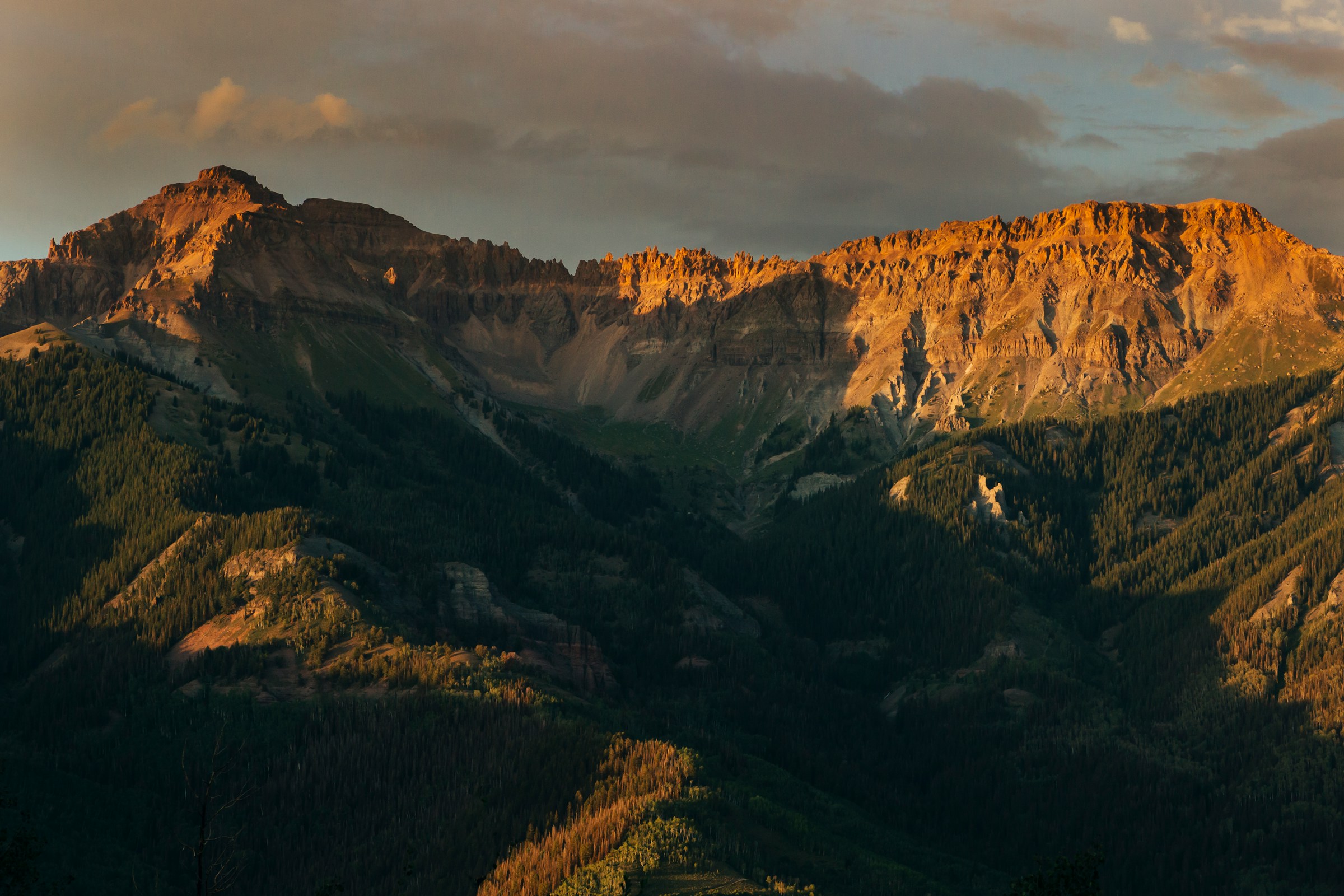
There are many beautiful mountain towns in the American West. Telluride is special because so many elements happen to exist in the same small space.
A historic mining town. A National Historic Landmark District. A box canyon surrounded by enormous peaks. Vast aspen forests. A free mountain gondola. A world-famous film festival. A major music and craft-beer festival.
And, for a few weeks each year, hillsides that appear to have been painted gold. That combination explains why Telluride continues to attract visitors who could choose almost anywhere in the American West.
It isn’t simply the scenery. It is the fact that the scenery, architecture, history and culture all seem to belong to the same story. And when autumn arrives, that story becomes almost absurdly photogenic.
If there is a moment to see Telluride at its most spectacular, late September into early October is usually the place to start – although in 2026, the color may arrive earlier than usual.
The trick is catching it at exactly the right moment. For perhaps two or three weeks, the San Juan Mountains turn gold, the old mining town glows beneath them, and Telluride looks less like a real place than a movie set that somehow survived the cameras.
Sources:
- National Park Service – Telluride National Historic Landmark District (NPGallery)
- Library of Congress (Library of Congress Guides)
- Visit Telluride – 2026 Fall Foliage Update (Visit Telluride)
- Visit Telluride – Gondola (Visit Telluride)
- Telluride Film Festival (Telluride Film Festival)
- Telluride Blues & Brews (Telluride Blues & Brews Festival)
- Visit Telluride – Getting Here (Visit Telluride)
- Visit Telluride – Gold Season (Visit Telluride)


