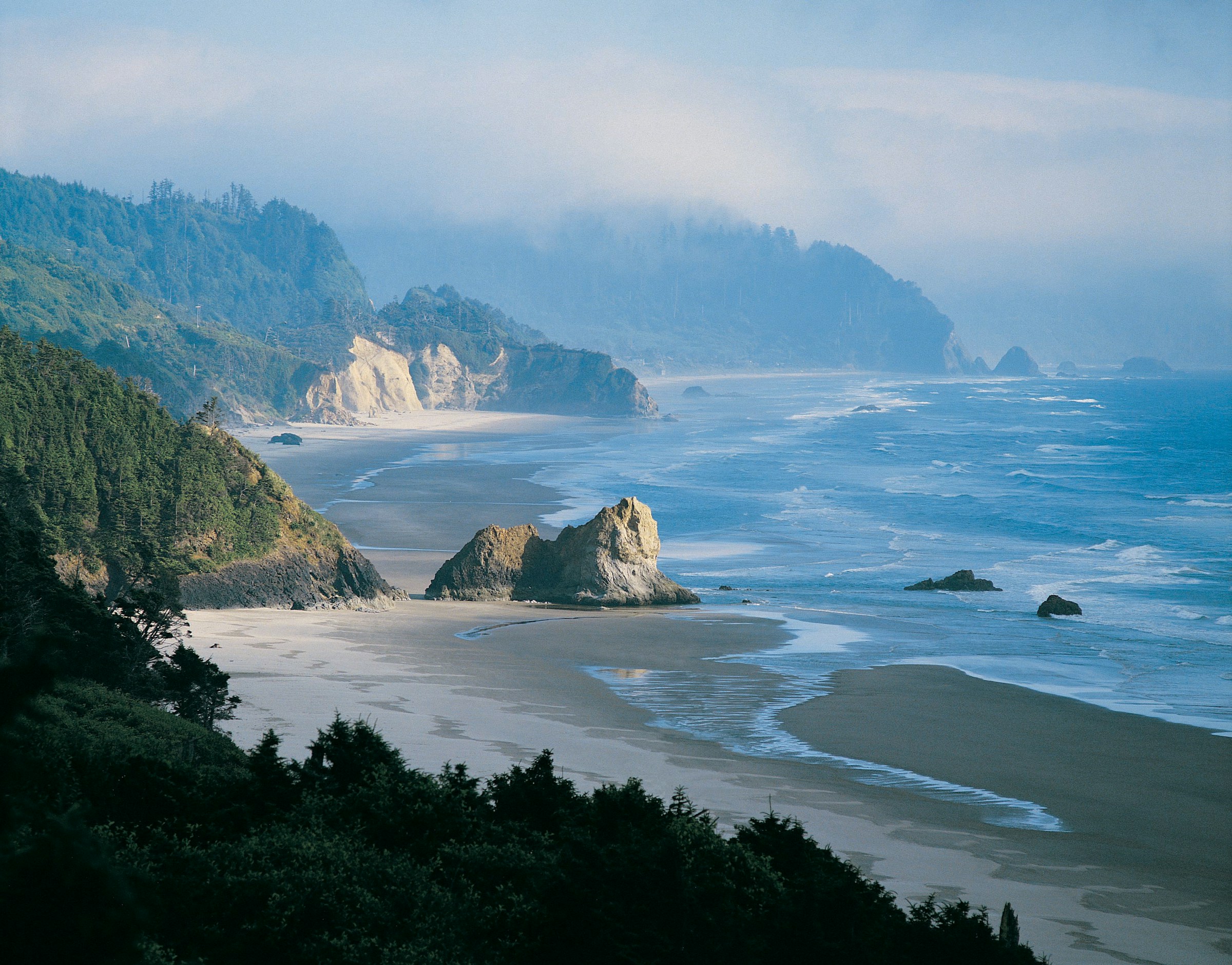
Sun, sand, and the occasional reason to stay very close to shore. From Pacific sneaker waves to a lake that quietly keeps its dead, these ten stretches of coastline prove that “beach” doesn’t always mean “safe.”
There’s a particular kind of trust people extend to a beach. Sand, water, a horizon line – it reads as recreation, almost by default.
But the American coastline, and a few of its inland waters, include some genuinely treacherous stretches: places where rip currents run stronger than most swimmers can fight, where waves arrive without warning after long stretches of calm, where the water itself carries risks that have nothing to do with drowning at all.
None of the places on this list are secret. People visit all of them, every year, often without incident. But each one has a documented pattern of danger specific to its geography – and understanding what that danger actually is tends to be the difference between a great day at the beach and a story that makes the news.
01
New Smyrna Beach
VOLUSIA COUNTY, FLORIDA
Shark bites; Frequent closures;
New Smyrna Beach has earned an informal but well-documented title: the shark bite capital of the world. The inlet here creates ideal conditions for blacktip and spinner sharks hunting baitfish in the same shallow, churned-up water where surfers and swimmers cluster. Most incidents are brief, exploratory bites rather than predatory attacks, and serious injuries are rare – but the frequency is real, and lifeguards close stretches of the beach with some regularity when sharks are spotted working close to shore.
02
Hanakapiai Beach
NĀPALI COAST, KAUAI, HAWAII
No lifeguards; Extreme currents;
Reached only by a strenuous 4-mile hike along Kauai’s Nāpali Coast, Hanakapiai has no lifeguards, no safe harbor, and a beach profile that shifts dramatically with the seasons. The surf here can pull a wading swimmer off their feet and out past the breakers within seconds, and the remoteness that makes the beach so striking is the same remoteness that makes a rescue difficult. A sign near the trailhead reportedly tracks the unofficial death count – a blunt piece of local signage that errs on the side of scaring people into caution.
03
Park Point & Picnic Rocks
LAKE SUPERIOR – DULUTH, MN / MARQUETTE, MI
Freshwater rip currents; Cold shock;
It’s easy to underestimate a lake. Lake Superior is the largest of the Great Lakes by surface area, and it generates genuine rip currents – fast, narrow channels of water pulling away from shore – at spots like Park Point in Duluth and around the rock formations at Picnic Rocks in Marquette, where the terrain funnels water with surprising force. The lake’s water stays cold even in midsummer, cold enough to trigger the same involuntary gasp reflex associated with ocean cold-shock drowning. Search-and-recovery operations on Lake Superior are also complicated by its depth and near-freezing bottom layers, which is part of why the lake has a long-standing reputation, among Great Lakes sailors, for rarely giving its dead back.
04
Thor’s Well & Falcon Cove
OREGON COAST
Sneaker waves; Floating logs;
The Oregon coast draws photographers, not sunbathers – and that distinction matters, because the danger here isn’t about swimming. It’s about standing on what looks like dry rock. Sneaker waves are unusually large waves that arrive without the buildup of a normal swell, sometimes after long stretches of calm water, and can surge tens of meters further up the shore than visitors expect. At Thor’s Well, a collapsed sea cave near Cape Perpetua, the wrong timing can mean being swept directly into the opening. At Falcon Cove and other driftwood-strewn beaches nearby, the National Weather Service has documented incidents where sneaker waves mobilize large, waterlogged logs, turning ordinary beach debris into a serious impact hazard for anyone standing nearby.
05
Cape Disappointment
WASHINGTON / OREGON BORDER, MOUTH OF THE COLUMBIA RIVER
“Graveyard of the Pacific”; Dense fog;
The name alone suggests something. Cape Disappointment sits where the Columbia River – one of the most powerful rivers in North America – collides with the open Pacific, creating a notoriously unpredictable convergence of currents, sandbars, and swells. The stretch of coastline here is informally known as the Graveyard of the Pacific, a reference to the scale of historical shipwrecks the area has produced. Fog can roll in fast enough to erase visibility within minutes, and the U.S. Coast Guard operates one of its most demanding heavy-surf rescue training schools at the nearby Cape Disappointment station – training that exists specifically because the waters here are considered among the most difficult in the country to navigate safely.
06
Mavericks
HALF MOON BAY, CALIFORNIA
60-foot waves; Underwater rock caves;
Mavericks is one of the most famous big-wave surf breaks on Earth, and also one of the deadliest. An unusual underwater rock formation off Pillar Point acts almost like a lens, focusing and amplifying winter swell energy until waves regularly exceed 50 feet and have been recorded above 60. The break’s notorious “Boneyard” – a tangle of jagged underwater boulders and caves just inside the main lineup – has trapped surfers beneath the surface during wipeouts. Big-wave pioneer Mark Foo drowned here in 1994; surfer Sion Milosky died here in 2011 after a prolonged two-wave hold-down. Mavericks isn’t a swimming beach in any conventional sense – but its reputation, and its body count, make it impossible to leave off a list like this one.
07
Kilauea’s Ocean Entry Points
BIG ISLAND, HAWAII
Lava haze (“laze”); Boiling seawater;
When active lava flows reach the Pacific along Hawaii’s Big Island, the resulting coastline is unlike any other beach on this list – and in some ways the most genuinely otherworldly entry here. The collision of molten rock and seawater produces a phenomenon the U.S. Geological Survey calls “laze,” short for lava haze: a billowing plume of hydrochloric acid gas, scalding steam, and microscopic shards of volcanic glass, with the corrosive properties of dilute battery acid. The USGS has directly attributed two deaths to the plume at a coastal entry point in 2000, and continues to warn that the haze can change direction with the wind and is hazardous to skin, eyes, and lungs even from a distance. Active lava deltas can also collapse without warning, triggering explosions and waves of scalding water – a hazard authorities describe in blunt terms: stay back, and don’t trust the ground you’re standing on.
08
Myrtle Beach
SOUTH CAROLINA
Rip currents; High crime rate;
Myrtle Beach is one of the most visited family resort towns on the East Coast – and also a regular fixture on rip-current fatality statistics for the southeastern U.S. The area’s coastal geography produces frequent, fast-forming rip currents capable of pulling even strong swimmers away from shore in seconds. Less expected: the city built around the beach has, in various national rankings, registered crime rates notably higher than the national average for resort destinations of its size – a statistic that sits uneasily alongside its family-vacation branding.
09
Galveston Island
TEXAS GULF COAST
Flesh-eating bacteria; Water contamination;
Galveston’s warm, murky Gulf waters carry a risk that has nothing to do with waves or currents. Proximity to shipping channels and runoff can elevate bacterial counts along the shoreline, and the waters here have been linked to cases of Vibrio vulnificus – sometimes called flesh-eating bacteria – a naturally occurring organism that thrives in warm coastal water and can cause severe, fast-moving infections in anyone entering the water with an open cut or wound. Untreated, infections can progress to amputation or death within 48 hours, making it one of the few beach hazards on this list that has nothing to do with the water’s movement and everything to do with what’s living in it.
10
Sandy Beach, Kotzebue
NORTHWEST ARCTIC BOROUGH, ALASKA
Polar bears; Near-freezing water;
North of the Arctic Circle, the concept of “beach” changes shape entirely. Kotzebue sits on the edge of the Chukchi Sea, where grizzly and polar bears regularly patrol the shoreline searching for stranded fish or marine mammal carcasses. Water temperatures hover close to freezing even in summer, survival time after immersion is measured in minutes, and the wildlife risk is not theoretical – coastal bear encounters are a standard part of life for residents. It’s less a swimming destination than a reminder of how differently “the beach” can be defined depending on where in the country you stand.
What ties these ten places together isn’t a single hazard – it’s the gap between appearance and reality. A calm-looking lake that doesn’t return its dead. A photogenic sea cave that times its surges to catch the unprepared. A family beach with statistics most tourism boards wouldn’t print. The American coastline, in all its variety, rewards exactly one kind of visitor: the one who checks the conditions, reads the signage, and takes the warnings as seriously as the view.
REFERENCES:
– National Weather Service – Sneaker wave hazard advisories, Oregon and Pacific Northwest coast / weather.gov
– U.S. Coast Guard – National Motor Lifeboat School, Cape Disappointment, WA. forcecom.uscg.mil
– Surfer Magazine – “30 Years After His Death at Mavericks, Remembering Big-Wave Hero Mark Foo.” surfer.com
– Grokipedia – “Mavericks (location)” — wave bathymetry and recorded surfing fatalities. grokipedia.com
– U.S. Geological Survey – “Volcanic Gas Hazards from Kīlauea Volcano” (laze plume composition and acidity). usgs.gov
– U.S. Geological Survey – “Lava Entering Ocean” (ocean-entry hazards and 2000 laze fatalities). usgs.gov


