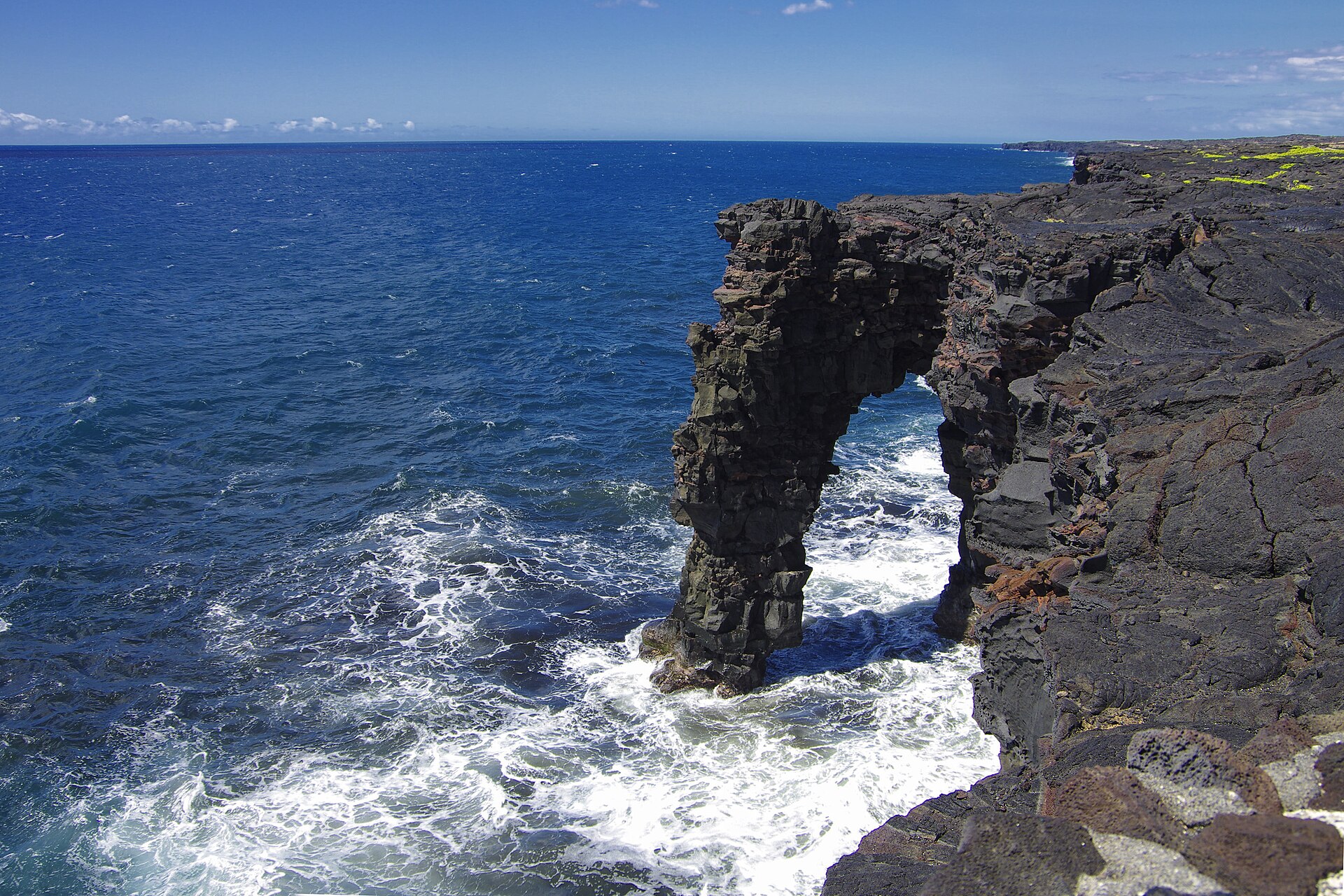
HAWAII NATIONAL PARK, Hawaii – The Hōlei Sea Arch, one of the most recognizable landmarks along Hawaii’s Big Island, has collapsed into the Pacific Ocean after centuries of erosion and years of structural instability.
The 90-foot (27-meter) basalt formation was still standing on September 23 but had disappeared by the night of September 27, according to the National Park Service. Officials said the exact time of the collapse is unknown.
It may have occurred while Hawaiʻi Volcanoes National Park was temporarily closed during Tropical Storm Nolo, although the park service has not confirmed that the storm directly caused the collapse.
The arch stood along the rugged southern coastline of Hawaiʻi Volcanoes National Park, at the end of Chain of Craters Road. Visitors have been warned to remain away from the area, as the surrounding cliffs are unstable and drop sharply into rough ocean waters.
The National Park Service also cautioned that people entering closed sections of the coastline could face a serious risk of falling, drowning or requiring a dangerous rescue operation.
Years of Instability
The collapse followed a long period of geological weakening. Earthquakes associated with the 2018 eruption of Kīlauea and the subsequent collapse of the volcano’s summit damaged cliffs near the arch.
In January 2020, park officials closed the original viewing area after identifying new cracks and signs of instability. A safer viewing area opened farther from the cliff edge several months later.
Powerful surf from Tropical Storm Darby later broke off a section of rock from the lower part of the arch, further demonstrating how vulnerable the formation had become.
How the Arch Formed
Hōlei Sea Arch was carved into an ancient lava flow estimated to be about 550 years old. Waves gradually attacked weaker layers and cracks in the volcanic rock, removing softer material faster than harder sections.
This process, known as differential erosion, eventually created a natural opening through the cliff. The formation was never considered permanent.
The National Park Service described it as a temporary feature with a limited lifespan, noting that continued wave action would ultimately cause the arch to crumble into the sea. As the coastline slowly retreats inland, new arches may eventually form in other sections of the cliff.
Although the collapse marks the disappearance of a well-known Hawaiian landmark, it is also part of the continuing geological cycle that shapes the island’s volcanic coastline.
Sources:
- Hōlei Sea Arch Collapses in Hawaiʻi Volcanoes National Park – Hawaiʻi Volcanoes National Park (U.S. National Park Service) nps.gov
- Hōlei Sea Arch nps.gov
- Hawaii’s famed Hōlei Sea Arch has collapsed into Pacific Ocean abc7news.com
- New Sea Arch Viewing Area Opens – National Park Service nps.gov
- Hawaii’s iconic 550-year-old Hōlei Sea Arch collapses bbc.com
- The Hōlei Sea Arch has collapsed | Hawai’i Public Radio hawaiipublicradio.org