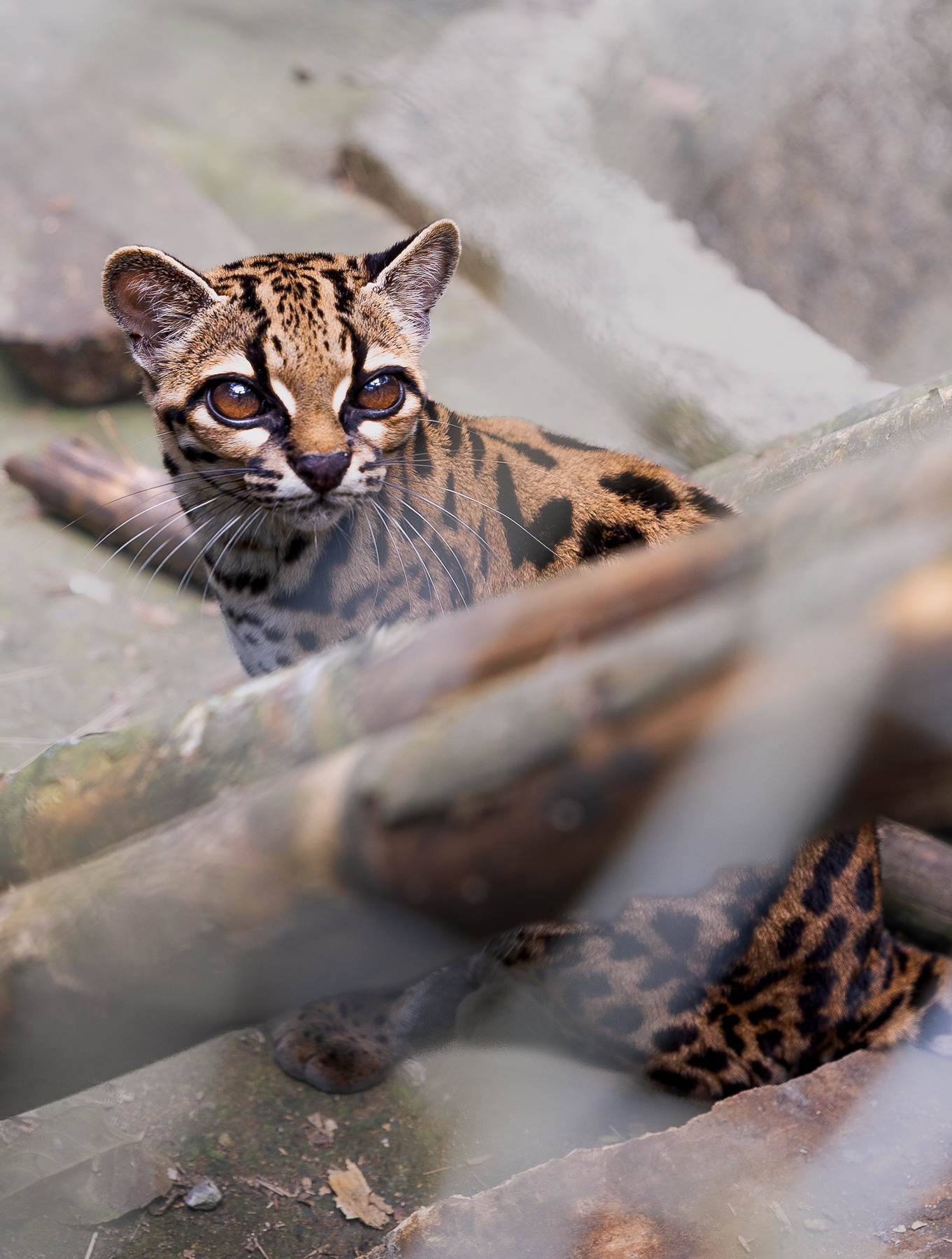
A small, spotted feline from the Andes is forcing scientists to redraw the evolutionary map of South America’s tiger cats.
A small wild cat living in Bolivia’s cloud forests has been formally identified as a species new to science – the first newly described living feline in more than a century.
Named Leopardus tilcayo, the animal inhabits the Yungas, a humid and mountainous forest region on the eastern slopes of the Andes, where the mountains meet the Amazon Basin. The discovery was reported in a study published in the journal Current Biology on September 17, 2026.
The tilcayo is smaller than an average domestic cat, measuring approximately 46 centimetres in length and weighing about 1.4 kilograms.
Its light-brown coat is marked with irregular dark rosettes, giving it a leopard-like appearance despite its diminutive size.
A Discovery Hiding in Plain Sight
The story began in 2017, when Bolivian biologist and National Geographic Explorer Paola Nogales-Ascarrunz was contacted by a wildlife sanctuary about an unusual animal.
A local family had taken in the cat as a kitten after finding it beside a road, initially believing it was a domestic animal. The cat was eventually transferred to Senda Verde Wildlife Sanctuary after its wild behaviour became apparent.
Nogales-Ascarrunz noticed that its physical features did not quite match descriptions of the tiger cats known from neighbouring countries, particularly Brazil. The animal had unusually large rosettes, a compact face and rounded ears.
At first, researchers assumed that the cat belonged to a known species within the tiger-cat group. These small, spotted felines are notoriously difficult to distinguish by appearance alone.
Their ranges overlap across parts of Central and South America, and many specimens in museums were historically classified on the basis of limited physical characteristics.
Genetic analysis ultimately revealed that the Bolivian cat represented a separate evolutionary lineage.
DNA Redraws the Tiger-Cat Family Tree
Researchers compared genetic material from 38 cats across the Leopardus genus, including living animals, rescued specimens and museum samples.
The study found that the group traditionally treated as tiger cats actually consists of five genetically distinct species.
The lineage leading to Leopardus tilcayo separated from other tiger cats approximately 1.4 million years ago.
Scientists say that the genetic distance is substantial enough to support recognition of the Bolivian population as a separate species.
The research also identified a previously unrecognised tiger-cat subspecies in Peru. The researchers named it Leopardus tigrinus antisuyo, after Antisuyu, the eastern region of the Inca Empire.
The findings show how modern genomic techniques can reveal biological differences that are nearly impossible to detect from photographs or brief observations in the field.
Even experienced researchers had previously grouped several distinct lineages under the same broad classification.
A Name Rooted in Local Knowledge
The scientific name Leopardus tilcayo preserves the name used by local communities for the animal.
Researchers say the word has been passed down through generations, although its precise meaning is unclear.
Using a local name is also a recognition of the communities that live alongside the species and were familiar with the animal long before it received a formal scientific description.
The discovery is particularly significant because it concerns an entirely new living member of the cat family, rather than a known subspecies being elevated to species status.
The last newly described living wild cat species was the pampas cat, recognised in 1923. Conservation risks remain uncertain
Much about the tilcayo’s behaviour and ecology remains unknown. Scientists have only limited information about its population size, reproduction and distribution.
Camera-trap observations suggest that it may be active at night, while remains found in scat indicate that small rodents could form part of its diet.
So far, the species has been confirmed only in Bolivia’s Yungas region. Researchers do not yet know whether it occurs elsewhere in the Andes or whether its range is restricted to a small area of cloud forest.
That uncertainty creates an immediate conservation challenge. The Yungas are under pressure from deforestation, agricultural expansion, mining and human-caused fires.
Habitat fragmentation could be particularly damaging if L. tilcayo has a small population and a limited geographic range.
The International Union for Conservation of Nature has been informed of the findings. Previously, tiger cats were assessed more broadly, but the five lineages may now need to be evaluated separately.
A species that appears relatively secure when considered across a large continental range could face a much higher risk when assessed on its own.
Why the Discovery Matters
The tilcayo’s discovery demonstrates that even well-known groups of mammals can still contain species hidden in plain sight.
Small wild cats receive less scientific attention than lions, tigers and leopards, partly because they are elusive and often inhabit dense, difficult-to-access forests.
Researchers say the same combination of genomic analysis, museum collections and field observations could reveal additional undiscovered species in South America and other parts of the world.
The new species also highlights a race against time. Some animals may disappear before scientists have the opportunity to identify them, particularly in ecosystems facing rapid habitat loss.
For now, the tilcayo remains one of the least-known members of the cat family. But its formal recognition has already changed the scientific understanding of South America’s tiger cats – and added a new, fragile branch to the world’s feline family tree.
Sources:
- National Geographic – “Meet the First New Cat Species Discovered in 100 Years” (nationalgeographic.com)
- Reuters – “New cat species identified in Bolivia, first in over a century” (reuters.com)
- Current Biology study – “Phylogenomics and museomics reveal five distinct species of tiger cats in South America” (doi.org and phys.org)
- BBC – “Spotted wildcat from Bolivian forest revealed as new species” (bbc.com)
- The Guardian – “New cat species identified for first time in more than a century in Bolivia” (theguardian.com)


