Safety, working institutions and a quiet life used to mean Switzerland or Austria. The 2026 data points to a longer list, and a few caveats worth reading before you pack.
Nobody wants to compromise anymore. People looking for a place to live, or to spend half the year, now ask for everything at once: low crime, institutions that work, clean cities, real nature on the doorstep, decent healthcare and a monthly bill that does not make them wince.
For decades the shorthand for that wish list has been Switzerland and Austria, and the data still backs the reputation.
Switzerland ranks third in the world in the Institute for Economics & Peace’s 2026 Global Peace Index and sixth in Transparency International’s corruption ranking.
The problem is the price tag. According to Eurostat’s 2025 comparison, consumer prices in Switzerland run 71% above the EU average, and Austria’s run 13% above it.
Numbeo’s mid-2026 cost-of-living index, which compares a basket of goods including rent against New York City at 100, puts Switzerland at 81.5.
The countries below land at roughly a quarter to half of that figure. We picked them using three lenses: how peaceful a country is (Global Peace Index 2026), how clean its public institutions are perceived to be (Corruption Perceptions Index 2025), and what everyday life costs.
None is a perfect Switzerland. Each gets a close look, including the weak spots, and the list is in no particular order.
| Peace rank (GPI 2026, of 163) | Corruption score (CPI 2025, 0–100) | Cost of living plus rent (Numbeo, NYC = 100) | |
| Switzerland (benchmark) | 3 | 80 | 81.5 |
| Uruguay | 43 | 73 | 35.9 |
| Slovenia | 4 | 58 | 37.2 |
| Estonia | 25 | 76 | 39.2 |
| Portugal | 7 | 56 | 37.1 |
| Czechia | 13 | 59 | 37.0 |
| Croatia | 23 | 47 | 35.2 |
| Malaysia | 12 | 52 | 22.4 |
| Chile | 52 | 63 | 25.8 |
| Costa Rica | 62 | 56 | 40.5 |
| Argentina | 72 | 36 | 30.2 |
| Bonus 1: Bulgaria | 26 | 40 | 27.6 |
| Bonus 2: Poland | 22 | 53 | 32.6 |
Uruguay: the quiet one in South America
Uruguay is the most peaceful country in South America, ranking 43rd globally, and the least corrupt in Latin America, with a score of 73 that places it 17th in the world. It also ranks among the top 15 democracies on the Economist Intelligence Unit’s index.
Montevideo’s Pocitos district offers beach promenades and a European-style urban rhythm, while the colonial town of Colonia del Sacramento is a short ferry ride from Buenos Aires.
The caveats: Uruguay is not Swiss-level peaceful, and it is the priciest of the Southern Cone picks on Numbeo’s index, costing more than Argentina or Chile. It buys predictability rather than bargains.
Slovenia: the Alpine option that outranks Austria
Slovenia ranks fourth on the 2026 Global Peace Index, one place behind Switzerland and two ahead of Austria.
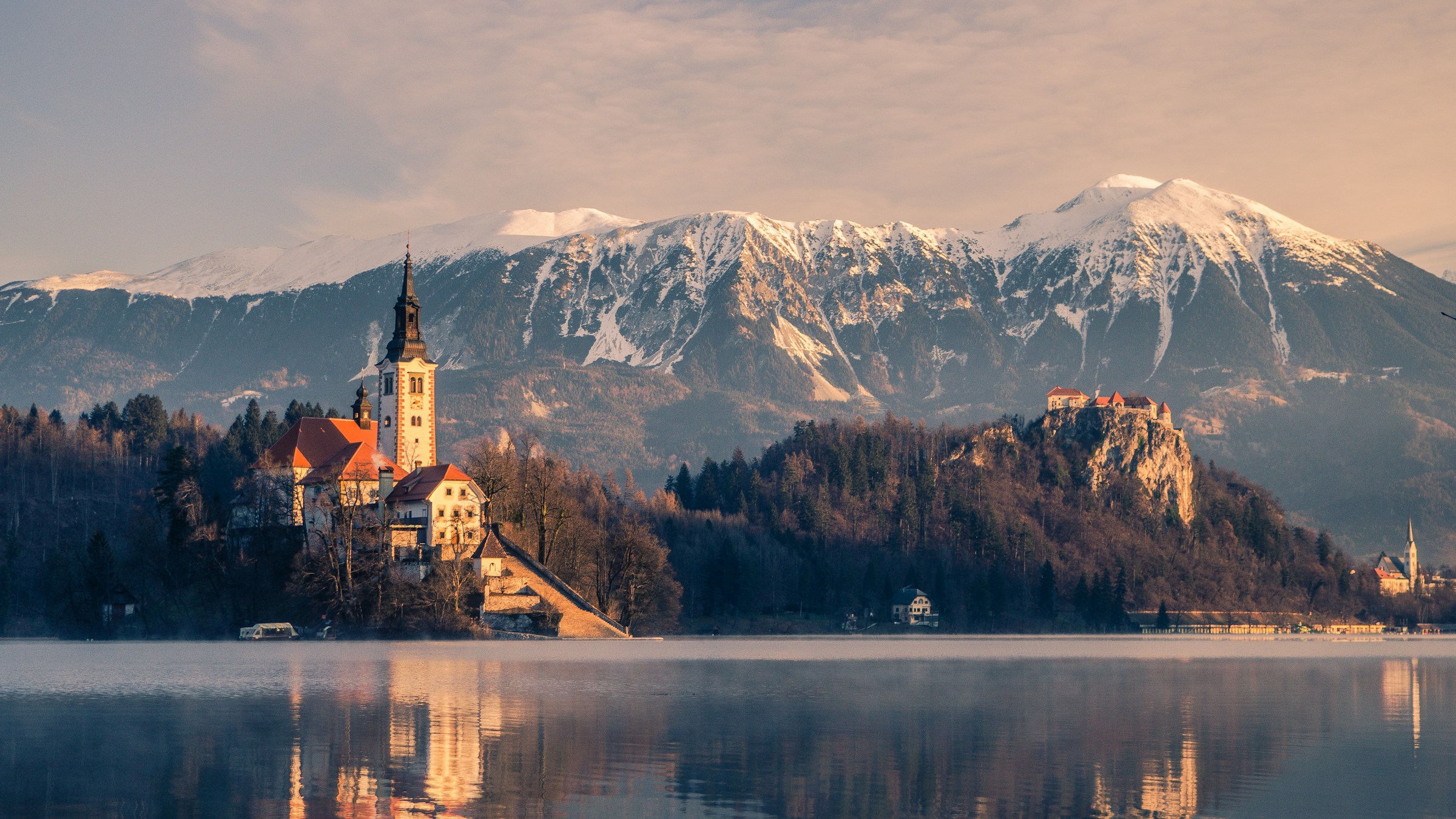
Ljubljana is compact and green, Lake Bled sits beneath the Julian Alps, and prices run close to 10% below the EU average, against 71% above for Switzerland.
Its corruption score of 58 is respectable rather than outstanding, and it slipped two points in the latest ranking.
Estonia: a digital state with the cleanest institutions on the list
Estonia scores 76 on the corruption index, 12th in the world and the closest to Switzerland’s 80 of any pick here.
It is the country many associate with government services that run online, and Tallinn and Tartu both offer a calm, walkable base.
It is also the least cheap of the European picks. Eurostat puts overall prices roughly at the EU average, though that is still around 40% below Switzerland.
Estonia fell five places on the peace index this year, largely because defense spending is rising across NATO’s eastern flank.
Portugal: the Atlantic coast at seven
Portugal ranks seventh on the Global Peace Index, one place behind Austria, with prices about 13% below the EU average.
Lisbon and Porto have become pricey for newcomers, so Braga in the north and Aveiro on the coast are the options to look at. The corruption score of 56 has slid from 62 five years ago, a trend worth watching.
Czechia: order, trains and a rising score
Czechia ranks 13th for peace and has been one of Europe’s biggest improvers on corruption, up ten points since 2012 to 59. Prices sit about 11% below the EU average. Brno and Plzeň offer the infrastructure and public transport of a wealthy country, minus the capital-city premium of Prague.
Croatia: calm Adriatic living, with softer institutions
Croatia ranks 23rd for peace, uses the euro and has been in the Schengen area since 2023. Zagreb and Zadar offer relaxed city living, and consumer prices run about 22% below the EU average.
The weak point is institutional quality: Croatia’s corruption score of 47 is the lowest among the European picks apart from Bulgaria’s. Coastal prices also climb sharply in summer.
Malaysia: the tropical outlier
Malaysia ranks 12th for peace, ahead of Czechia and fourth in the Asia-Pacific region, and is the cheapest pick, at about a quarter of Swiss costs on Numbeo’s index. Penang’s George Town, a UNESCO World Heritage city, and Kuala Lumpur are the usual bases. The trade-offs are climate, since heat and humidity are constant, and a mid-table corruption score of 52.
Chile: strong institutions, a security caveat
Chile ranks 52nd for peace, second in South America, and scores 63 on corruption, 31st in the world. It is also the cheapest of the Southern Cone countries. The caveat is security: the peace index notes that Chile’s homicide rate has tripled since 2017. Most newcomers looking for Swiss-style calm head south instead of to Santiago, to places such as Puerto Varas, a lake town founded by German settlers with the Osorno volcano on the horizon.
Costa Rica: the Swiss label, with an asterisk
Costa Rica earns the “Switzerland of Central America” nickname through neutrality: it abolished its army in 1948 and has long invested in health and education.
The security picture has changed, though. The U.S. Embassy’s security report puts the 2025 homicide rate at 16.8 per 100,000, up from 11.5 in 2021, and the State Department advises increased caution.
The country fell 14 places on this year’s peace index to 62nd. There is some relief: homicides in the first half of 2026 were running about 19% below the same period of 2025. It is also the priciest pick on Numbeo’s index, at about half of the Swiss figure.
Still, geography matters: the gap in safety between expat hubs like Atenas or Nosara and high-crime urban pockets like Limón or parts of San José remains wide.
Argentina: the wild card
Argentina’s Bariloche, with its Alpine-style architecture, lakes and chocolate shops, is nicknamed the “Swiss town” of Patagonia, and the vineyards and Andes backdrop of Mendoza add to the appeal.
But Argentina is the least Swiss option on the list in terms of stability. It dropped 20 places on the 2026 peace index, to 72nd, largely because of political unrest around the government’s austerity program, and its corruption score is 36.
Annual inflation was around 33% in mid-2026, down sharply from nearly 118% in 2024, and the bargains that once made Buenos Aires famous have largely faded as the peso strengthened. The State Department rates Argentina at its lowest advisory level, according to its May 2026 update.
Bonus pick 1: Bulgaria
Bulgaria has changed fast. It joined the Schengen area in January 2025 and adopted the euro on January 1, 2026, becoming the 21st member of the euro area.
Eurostat says it has the lowest price level in the EU, 37% below the average. It is also the most peaceful country in its region, ranking 26th globally, and the World Bank now classifies it as high-income.
The best-known bases for foreigners are Sofia, which has the Vitosha mountain on its doorstep, Varna on the Black Sea coast, and Bansko, a ski resort and remote-work hub in the Pirin mountains.
The weak spot is institutions: Bulgaria scored 40 on the corruption index, tied for the lowest in the EU. Meanwhile, life in the country has indeed become more expensive since the euro was introduced on 1 January 2026 – inflation stood at 4.5% in August 2026, with rents, services, and fuel seeing the steepest increases – although the European Central Bank insists that the changeover itself has had only a limited, largely one-off impact on consumer prices, concentrated in the services sector.
Bonus pick 2: Poland
Poland posted the biggest improvement of any country on the 2026 peace index, rising 23 places to 22nd as political tension eased after the 2023 change of government.
The index says its homicide rate is among the lowest in Europe, and survey data shows nearly nine in ten Poles consider their country a safe place to live.
Prices are about 27% below the EU average. Kraków, Wrocław, Gdańsk and Warsaw all offer modern infrastructure and big-city amenities at mid-range cost.
The caveat is geography. Poland borders both Russia and Ukraine and is rearming rapidly, with defense spending estimated at around 4.5% of GDP, among the highest in NATO. Its corruption score of 53 sits in the middle of this list.
The bottom line
No country here offers all of Switzerland for half the price. Slovenia, Portugal and Czechia come closest on peace and price. Estonia and Uruguay lead on institutional trust. Malaysia, Chile, Bulgaria and Poland are the cheapest, each with a trade-off to weigh. Costa Rica and Argentina sell scenery and lifestyle more than stability.
Every index here is a national average, and city-level reality varies. Numbeo’s prices are crowd-sourced. The honest approach for anyone tempted: rent first, buy later, and decide which compromise you can live with.
Sources: Institute for Economics & Peace, Global Peace Index 2026 (June 2026); Transparency International, Corruption Perceptions Index 2025; Eurostat, comparative price levels of consumer goods and services, 2025; Numbeo, Cost of Living Index by Country, mid-2026; U.S. Overseas Security Advisory Council (OSAC), Costa Rica Country Security Report (June 2026); European Central Bank, Bulgaria euro changeover; European Stability Mechanism, “Bulgaria joins the euro” (January 2026); International Monetary Fund, Finance & Development, “From Hyperinflation to the Euro” (December 2025); Statista, Economist Intelligence Unit Democracy Index data for Uruguay; Argentina’s INDEC inflation data as reported by WageIndicator; Visual Capitalist, 2025 and 2026 index graphics.


