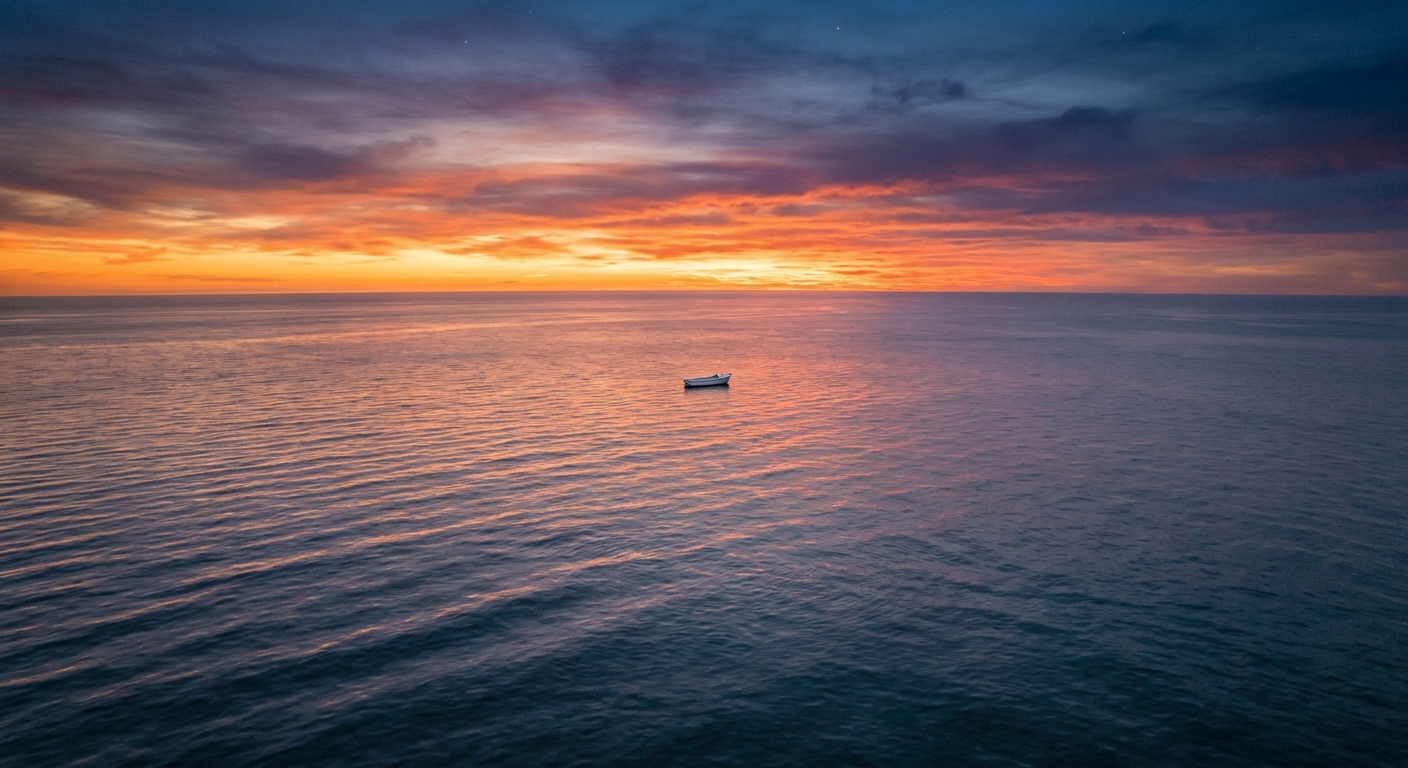
A shark-fishing trip meant to last thirty hours became the longest known survival story in a small boat. It is also a story about one man’s account, a companion who did not return, and how much a human being can endure.
The Trip
On November 17, 2012, José Salvador Alvarenga set out from the fishing village of Costa Azul, on the coast of Chiapas, Mexico.
He was an experienced fisherman, planning a 30-hour shift of deep-sea fishing for sharks, marlin and sailfish. The Salvadoran had left home for Mexico in 2002 and had been fishing there ever since.
His usual partner could not come. So he took along a 24-year-old named Ezequiel Córdoba, who was inexperienced and with whom he had not previously spoken. Córdoba, according to accounts, had agreed to go for about $50 and was nervous from the start.
The Storm
Their boat was a seven-meter (23-foot) open fiberglass skiff with one outboard motor and a large icebox. A storm that lasted five days blew it off course, damaging the motor and most of the portable electronics.
The two men dumped nearly 500 kilograms of fresh fish overboard to keep the boat maneuverable. Alvarenga managed to radio his boss for help, but the radio’s battery died.
There were no sails, no oars, no anchor and no way to call for help. The search organized by his employer gave up after two days because of poor visibility. The boat began to drift west.
Surviving
What followed, as Alvarenga later described it, was an education in improvisation. He caught fish, turtles, jellyfish and seabirds with his bare hands, and the pair salvaged bits of floating debris.
For water, they collected rain when they could and otherwise drank turtle blood or their own urine. A fish box served as his only shelter from wind and sun.
Córdoba did not adapt. According to Alvarenga, Córdoba lost hope about four months into the voyage after getting sick from the raw food, and eventually died by refusing to eat.
According to Alvarenga, he kept the corpse on the boat for six days, sometimes speaking to it, before fearing for his sanity and putting it into the ocean.
He has said that he contemplated suicide for four days afterward, but his faith held him back. Alone, he kept track of time by the phases of the moon. He saw numerous container ships but none stopped.
To a man in a small boat, each of those ships must have felt like a missed rescue. From the ship’s side, the picture is often very different.
A container ship’s bridge sits high above the water, and the blind spot ahead of a large vessel can extend several hundred meters, and further still when containers are stacked on deck.
Seen from that height, a low, seven-meter skiff would be a tiny object on a vast, moving sea. Radar is not a guarantee either: a small boat often does not appear on a ship’s radar and may be unseen by the bridge team.
Even under ideal conditions, international standards require only that a small vessel with a radar reflector be detectable at five nautical miles, and a boat like Alvarenga’s, with no radar reflector, no lights and no radio, would have been harder to detect.
Accident investigators have repeatedly identified difficulty detecting small vessels by radar as a factor in collisions at sea.
None of this proves that any particular ship failed to see him, only that a passing vessel could easily miss a small boat far away, and that being in view of a giant ship was not the same as being seen.
Why the Boat Didn’t Sink
A fiberglass skiff of this size seems an unlikely vessel for crossing the largest ocean on Earth, yet some of what saved it was its smallness.
With no sails, no anchor and no engine, the boat did not fight the sea but moved with it, carried by the water itself.
Oceanographers say the geography was on Alvarenga’s side. A strong westward current just north of the equator drives anything floating from Mexico toward Indonesia, passing right over the Marshall Islands.
Erik van Sebille, an oceanographer at the University of New South Wales, said there was a good chance that a boat drifting off Mexico’s west coast would eventually be carried there by currents.
The trip would typically take upwards of 18 months, though favorable winds and currents could shorten it. The ocean, though, is not a conveyor belt: it is chaotic and full of eddies, and the outcome depends on factors such as wind and the season of departure.
Van Sebille has said that the current could just as easily have swept the boat into the great garbage patch of the North Pacific, where he could have been floating for centuries.
The boat’s condition when it landed fits the story: an observer on Ebon described it as covered in barnacles and littered with turtle carcasses and fish remains.
Why this particular boat held together through storms and months of sun and salt is something no source can fully explain. Luck was clearly part of the answer.
Landfall
After about fifteen lunar cycles, he saw land. On January 30, 2014, he abandoned his boat and swam ashore at Tile Islet, part of Ebon Atoll in the Marshall Islands.
Two local residents found him naked, clutching a knife and shouting in Spanish. He had drifted somewhere between 8,900 and 10,800 kilometers, depending on the estimate.
He was anemic and weak. A Marshall Islands official said his vital signs were good except for unusually low blood pressure, and doctors suspected raw meat had led to liver parasites. After treatment in Majuro, he flew home to El Salvador on February 10.
Too Incredible to Believe?
The reaction was disbelief. The owner of the boat said it was hard to believe anyone could go more than six or seven months without getting scurvy.
A Duke University physiologist countered that fresh bird and turtle meat contain enough vitamin C to prevent scurvy.
Investigators found support for the basics. A Mexican rescue official confirmed that a fishing boat had gone missing in the area on November 17, 2012. The report used different names, but Alvarenga’s parents explained that in Mexico he was known as “Cirilo.” Scientists also backed the plausibility: a University of Hawaii modeling study found that a boat drifting from Mexico would end up within about 190 kilometers of Ebon. His lawyer said he passed a polygraph test. Alvarenga is regarded as the first person in recorded history to have survived more than a year in a small boat lost at sea.
The Shadow That Remained
Life after rescue was not easy. He developed anemia, trouble sleeping and a fear of water. He visited Córdoba’s mother in Mexico, and reportedly still carries guilt over his companion’s death.
His story was told in the 2015 book 438 Days by journalist Jonathan Franklin. Because Córdoba cannot tell his side, the details of his final weeks are known only through the account of the one man who came home.
What the Story Shows
Strip away the controversy, and what remains is a remarkable portrait of endurance. A man with no equipment, no navigation and almost no food lived for fourteen months in conditions that would have broken most people within weeks.
Scientists point to practical explanations, such as protein-rich fresh meat, rainwater and the cooler climate at sea. The harder question is psychological: how a person keeps going when nothing around him changes for over a year.
The unanswerable part is why the two men on the same boat had different fates. Alvarenga was an experienced fisherman, and Córdoba was a young man on his first deep-sea trip. One lost hope, and one did not. It is a reminder that survival depends not only on the body but also on what the mind will allow.
Sources:
- Wikipedia, “José Salvador Alvarenga” (overview, timeline and references): en.wikipedia.org
- The Guardian, “Pacific castaway recounts his 13-month odyssey” (Feb 3, 2014): theguardian.com
- The Guardian, “José Salvador Alvarenga’s 14 months at sea backed by fishermen and officials” (Feb 4, 2014): theguardian.com
- The Guardian, Jonathan Franklin, “Lost at sea: the man who vanished for 14 months” (Nov 7, 2015): theguardian.com
- CNN, “Castaway claims he drifted 14 months in Pacific” (Feb 3, 2014): cnn.com
- CBC, “Jose Salvador Alvarenga and the science of survival” (Feb 6, 2014): cbc.ca
- NBC News, “Pacific Castaway Passed Lie Detector Test, Lawyer Says”: nbcnews.com
- Jonathan Franklin, 438 Days: An Extraordinary True Story of Survival at Sea (Atria/Simon & Schuster, 2015)
- El Diario de Hoy (El Salvador), “A 12 años de la hazaña”: eldiariodehoy.com
- Pacific Pilotage Authority Canada, Safe Navigation guide (small boats and large ships’ blind spots): app-ppa.gc.ca
- Yachting Monthly, “Just how visible are yachts to shipping?” (radar detection standards): yachtingmonthly.com
- U.S. National Transportation Safety Board, marine accident report MIR2314 (difficulty detecting small vessels by radar): ntsb.gov


