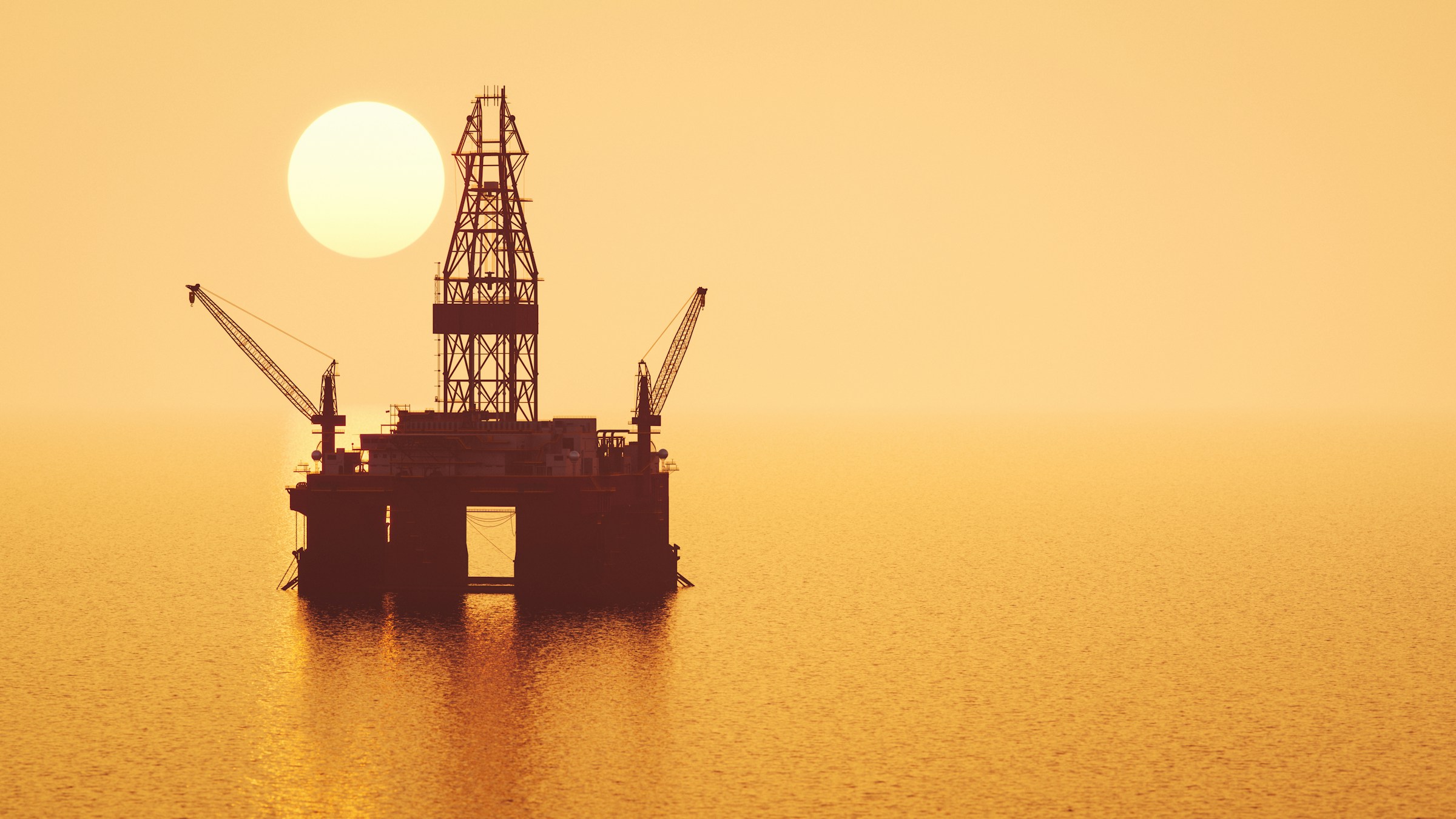
Last Saturday, a drilling rig with 115 people aboard sank off the coast of Gabon. It was a reminder that the machines we send into the sea to pull up oil have always been among the most dangerous workplaces on Earth.
The Night Prospector 5 Went Down
At about 8:37 p.m. on Saturday, October 24, the drilling rig Prospector 5 was preparing to begin work off the coast of Gabon when something went wrong.
Footage showed the rig, which had 115 people on board, listing into the water near the town of Mayumba. The rig, owned and operated by the Bermuda-based contractor Borr Drilling, had not yet begun drilling.
By Monday, 110 employees were reported safe and brought ashore, while teams searched for five people who had disappeared.
Reuters, citing sources, reported that one of the missing, an Indian national, had been found dead, but the Gabonese government had not confirmed the death and still listed five people as missing.
The country’s petroleum ministry ordered a technical investigation and told the navy to reinforce the search.
The company’s initial explanation is a “punch-through.” That is when one of a jack-up rig’s legs suddenly pushes through the seabed soil further than intended while the rig is being raised.
This is the company’s preliminary account, not the result of a completed independent investigation. No storm was reported.
Even so, the disaster shows something about this industry: its most dangerous moments do not always come from the weather.
From Piers to the Horizon
The idea of drilling for oil at sea is more than a century old, and it began modestly. Around 1896, the first submerged oil wells in salt water were drilled in California’s Summerland field, from piers extending out into the Santa Barbara Channel. Those were essentially wooden walkways.
The real leap came after the Second World War. As recently as 1947, no company had ever risked drilling beyond sight of land. That year, Kerr-McGee completed a well in the Gulf of Mexico that became the first oil discovery drilled out of sight of land.
It stood in about 18 feet of water, around ten miles from shore. Drilling began on September 10, and a week later the season’s biggest hurricane arrived, with winds of 140 mph. The industry has been dealing with weather ever since.
Technology moved quickly. Helicopters were first used to carry workers offshore in 1948. The first jack-up rig was invented in 1954, and the first semi-submersible came from an unexpected observation in 1961.
Does It Float, or Stand on the Seabed?
Both, depending on the platform, and that is the key to understanding the risks. Fixed platforms are anchored directly to the seabed and intended for long-term use. They were the answer when offshore drilling moved into waters up to about 100 feet deep.
At the other end, a semi-submersible is a massive floating vessel that rests on huge columns secured to large pontoons, and uses thrusters or anchors to stay in place.
The type Prospector 5 belonged to, the jack-up, sits between the two. It stands on three, sometimes four, legs secured to the ocean floor, and the platform can travel up and down those legs.
The first jack-ups appeared when drilling moved into water of roughly 100 to 400 feet. The method works only if the soil can bear the weight: the footings at the bottom of the legs, known as spudcans, transfer the rig’s load to the seabed. That is exactly what a punch-through puts in question.
Life on a Machine in the Sea
Life aboard is built around a schedule. Workers reach the rig by helicopter on a ride of 45 to 60 minutes, and the usual pattern is two weeks on and two weeks off, in 12-hour shifts.
A review of the writer A. Alvarez’s book on the North Sea describes 12-hour days amid constant noise and vibration, and 40-knot winds and 50-foot seas.
The comforts can be basic: on Shell’s Perdido platform, rooms hold just a pair of bunk beds, a desk and some lockers, though there is a free restaurant, gym and movie theater.
A North Sea rigger, interviewed by the Daily Post, put it bluntly: “The North Sea is the worst place I’ve ever worked for weather.”
Where the Sea Is Cruelest
The North Sea is indeed among the best-known harsh environments, but it is not alone. The title of “harshest” depends on what you measure.
In the North Sea, the proof came on New Year’s Day 1995. The Draupner platform, designed for a predicted once-in-10,000-years wave of 20 meters, recorded a wave of 25.6 meters, and sustained only minor damage. It was the first rogue wave ever detected by a measuring instrument.
Farther north and west, the dangers change. In the Barents Sea, the design wave for platforms is up to 15 meters, while the Grand Banks off Canada are prone to icebergs of as much as 10 million metric tons.
Off Russia’s Sakhalin Island, operators face severe waves, wind and earthquakes year-round, plus pack ice up to 1.5 meters thick for half the year. And in the Gulf of Mexico, hurricanes pose significant risks.
The Deadliest Nights
The most notorious catastrophes have come from storms, from structural failure and from fire.
In March 1980, the Alexander L. Kielland, a floating accommodation platform in the Norwegian North Sea, was housing 212 workers. 123 of them died and 89 survived. The wind was gusting to 40 knots, with waves up to 12 meters high.
A horizontal bracing fractured, one of the platform’s legs collapsed, and the platform capsized within 15 minutes. An inquiry later concluded that a fatigue fracture in a support brace was the direct cause.
Almost two years later, in February 1982, the Ocean Ranger, then the world’s largest semi-submersible drilling rig, capsized and sank in a fierce storm on the Grand Banks with the loss of all 84 crew members.
Inquiries found that seawater entered its ballast control room through a broken porthole. A Canadian royal commission concluded that the rig had several design flaws and that its crew lacked proper safety training and equipment.
The deadliest of all was not caused by waves. In 1988, explosions on the Piper Alpha platform in the British North Sea killed 167 people, making it the deadliest offshore oil rig accident in history. Only 61 of the men on the platform survived.
Other disasters are better known for what they did to the environment than for their human toll: the Deepwater Horizon disaster in 2010 killed 11 people and caused one of the largest oil spills in history.
The Lesson of the Rigs
Decades of offshore engineering have produced stronger platforms, but the sea has never stopped testing them. The Gabon sinking is a reminder that a rig can fail without a storm, simply by trusting a patch of seabed.
What the industry has learned in places like the North Sea, the Grand Banks and the Gulf of Mexico is that safety on the water is measured in margins, and that the margins have often been paid for in lives.
As the search and the investigation continue off Gabon, the industry is once again being asked what margins are enough.
Sources:
- Reuters via ThePrint, “Borr Drilling rig sinks off Gabon, one person dead and four missing” (Oct 25, 2026): theprint.in/world/borr-drilling-rig-sinks-off-gabon-one-person-dead-and-four-missing/3081194/
- Borr Drilling press release, “Prospector 5 Rig Incident” (Oct 25, 2026): prnewswire.com/news-releases/borr-drilling-limited–prospector-5-rig-incident-302918752.html
- OE Digital, “Borr Drilling Rig Sinks Off Gabon, 110 Rescued as Search for Five Missing Continues”: oedigital.com/amp/news/543886-borr-drilling-rig-sinks-off-gabon-110-rescued-as-search-for-five-missing-continues
- Offshore Magazine, “Borr Drilling’s Prospector 5 drilling rig sinks offshore Gabon”: offshore-mag.com/special-reports/news/55414243/borr-drillings-prospector-5-drilling-rig-sinks-offshore-gabon
- Energy Voice, “UPDATE: Borr Drilling rig collapse” (Oct 27, 2026): energyvoice.com/oilandgas/605976/update-borr-drilling-rig-collapse/
- Insurance Journal, “Borr rig sinks off Gabon” (Oct 26, 2026): insurancejournal.com/news/international/2026/10/26/890267.htm
- HSE Blog, “Prospector 5 rig sinks offshore Gabon”: hseblog.com/news/prospector-5-rig-sinks-offshore-gabon/
- Yahoo News, “Giant oil rig sinks off Gabon”: yahoo.com/news/world/articles/giant-oil-rig-sinks-off-124752822.html
- LADbible, “Horrifying footage shows moment huge oil rig sinks” (Oct 27, 2026): ladbible.com/news/world-news/gabon-oil-rig-sinking-video-prospector-5-platform-four-missing-262776-20261027
- Offshore Energy, “Offshore Drilling: History and Overview”: offshore-energy.biz/?p=161359
- American Oil & Gas Historical Society, “Offshore Petroleum History”: aoghs.org/offshore/offshore-oil-history/
- National Academies Press, “Brief History of Subsea Oil Exploration”: nap.nationalacademies.org/read/25032/chapter/13
- Offshore Magazine, “50 key events, technologies shaped the offshore industry”: offshore-mag.com/drilling-completion/article/16756972/anniversary-special-50-key-events-technologies-shaped-the-offshore-industry
- Wikipedia, “Offshore drilling”: en.wikipedia.org/wiki/Offshore_oil
- Arnold & Itkin, “Types of Offshore Oil Rigs”: arnolditkin.com/blog/maritime/types-of-offshore-oil-rigs/
- Inspenet, “Prospector 5 sinks off Gabon; search underway for five workers”: inspenet.com/en/news/prospector-5-sinking-gabon-dussafu/
- Wikipedia, “Draupner wave”: en.wikipedia.org/wiki/Draupner_wave
- Offshore Magazine, “Fixed platforms face development challenges in ice-infested waters”: offshore-mag.com/field-development/article/16757283/fixed-platforms-face-development-challenges-in-iceinfested-waters
- OE Digital, “Organizing the weather off Sakhalin”: oedigital.com/news/458340-organizing-the-weather-off-sakhalin
- Offshore Technology, “The world’s deadliest offshore oil rig disasters”: offshore-technology.com/features/feature-the-worlds-deadliest-offshore-oil-rig-disasters-4149812/
- Norwegian Petroleum Museum, “Alexander L. Kielland – accident”: kielland.industriminne.no/en/home/
- Life in Norway, “Remembering the Alexander L. Kielland Disaster of 1980”: lifeinnorway.net/alexander-l-kielland-disaster/
- Wikipedia, “Alexander L. Kielland (platform)”: en.wikipedia.org/wiki/Alexander_L.Kielland(platform)
- The Canadian Encyclopedia, “Ocean Ranger”: thecanadianencyclopedia.ca/en/article/ocean-ranger
- gCaptain, “Canada Marks 40 Years Since the Ocean Ranger Sinking”: gcaptain.com/canada-marks-40-years-since-the-ocean-ranger-sinking/
- Drilling Formulas, “Top 10 catastrophic accidents in oil and gas”: drillingformulas.com/top-10-worlds-catastrophic-accidents-in-oil-and-gas-industry/
- People With Energy, “What is Life Like on an Offshore Oil Rig?”: peoplewithenergy.co.uk/news/what-is-life-like-on-an-offshore-oil-rig/
- NBC News, “Deepwater oil rig work takes a certain attitude”: nbcnews.com/id/45826042/
- Publishers Weekly, review of A. Alvarez, Offshore: A North Sea Journey: publishersweekly.com/9780395399729
- Daily Post, ex-oil worker interview: dailypost.co.uk/news/north-wales-news/north-wales-ex-oil-worker-25950224


