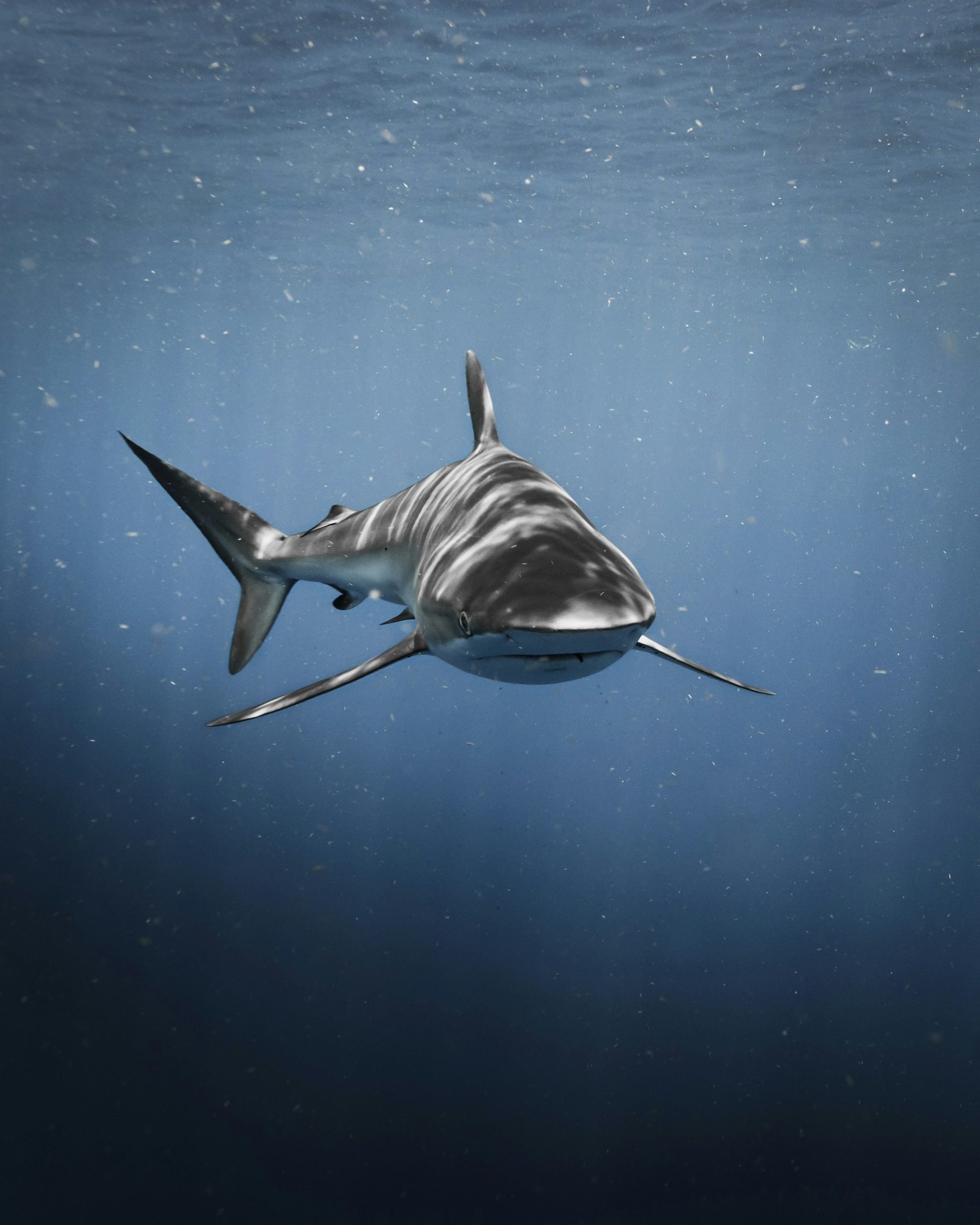
Picture a shark that doesn’t just patrol the open ocean – it can swim beneath your feet while you’re wading in a river, hundreds of miles from the nearest coastline, in water barely deep enough to cover your knees.
That’s the bull shark. And of the ocean’s most feared predators, it might be the one most likely to show up somewhere you’d never expect.
What Makes a Bull Shark a Bull Shark
The name comes from the animal’s short, blunt snout, its stocky, muscular build, and its habit of ramming prey with its head before striking – a behavior reminiscent of, well, a bull.
Physically, they’re substantial but not gigantic. Males typically max out around 7 to 7.5 feet (2.1–2.3 meters), while females run noticeably larger, reaching 10 to 11.5 feet (3.3-3.5 meters) and weights north of 500 pounds (230 kg) – with exceptional individuals pushing past 660 pounds (300 kg).
Their real superpower, though, isn’t size. It’s osmoregulation – the physiological trick that lets bull sharks control the salt balance in their bodies well enough to survive comfortably in both saltwater and completely fresh water.
Rivers, lakes, brackish estuaries – none of it fazes them. It’s a rare enough ability among sharks that it single-handedly explains most of what makes this species so unsettling to swimmers.
Where Exactly Do They Turn Up?
North America. Along the U.S. Atlantic coast, bull sharks typically range as far north as North Carolina, though warm summer currents occasionally push them up to the Chesapeake Bay and, on rare occasions, as far as New York or Massachusetts.
Their freshwater tolerance is where things get genuinely strange: bull sharks have been documented roughly 1,700 miles (2,700 km) up the Mississippi River, reaching all the way into Illinois.
On the Pacific side, they’re far scarcer – occasional stragglers show up off Southern California during unusually warm current events, with a more established population found in Mexico’s Gulf of California, and their range extending south to Peru.
Northern Europe. They simply don’t make it there. Cold water acts as a hard natural barrier, keeping bull sharks out of the UK, the North Sea, and Scandinavian waters entirely.
The Mediterranean, Canary Islands, and Azores. This is where popular imagination and reality tend to diverge.
The Mediterranean has no established bull shark population – despite the occasional old, disputed report – with blue sharks and the rare wandering great white being the more likely suspects behind any historical sightings.
The Canary Islands, despite hosting more than 50 shark species, don’t offer the river mouths and continental shelf habitat bull sharks prefer, given their volcanic origins.
The Azores hold the record for the northernmost confirmed bull shark catch in the open North Atlantic – a single animal in 1993, almost certainly swept there by the Gulf Stream – but these are deep-ocean islands, not bull shark territory in any meaningful sense.
Why They’re Considered the World’s Most Dangerous Shark
Bull sharks belong to what researchers sometimes call the “Big Three” of dangerous shark species, alongside the great white and the tiger shark.
Plenty of shark scientists argue bull sharks are actually the most dangerous of the trio – and the reasoning comes down to a few specific factors.
#1: Proximity
Bull sharks live exactly where people swim: shallow, murky coastal water – often under three feet deep – river mouths, canals, and bays.
#2: Temperament and biology
They carry some of the highest testosterone levels recorded in any animal on the planet. Pound for pound, their bite force is estimated to be stronger than a great white’s. And they hunt primarily by smell and electroreception in cloudy water, a combination that makes misidentifying a splashing human for actual prey far more likely.
The New Smyrna Beach Mystery
Volusia County’s New Smyrna Beach, Florida, holds a genuinely unusual title: more shark bites occur here per square mile than anywhere else on Earth.
Here’s the twist – bull sharks aren’t actually the main culprit. Despite patrolling the area, the vast majority of the beach’s dozens of annual bites come from much smaller, far more agile blacktip and spinner sharks.
New Smyrna is a surfing mecca, thanks to the strong waves near the Ponce Inlet river mouth, and its murky, baitfish-choked water creates ideal conditions for blacktips to mistake the flash of a surfboard or a kicking limb for a fish.
These are quick “hit and run” bites – painful, sometimes requiring stitches, but rarely life-threatening.
If bull sharks were actually behind the dozens of annual incidents here, the numbers tell a different story: fatalities would very likely run into the dozens instead of remaining vanishingly rare.
Australia’s “River Monsters”
If Florida gives bull sharks an undeserved reputation, Australia gives them a well-earned one. Bull sharks regularly push into the river systems around Sydney (including the Parramatta River) and Brisbane.
Along the Gold Coast, an entire network of artificial canals connects luxury waterfront properties directly to the ocean – and those canals are frequently home to resident bull sharks.
Australia has recorded a number of fatal attacks on people swimming in rivers or in the canals behind their own homes, cementing the bull shark’s reputation there as an unpredictable, almost domestic predator – one that doesn’t stay confined to the open sea.
The Numbers Behind the Fear
According to the International Shark Attack File (ISAF), maintained by the Florida Museum of Natural History, bull sharks rank third worldwide for confirmed unprovoked attacks on humans, trailing only the great white and tiger shark.
Globally, they’re linked to at least 121 confirmed unprovoked attacks, 27 of them fatal. Researchers caution that the real number is almost certainly higher – bull sharks hunt in murky water and lack the distinctive markings of a great white, meaning many attacks, particularly in developing coastal regions, likely go unrecorded or get logged simply as “unidentified shark.”
In Florida, among attacks where the species was identified, bull sharks top the list at 16% of serious bites, narrowly ahead of blacktip sharks at 15%.
And the New Smyrna Beach paradox holds up in the data: while Volusia County accounts for roughly 60% of all Florida shark bites, more than 90% of those incidents are attributed to blacktip and spinner sharks rather than bull sharks.
In Australia, the picture darkens. Data from the Australian Shark Incident Database (ASID) puts the fatality rate for bull shark attacks at around 32% – compared with roughly 25% for the great white.
Researchers attribute the higher lethality to where these attacks happen: shallow water, where a powerful bite is more likely to strike a major artery.
Recent years, including 2025 and 2026, have brought serious and fatal incidents in river mouths and estuaries – including Western Australia’s Swan River and canal systems in New South Wales – involving swimmers and teenagers jumping from docks, exactly the kind of shallow, enclosed water bull sharks favor.
The Numbers That Should Reassure You
None of this makes bull sharks a reason to avoid the water. In the United States, all shark species combined account for only about 30 to 40 bites a year, out of more than 100 million annual beach visits – and fewer than one fatality a year on average. For comparison, drowning kills more than 4,000 people annually in the U.S. alone.
Living With Them
Sharks aren’t monsters, and humans have never been part of a bull shark’s natural diet. Most attacks trace back to poor visibility and territorial behavior rather than predatory intent. A few sensible precautions go a long way:
- Avoid swimming at dawn and dusk, prime bull shark hunting hours.
- Stay out of river mouths, or the ocean right after heavy rain, when water turns murky.
- Keep your distance from fishermen or visible schools of baitfish.
The bull shark’s reputation is well-earned – but so is its place as one of the ocean’s most genuinely fascinating survivors: an animal equally at home crossing an entire ocean or cruising past your ankles in three feet of river water.
Sources:
- International Shark Attack File (ISAF), Florida Museum of Natural History, floridamuseum.ufl.edu
- Australian Shark Incident Database (ASID), taronga.org.au
- National Wildlife Federation, “Bull Shark,” nwf.org
- Forbes, “New ISAF Report Shows Increase In Global Shark Attacks,” forbes.com