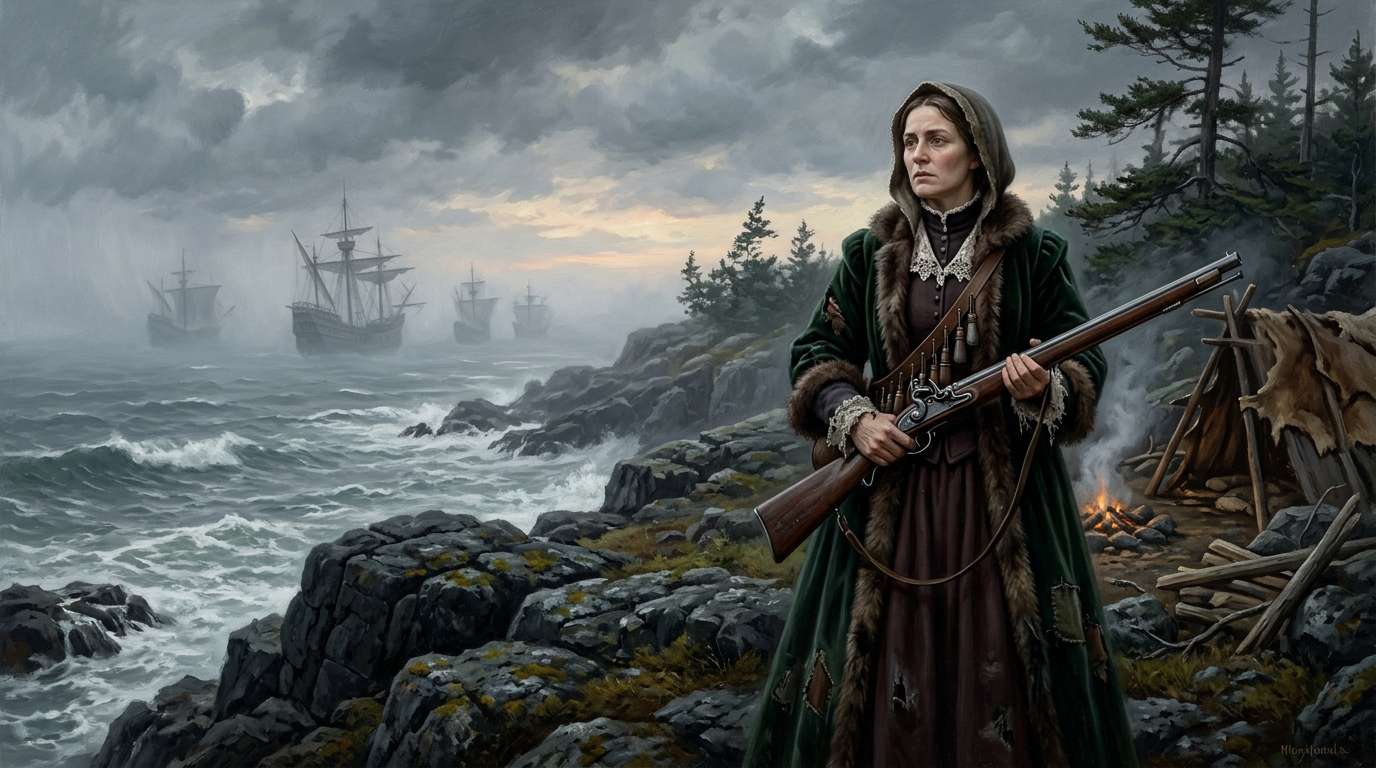
In 1542, a French noblewoman was put ashore on a haunted island at the edge of the New World. She had an arquebus, a lover, a maid – and very little else. Two and a half years later, according to the legend, she was the only one left alive.
In the spring of 1542, three ships sailed from France for Canada. Their commander, Jean-François de La Rocque de Roberval, had been appointed lieutenant general of New France by King Francis I. On board were some two hundred colonists and a young noblewoman named Marguerite de La Rocque.
Almost everything about her is uncertain – beginning with her relationship to the man in charge. André Thevet, the royal cosmographer, called Roberval her uncle; another writer, François de Belleforest, described them as brother and sister; the historian Elizabeth Boyer suggested they were cousins.
What is clear is that Marguerite was a woman of means: in 1536 she formally swore homage for her lands in Périgord and Languedoc, and she was co-lord of the manor of Pontpoint with Roberval.
A Lover at Sea
During the crossing, Marguerite took a lover from among the young men on board. Roberval was displeased.
His objection may have been moral – he held strict Calvinist views – but historians have proposed a more calculating motive: Roberval was heavily in debt, and Marguerite’s death would have benefited him. That is a theory, not a proven fact.
Whatever the reason, Roberval had the ship anchor off a remote island and set Marguerite ashore. Her lover and her maidservant, Damienne, went with her.
The accounts disagree on the details: in one, the lover was put down first and Marguerite chose to join him; in another, he swam to be with her. According to the legend, she was left a gun and some supplies.
An Island with a Reputation
The place had a name. Sailors and writers of the time called it the Isle of Demons, and Thevet’s tales told of devils haunting the wilderness.
As for the location, it is anyone’s guess. Some say Quirpon Island in Newfoundland, while a Quebec historian places the landing on the Lower North Shore near Vieux-Fort.
Local folklore there identifies the island as Harrington Harbour, and the nearby Îles de la Demoiselle are believed to be named after Marguerite herself.
Bears, Demons and a Bible
In the legend, the three castaways did not live long. Marguerite gave birth on the island; the baby died, followed by the lover, and then Damienne. One possibility is that the baby died because Marguerite’s poor diet left her without enough milk.
Marguerite herself survived by hunting. In Thevet’s account, she shot bears with an arquebus – an early firearm – and a woodcut in his Cosmographie shows her standing over two dead bears with her gun. She also faced the demons, which she is said to have kept at bay with her gun and her Bible.
After Two Years and Five Months
That, at least, is Thevet’s timeline: after two years and five months, fishing boats passing the island spotted her.
The fishermen are usually described as Basque – dozens of ships left the Basque country every year to hunt whales in the Gulf of St. Lawrence – though one retelling says they were Breton.
Marguerite, the only survivor, was taken back to France, where she became something of a celebrity. She settled in Nontron and lived as a schoolmistress. Her death was never recorded. Nor does any record survive of an action or charge she brought against Roberval.
How Much Is True?
The story reaches us through three sources. The first is the Heptaméron, a collection of tales by Queen Marguerite of Navarre, published after her death in 1558 and based on information provided by Roberval.
The second is a volume of tragic tales by Belleforest (1570). The third is Thevet’s Cosmographie (1575); Thevet claimed to have heard the story from Marguerite herself. He gives the most detail, but comparisons show he knew the earlier versions.
Historians are divided. The Dictionary of Canadian Biography states that scholars have conceded the two contemporary accounts rest on an actual event, and some details in Thevet – such as the separation of Cartier’s and Roberval’s ships – are historically accurate.
The duration of Marguerite’s stay is also disputed, with estimates ranging from two to five years. And many of the most dramatic details – the demons, the bears, the Bible – come from a single storyteller.
The Story That Never Left
Marguerite has been retold for nearly five hundred years. In 2003, Douglas Glover’s novel Elle won Canada’s Governor General’s Award for fiction.
The Newfoundland playwright Robert Chafe wrote a play called Isle of Demons, and in 2025 Allegra Goodman published a novel about her, Isola.
A film, A Survivor’s Tale, directed by Micha Wald, is in development. On Quirpon Island, where local legend says the ghosts of Marguerite and her lover still walk, the story has become part of the landscape.
Whether it happened exactly as told may never be known. But it has survived, perhaps because it asks a question that is still uncomfortable: what happens to a woman when the person in charge of her fate decides she has broken the rules?
Sources:
- Wikipedia, “Marguerite de La Rocque”: en.wikipedia.org/wiki/Marguerite_de_La_Rocque
- R. La Roque de Roquebrune, “La Roque, Marguerite de,” Dictionary of Canadian Biography, vol. 1 (1966): biographi.ca/en/bio/la_roque_marguerite_de_1E.html
- James H. Marsh, “Marguerite de La Rocque,” The Canadian Encyclopedia: thecanadianencyclopedia.ca/en/article/marguerite-de-la-rocque
- Rémy Gilbert, “L’incroyable et romanesque aventure de demoiselle Marguerite de La Roque en Basse-Côte-Nord (1542-1543),” Téléscope (UQAR): semaphore.uqar.ca/2664/1/Marguerite%20de%20La%20Roque%20en%20Basse-C%C3%B4te-Nord%20%281542-1543%29.pdf
- Haijo Westra and Adam Westra, on Douglas Glover’s Elle and Thevet’s account, Numéro Cinq (2011): numerocinqmagazine.com/2011/02/03/douglas-glover’s-elle-a-menippean-satire-by-haijo-westra-adam-westra
- Wikipedia, “Jean-François Roberval”: en.wikipedia.org/wiki/Jean-Fran%C3%A7ois_Roberval
- Ancient Origins, “Marguerite de La Rocque: 16th Century Noblewoman Stranded on the Isle of Demons”: ancient-origins.net/node/2678
- Canadian Centre for Architecture, “On Phantom Islands and Unknown Lands”: cca.qc.ca/en/articles/issues/31/figuring-territory/86509/on-phantom-islands-and-unknown-lands
- Marguerite de Navarre, L’Heptaméron (novella 67), 1558/1559
- André Thevet, Cosmographie universelle (1575) and Le Grand Insulaire et pilotage
- Elizabeth Boyer, Marguerite de la Roque: A Story of Survival (1977)
- Edward E. Leslie, Desperate Journeys, Abandoned Souls (1988)
- Variety, “Pulsar Content Boards ‘A Survivor’s Tale’” (Sept. 3, 2024): variety.com/2024/film/global/pulsar-content-a-survivors-tale-the-harrowing-marguerite-de-la-rocque-1236127488/


