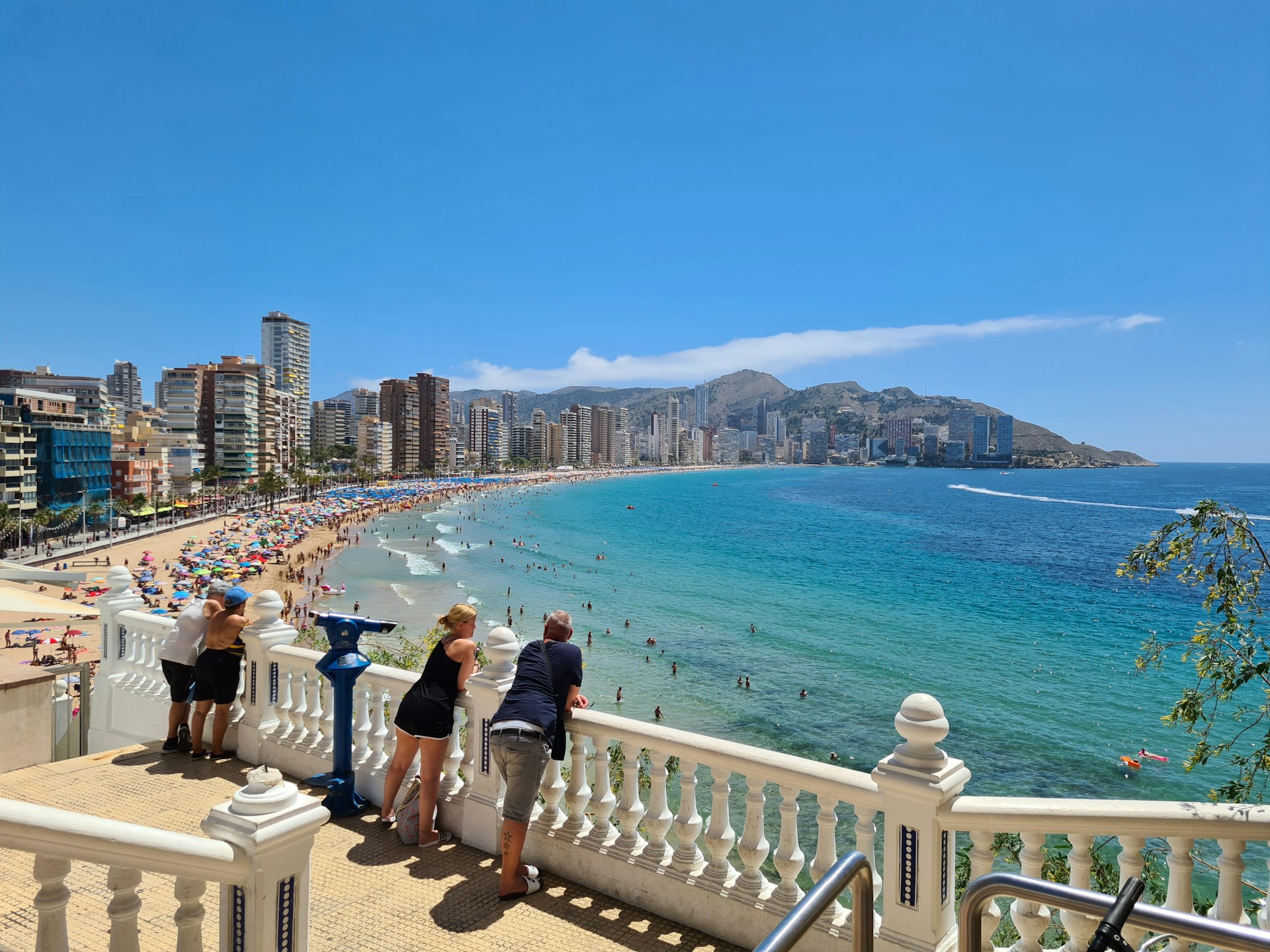
By August, Spain’s beaches are supposed to be at their most inviting. Instead, in some of the country’s busiest coastal destinations, the height of summer is exposing a problem that is becoming harder to ignore: tourism is growing faster than some of the infrastructure built to support it.
Spain has one of the world’s great tourism economies, built in large part around its coastline – from the Mediterranean beaches of Andalusia and the Balearic Islands to the volcanic shores of the Canary Islands.
But the same places that attract millions of visitors are increasingly being asked to absorb them with limited water supplies, wastewater capacity, roads and public services. The problem is not that Spain’s beaches are broadly unsafe.
The country’s overall bathing-water record remains very strong. The problem is what happens when enormous seasonal populations are concentrated in places where infrastructure has relatively little room for error.
A Country Under Extraordinary Tourist Pressure
The scale of Spain’s tourism industry is difficult to overstate. Spain received almost 46.6 million international tourists during the first six months of 2026, up 4.6% from the same period a year earlier, according to the country’s National Statistics Institute. June alone brought 9.7 million international visitors.
The pressure is particularly intense in some coastal and island destinations, where millions of visitors can be concentrated within relatively small geographic areas.
The Canary Islands illustrate the problem especially clearly. The archipelago received about 18.4 million tourists in 2025, according to the regional government, generating more than €23 billion in estimated tourism revenue.
That economic success comes with a physical constraint that no marketing campaign can change: the islands are small. They have limited land, limited freshwater resources and dense development concentrated along the coast.
Millions of visitors can arrive over the course of a few weeks, but there is no way for that volume of people to pass through such a limited environment without leaving a mark. Wastewater is one of the places where that pressure becomes visible.
When Infrastructure Cannot Keep Up
Sometimes the warning arrives in the form of a red flag on a beach. On August 17, authorities in Málaga closed six beaches – Campo de Golf-San Julián, Guadalmar, La Misericordia, Sacaba, San Andrés and El Palo – after water samples detected elevated levels of Escherichia coli.
The closures followed a storm that had caused discharges into the sea. The episode occurred in the middle of one of Spain’s busiest tourism periods, when beaches are crowded and coastal businesses are operating at full capacity.
The immediate cause was not simply the number of tourists. Heavy rainfall and stormwater can overwhelm wastewater systems, while aging infrastructure, inadequate treatment capacity and management problems can make the consequences worse.
But tourism adds another layer of pressure. A coastal municipality with a permanent population of tens of thousands may suddenly be serving several times that number during the peak season.
Every additional hotel guest, restaurant customer, vacation rental and beach visitor generates demand for water, toilets, showers, wastewater collection and treatment.
The infrastructure, however, does not expand and contract with the tourist season. That creates a structural mismatch: Spain’s tourism economy is highly flexible. Its wastewater infrastructure is not.
The Islands Are Especially Vulnerable
The Canary Islands face an even more difficult equation. Their economies depend heavily on tourism, but their geography imposes hard limits.
There is only so much land available for treatment plants, reservoirs, roads and other infrastructure, and much of the population and tourism activity is concentrated along the coast.
The result is that exceptionally high visitor numbers can put pressure on systems that already have limited capacity.
On Tenerife, the long-running wastewater problems around Playa Jardín in Puerto de la Cruz have become a particularly visible example. The beach has repeatedly faced bathing restrictions linked to water-quality concerns.
A recent local report estimated that around 13,000 cubic meters of inadequately treated wastewater per day were reaching the sea off Puerto de la Cruz, while the existing treatment plant was reportedly handling only about 7,000 cubic meters to an adequate standard.
An expansion of the treatment system is not expected to be completed until at least 2028. That is not simply a problem of a dirty beach. It is an infrastructure problem that happens to become visible at the shoreline.
Spain’s Beaches Are Not Generally Unsafe
There is an important distinction between these local pollution incidents and the overall state of Spain’s bathing waters.
According to the European Environment Agency’s assessment of the 2025 bathing season, 1,989 of Spain’s 2,296 monitored bathing waters – 86.6% – were classified as excellent.
Another 8.9% were rated good, while 97.3% met at least the European Union’s minimum bathing-water standard.
The figures matter because they show that Spain is not facing a nationwide collapse in coastal water quality. The problem is more localized and more episodic.
European bathing-water rules focus on microbiological indicators including E. coli and intestinal enterococci, which can signal fecal contamination and associated health risks.
Short-term pollution events can occur after heavy rainfall, particularly when wastewater systems do not have enough capacity to handle sudden increases in flow.
That is why a beach can be perfectly safe for most of the year and still be closed suddenly in the middle of August.
The issue is not necessarily that Spain’s coastline is becoming polluted everywhere. It is that some heavily developed coastal areas have less and less margin for error.
The August Effect
Tourism does not cause every sewage overflow. Storms can overwhelm drainage networks. Rainwater can enter sewer systems. Treatment plants can malfunction. Pipes can fail. Poorly managed or illegal discharges can also contribute to contamination.
But a large seasonal population can amplify the consequences. The basic equation is simple. More people mean more water consumption and more wastewater. If the treatment system has enough spare capacity, the increase may be barely noticeable. If it is already operating close to its limit, a major storm or technical failure can push it beyond that threshold.
This is particularly important for destinations whose economies depend on the same visitors who place the greatest seasonal pressure on their infrastructure. Tourism generates revenue, employment and business activity.
But the infrastructure required to accommodate that tourism – from sewage treatment to freshwater supply and waste collection – also has to keep pace. Otherwise, the very resource being sold to visitors can become part of the problem.
Pollution Is Becoming Part of the Overtourism Debate
That helps explain why wastewater has increasingly become part of the wider argument over overtourism in Spain.
Across the Canary Islands, the Balearic Islands and other heavily visited destinations, residents have raised concerns about housing shortages, rising rents, traffic, water consumption, waste, overcrowding and environmental degradation.
The question is gradually changing. It is no longer simply: How many tourists can Spain attract? It is becoming: How many tourists can a particular island, beach or municipality safely accommodate at the same time?
That is a much more complicated question. Hotel capacity is only one part of the equation. So are airport arrivals, water supply, wastewater treatment, waste collection, public transportation, emergency services and the ability of the surrounding environment to absorb the pressure.
In other words, the real carrying capacity of a destination may have less to do with how many hotel rooms it can build than with how much infrastructure can function reliably when those rooms are full.
The Danger of Loving a Place to Death
Spain has spent decades building one of the world’s most successful tourism industries. International visitors support millions of jobs and generate enormous economic activity, particularly in coastal regions and the islands.
The answer, therefore, is not to declare war on tourism. It is to recognize that successful destinations eventually reach a point where growth without sufficient infrastructure can become self-defeating.
A beach closed because of bacterial contamination is not merely an environmental inconvenience. It is a warning to the tourism industry itself.
The visitor who arrives expecting clear Mediterranean water does not care whether the problem began with an overloaded sewer, a summer storm, an aging treatment plant or a failure of local management.
They see a closed beach. Residents see something else: a destination attracting millions of visitors while struggling to provide the infrastructure required to accommodate them.
Spain’s broader record shows that investment can make a difference. The European Environment Agency says bathing-water quality across Europe has improved markedly over recent decades, largely because of better wastewater collection, treatment and systematic monitoring.
That makes the challenge facing Spain in the summer of 2026 less about whether tourism itself is sustainable and more about whether the infrastructure beneath it can keep up.
Because when the visitors keep coming, the water keeps being used and the wastewater system reaches its limit, the consequences do not disappear.
Eventually, they reach the sea.
Sources:
- Spain’s National Statistics Institute (INE) – Tourist Movements at Borders, June 2026
- Government of the Canary Islands – 2025 tourism figures
- European Environment Agency – Spain bathing water quality, 2025
- European Environment Agency – European bathing water quality in 2025
- Agencia EFE – Málaga closes six beaches after E. coli detected, August 17, 2026
- Teneriffa News – Puerto de la Cruz wastewater situation, August 2026