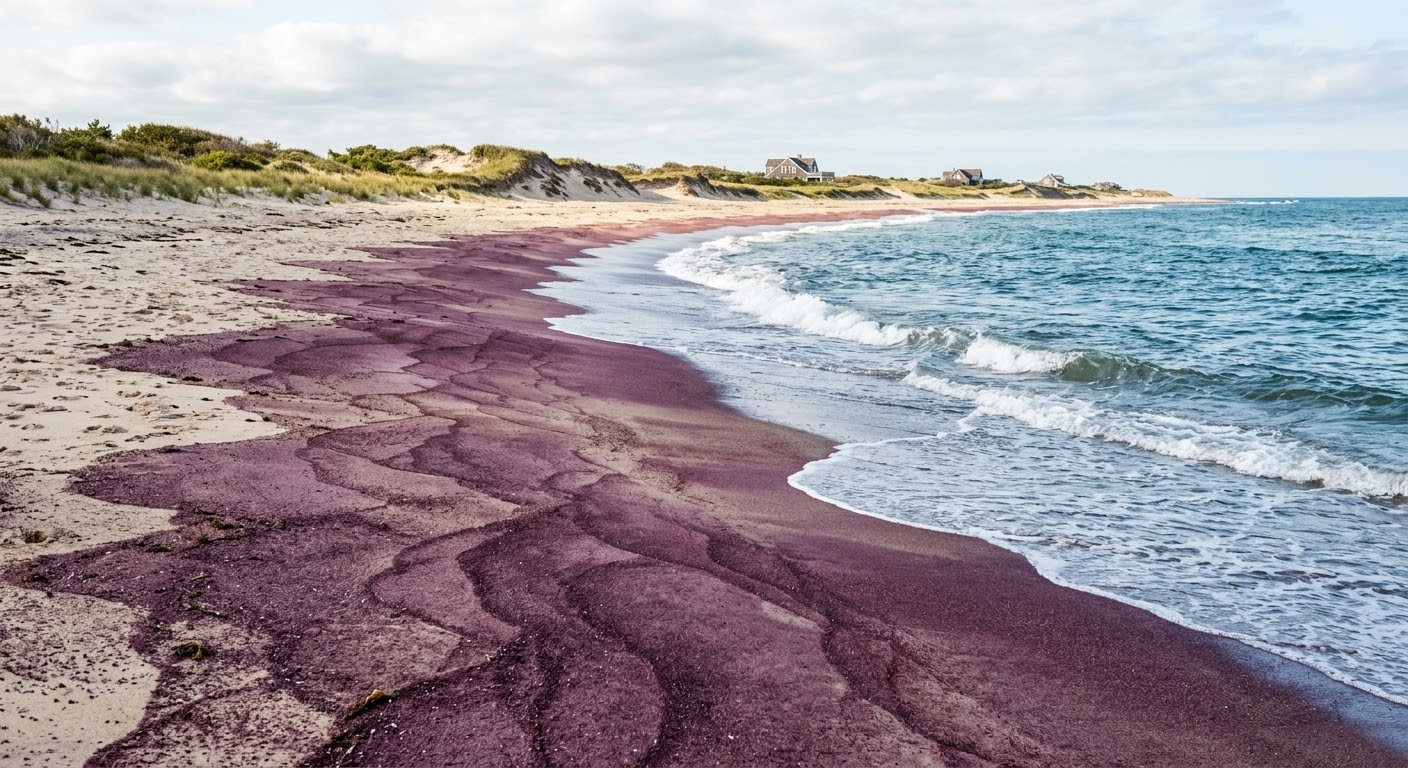
Along the coast of New York, a violent storm has temporarily transformed sections of Long Island’s shoreline into a deep reddish-purple landscape – revealing a geological secret hidden beneath the beach.
LONG ISLAND, New York – After a powerful nor’easter battered the coast of New York with strong winds, heavy surf and significant beach erosion, parts of Long Island appeared to undergo an almost surreal transformation.
Instead of the familiar pale sand, sections of the shoreline were covered in a striking reddish-purple layer, giving the beach an appearance more commonly associated with gemstones than with an Atlantic coastline.
The phenomenon was highlighted by FOX Weather, which described the scene as a “gemstone discovery.”
But there is no mystery – and no treasure chest – beneath the waves. The unusual color is the result of heavy mineral sands, including garnet, a mineral that occurs naturally along parts of Long Island’s coast.
A Storm Exposes What Is Normally Hidden
The key to the phenomenon is erosion.
During major coastal storms, powerful waves can remove large amounts of the lighter, more mobile sand that normally forms the visible surface of a beach. What remains can contain a much higher concentration of heavier minerals.
Scientists call this process hydraulic sorting: moving water separates sediment grains according to differences in size, shape and density.
The U.S. Geological Survey has documented precisely this type of process on Fire Island, New York, following Hurricane Sandy.
Researchers found layers enriched in heavy minerals, including garnet, and concluded that waves had selectively eroded and transported beach and dune sediments, concentrating the heavier grains under particular hydrodynamic conditions.
The U.S. Geological Survey has also noted that wave action can concentrate heavy minerals into distinct layers on beaches, with their abundance changing significantly from one storm to another. In other words, the storm did not create the purple sand. It uncovered and concentrated it.
Why Garnet Makes the Sand Look Purple
Garnet is best known as a gemstone, but in geological terms it is a group of minerals with varying chemical compositions.
New York’s garnets are predominantly almandine, and the state’s garnet is commonly dark red to reddish-brown, although garnet can occur in several colors, including purple.
Individual grains of garnet are tiny. But when thousands or millions of them become concentrated together, their collective reddish, wine-colored or purplish appearance can dramatically change the color of an entire section of beach.
Long Island is particularly interesting in this respect. A geological study of Montauk Point found garnet- and magnetite-rich beach sands and concluded that their concentration is linked to erosion and wave action.
Because garnet and magnetite are substantially denser than the quartz and feldspar that make up much of ordinary beach sand, wave action can hydraulically separate the minerals and produce a garnet-rich “placer” deposit.
The phenomenon is not limited to Montauk. New York State Parks has documented beaches on Long Island where sand contains quartz, garnet and magnetite, and specifically notes that garnet and magnetite can give some Long Island beaches a purplish hue.
New York’s Gemstone Beneath Its Feet
There is another remarkable connection between the landscape and the mineral. Garnet is New York State’s official gem.
According to the New York State Department of Environmental Conservation, some of the world’s largest garnet deposits are found in the Adirondacks.
New York garnet is predominantly red to very dark red, although other colors occur. The mineral is also commercially important and is widely used as an industrial abrasive because of its hardness.
The connection between the Adirondacks and Long Island may seem surprising, but the region’s geological history provides part of the explanation.
Long Island’s sediments were profoundly shaped by glaciers during the Ice Age. Ancient glacial deposits contain material derived from much older rocks, and coastal erosion subsequently reworks those sediments.
At the shoreline, the ocean effectively acts as a natural sorting machine. Lighter grains are more readily transported, while denser minerals such as garnet and magnetite can accumulate in concentrated bands.
A Temporary Geological Spectacle
The purple beach is therefore not necessarily a permanent transformation. As ordinary sand is redistributed by subsequent waves, tides and wind, the concentration of heavy minerals can change again.
The vivid color may fade, move to another part of the beach or disappear beneath a new layer of lighter sediment. That makes the phenomenon particularly ephemeral.
A storm that appears to have simply damaged the coastline may, for a brief moment, also reveal a hidden geological layer that normally remains invisible beneath the surface.
The striking images from Long Island are a reminder that beaches are not static stretches of sand. They are dynamic geological systems, constantly being eroded, transported and rebuilt by waves, wind and currents.
And sometimes, when a powerful storm rearranges the shoreline, the beach itself can reveal what was hiding underneath all along.
Sources:
- U.S. Geological Survey (USGS): research on selective sediment transport and heavy-mineral concentration on Fire Island following Hurricane Sandy.
- New York State Department of Environmental Conservation (NYSDEC): information on garnet, its geological characteristics and status as New York’s official gem.
- New York State Parks: documentation of garnet- and magnetite-bearing sands and naturally purplish sand on Long Island beaches.
- CUNY York College geological research: study of garnet-rich beach placer deposits at Montauk Point and the role of wave-driven hydraulic sorting.
- FOX Weather: recent reporting on the powerful nor’easter and its impacts, including beach erosion along Long Island.
- FOX Weather: coverage of the nor’easter and Long Island beach erosion
- U.S. Geological Survey: Fire Island heavy-mineral study
- New York State Department of Environmental Conservation: New York State symbols and garnet