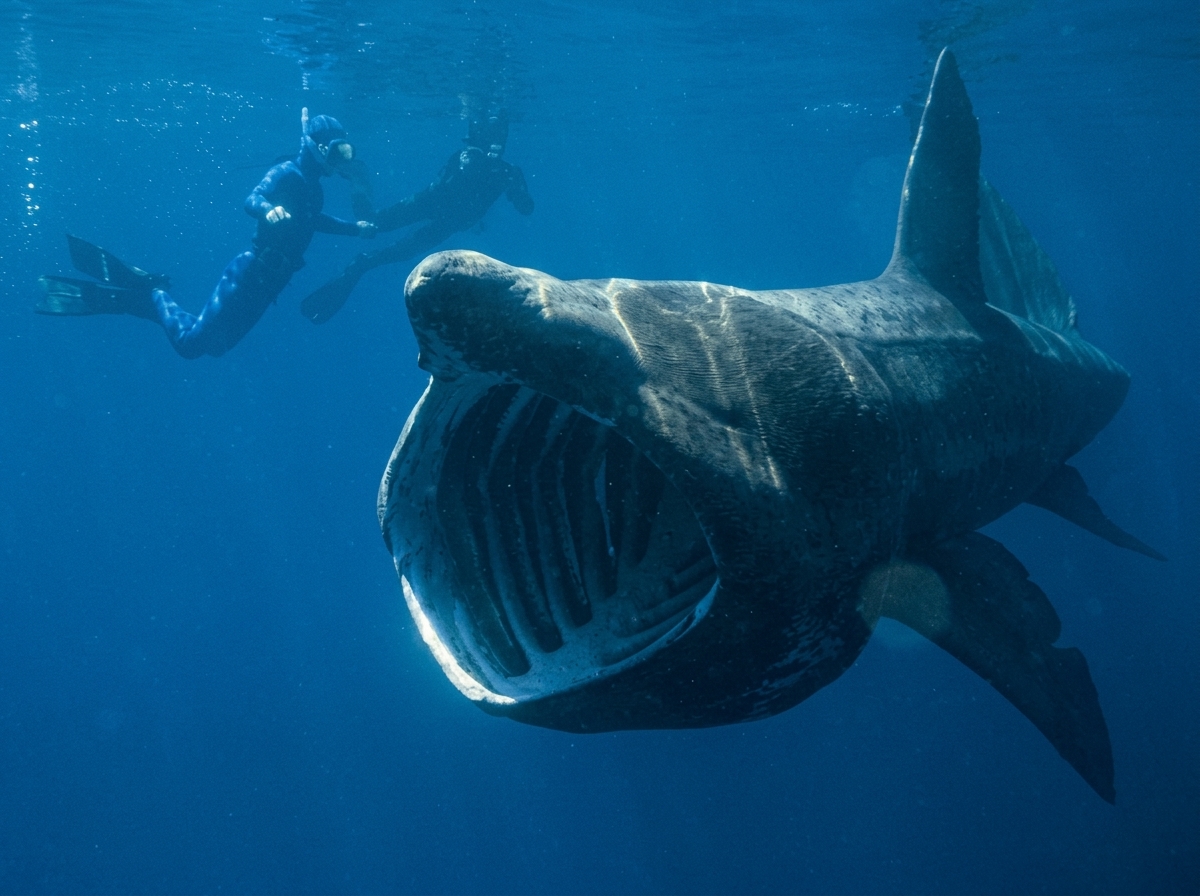
A fin as tall as a person cuts the surface. Beneath it glides a mouth a meter wide. In the Norwegian summer, one of the biggest fish on Earth drifts into the fjords, and it is far less frightening than it looks.
It starts with a triangle. On a calm summer day off the coast of Norway, a dark fin rises from the water, tall and slow, and keeps moving.
Then comes the snout, a pointed shape just beneath the surface, and finally a gaping mouth, as wide as a doorway, held open as the animal glides forward. An eight-meter (26-foot) shape the length of a city bus moves toward your boat.
It is no wonder that people have gasped. But the basking shark, Cetorhinus maximus, is also among the most peaceful creatures in the sea.
The Second-Largest Fish in the Ocean
After the whale shark, the basking shark is the largest fish in the sea, according to Norway’s Institute of Marine Research (IMR). Adults typically measure 6 to 8 meters (20 to 26 feet) and weigh about 5 tonnes (11,000 pounds).
Some reach 9 or 10 meters (30 to 33 feet), though after decades of hunting, individuals of this size have become rare. Historic reports from Norway of sharks over 12 meters (39 feet), the largest at 13.7 meters (45 feet), are considered dubious.
Its famous mouth can be nearly a meter (3 feet) wide, held open as it feeds. Its gill slits almost encircle the head, and they are lined with dark, bristle-like gill rakers. The shark does have teeth, hundreds of tiny, backward-pointing ones, but they are not used in feeding.
Why the Scary Look is Misleading
The basking shark is one of only three shark species in the world that feeds on plankton. As it swims slowly at about two knots (around 2.3 miles per hour), water flows through its mouth and over the gill rakers, which strain out zooplankton, fish eggs and tiny invertebrates.
According to National Geographic, a basking shark can filter about 2,000 tons of seawater an hour. Wildlife groups often cite a more conservative figure of over a million liters per hour (about 260,000 gallons).
That is the key to its temperament. A shark that hunts by sieving plankton does not hunt people. There is no record of a basking shark attacking a human. Marine biologists describe them as harmless.
So How Calm Can We Be?
Very calm, but with one qualification. A basking shark does not bite, but it is a huge and heavy animal, and a collision can be dangerous.
National Geographic notes that the only fatal shark encounter ever recorded in the United Kingdom involved a basking shark: in 1937, according to the magazine, a breaching individual accidentally capsized a boat, and three people died.
Breaching, in which the shark launches most of its body out of the water, is still not well understood. It may be a way of shedding parasites or a social display, and it costs a lot of energy, up to 32 times more than swimming.
For this reason, Norwegian researchers recommend giving the animals space. The IMR publishes a code of conduct for encounters with basking sharks, and asks boaters to avoid disturbing them.
Why Norway, and Why Summer?
The name “basking” comes from the sight of the shark lying at the surface, apparently warming itself in the sun. In reality, it is feeding. In summer, plankton blooms in the cool, nutrient-rich waters of the North Atlantic, and the sharks follow.
In Norway, the hot spot is the Lofoten archipelago, above the Arctic Circle. According to data from the IMR, citizen scientists reported 220 individual sightings in the area between 2007 and 2024, and about 97 percent of them were between June and August, with more than half in July. Almost a third of the animals were seen feeding. Lofoten accounts for more than half of all sightings in the country.
The sharks’ temperature preferences are broader than often claimed. According to the IMR, basking sharks have been recorded at sea temperatures between 5.8 and 21 degrees Celsius (42 to 70 degrees Fahrenheit), with most sightings between 15 and 17.5 degrees (59 to 63.5 degrees Fahrenheit).
Where Do They Go in Winter?
This is where it becomes a mystery. For decades, many people believed that basking sharks hibernate on the sea floor, partly because specimens caught in winter had shed their gill rakers.
But studies from 2003 disproved the idea. Basking sharks are active all year, and in winter they dive to depths of up to 900 meters (3,000 feet) to feed on deep-water plankton. Satellite tags have shown that they travel thousands of kilometers.
A new study, published on June 3, 2026, by researchers at the Woods Hole Oceanographic Institution, tracked basking sharks in the western Atlantic and found that they dive into the ocean’s twilight zone, sometimes below 1,000 meters (3,300 feet), and actively feed during long-distance migrations. It also showed the sharks traveling to the Sargasso Sea and the Caribbean.
What the Norwegian sharks do remains largely unknown. The IMR says it is still “a mystery where they migrate in winter,” and from 2021 to 2025, it led a research project called Sharks on the Move to tag basking sharks around Lofoten and Vesterålen with satellite trackers.
In 2022, scientists tagged eight-meter animals, and in 2023, six sharks had been tagged by June 21. The institute also runs a “shark hotline” and asks the public to register sightings.
A Recovery in Progress
The basking shark is endangered. The IUCN, the global authority on species’ status, lists it as Endangered, and the population is decreasing. People hunted it for centuries for its oil-rich liver, and the species has not fully recovered.
Today, it is no longer targeted by fisheries in Norway, but the IMR says that little is known about the effects of shipping, tourism and climate change. Basking sharks grow slowly, and one of the biggest mysteries is their reproduction.
A Reminder in the Water
Seeing a basking shark is a rare privilege, and also a gentle lesson. The animal that looks like a monster in the movies turns out to be a peaceful grazer of the sea, one that spends its days sifting the water for the smallest forms of life.
Sources:
- Norwegian Institute of Marine Research (IMR), “Sharks on the Move” (2021-2025): hi.no/en/hi/forskning/projects/sharks-on-the-move
- IMR, “Basking shark” species page: hi.no/en/hi/temasider/species/basking-shark
- IMR, Basking shark stock narrative (temperature range, habitat): hi.no/resources/klimastatus-pa-bestander/20211213_Basking-shark_narrative.pdf
- Important Shark and Ray Areas (IUCN SSC Shark Specialist Group), “Lofoten ISRA”: sharkrayareas.org/portfolio-item/lofoten-isra/
- Woods Hole Oceanographic Institution press release, “Endangered basking sharks rely on the ocean twilight zone during long-distance migrations” (June 3, 2026): whoi.edu/press-room/news-release/basking-migration/
- National Geographic, “Basking shark”: nationalgeographic.com/animals/fish/facts/basking-sharks
- Wikipedia, “Basking shark” (size, hibernation studies, migration): en.wikipedia.org/wiki/Basking_shark
- Marine Biodiversity Records, “Observations of basking sharks west of Shetland” (2018): link.springer.com/10.1186/s41200-018-0151-4
- Sims, D. W. (2008), “Sieving a living: a review of the biology, ecology and conservation status of the plankton-feeding basking shark Cetorhinus maximus,” Advances in Marine Biology
- IUCN Red List, “Cetorhinus maximus” (Rigby et al. 2021): iucnredlist.org/species/4292/194720747
- Norway Explained, “Sharks in Norway: Species, Safety, and Where to See Them”: norwayexplained.com/sharks-in-norway/