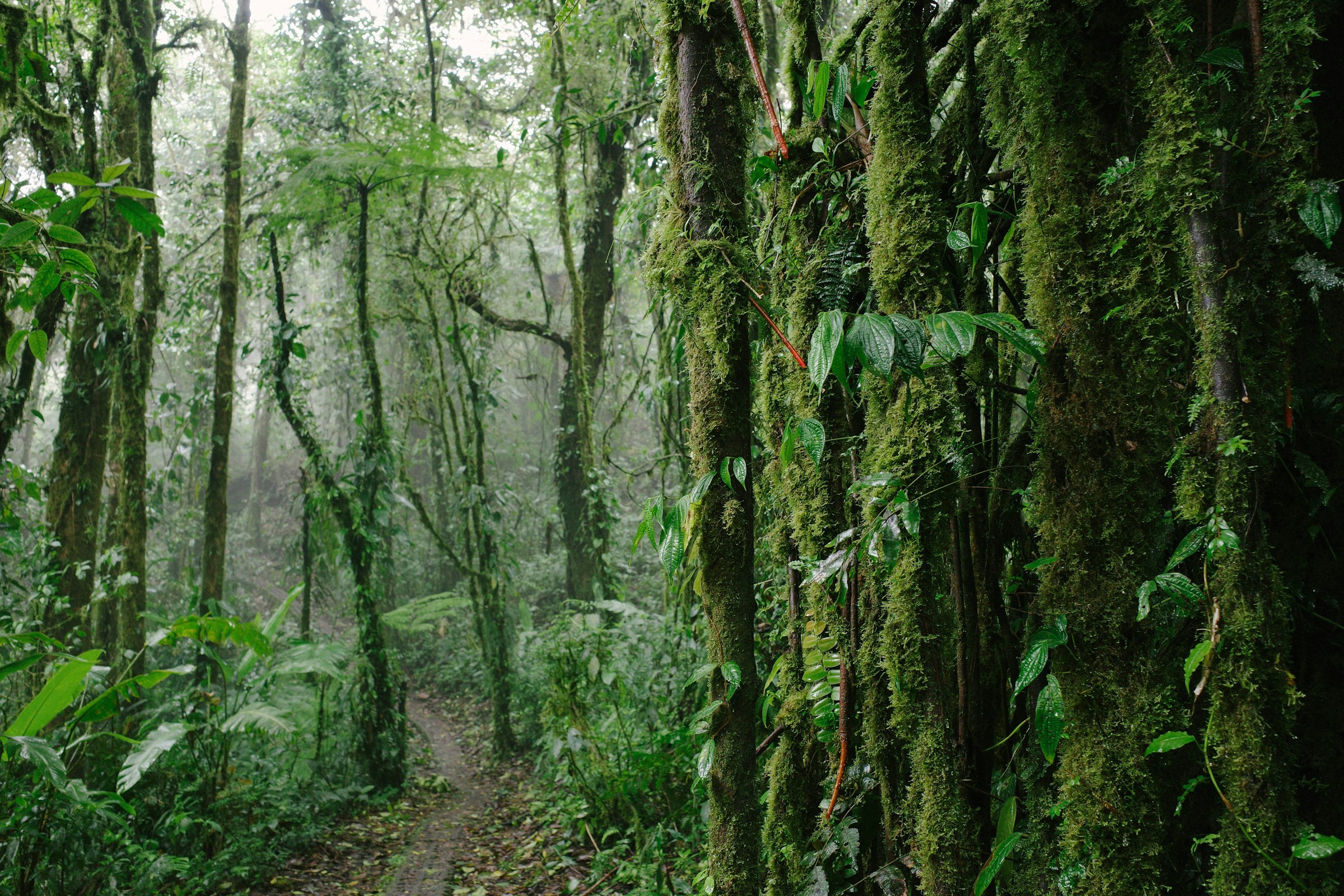
Tucked between the Pacific Ocean and the western slopes of the Andes, in the remote southern cone of South America, lies one of the planet’s rarest and least-known natural treasures: the Valdivian temperate rainforest.
Cool, misty, and ancient, it is a rainforest without the tropics – a green relic of a lost supercontinent, surviving at the edge of the map in Chile and a sliver of Argentina.
What and Where Are the Valdivian Forests?
The Valdivian temperate forests (ecoregion NT0404) form a narrow ribbon of land stretching roughly from 36° to 47° south latitude, covering most of south-central Chile and spilling over the Andes into a small portion of Argentina.
In total, the ecoregion spans roughly 248,000 square kilometers – about 12.7 million hectares – hemmed in by the Pacific to the west, the Andes to the east, the Atacama-influenced Mediterranean scrublands to the north, and the subpolar stormy Magellanic fjords to the south.
This isolation matters. Scientists often describe the Valdivian forests as a “biogeographic island”: cut off from climatically similar regions by ocean, desert, and mountains, its species have evolved in near-splendid isolation for millions of years.
The result is one of the most biologically distinctive places on Earth – a UNESCO-recognized biodiversity hotspot and one of only a handful of temperate rainforest regions in the world, the only one of its kind in South America and, together with the Magellanic forests to the south, the second-largest temperate rainforest on the planet after the Pacific rainforests of North America.
Why “Valdivian”?
The forests take their name from the city of Valdivia in southern Chile, which in turn was named after Pedro de Valdivia (1497-1553), the Spanish conquistador and first royal governor of Chile who founded the city in 1552.
The name stuck to the entire forest ecoregion that surrounds the region – a fitting, if ironic, monument: a wilderness far older than any European name, labeled after a man who never could have imagined what it contained.
A Cool, Green Climate (and Altitude to Match)
What makes these forests unusual among the world’s rainforests is their temperate character. Sitting near 40° south, the region lies squarely in the path of the westerlies – moist Pacific winds that dump their cargo against the Coast Range and the Andes.
Precipitation ranges from about 1,000 mm per year at the northern edge of the ecoregion to more than 6,000 mm in the far south, some of the wettest temperate terrain on Earth.
Temperatures are remarkably uniform, moderated by the ocean: coastal summers hover around 16 °C (62 °F), while winters rarely fall below 7 °C (45 °F). Rainfall is concentrated in winter in the north, becoming more evenly spread year-round toward the south.
The famous camanchaca – coastal fog nourished by the cold Humboldt Current – adds moisture in the form of mist, allowing cloud-forest enclaves to survive even in otherwise semi-arid northern Chile, such as the relict forest of Bosque de Fray Jorge National Park.
Elevation plays its part, too. The treeline sits at roughly 2,400 meters in the northern part of the ecoregion and descends to about 1,000 meters in the south, while the four main forest types of the region – deciduous southern beech forests, Valdivian laurel-leaved forests, Patagonian Andean forests, and Northern Patagonian forests – sort themselves by altitude, latitude, and rainfall.
A Living Relic of Gondwana
Here is the most extraordinary thing about the Valdivian forests: they are a museum of the ancient supercontinent Gondwana.
When Gondwana began to break apart some 180 million years ago, Antarctica, South America, Australia, and New Zealand shared a common flora – the so-called Antarctic flora.
As the continents drifted apart, that flora survived in fragments, and the Valdivian forests are its most magnificent surviving refuge in South America.
Walk through them today and you will find southern beeches (Nothofagus), podocarps, tree ferns, and monkey puzzle trees (Araucaria araucana) whose closest relatives grow not nearby, but in New Zealand, Tasmania, and southeastern Australia.
Biogeographically, this forest has more in common with forests on the other side of the Pacific than with the Amazon.
During the Pleistocene ice ages, the region escaped total glaciation – the coastal range provided refuge – allowing lineages to persist that vanished elsewhere.
The most celebrated living fossil is the monito del monte (Dromiciops gliroides), a tiny arboreal marsupial so ancient and distinct that it constitutes not just its own family but the sole surviving member of an entire order of mammals, Microbiotheria – the only place on Earth where an endemic mammalian order survives in a single species.
Other endemics and icons of the forest include the alerce (Fitzroya cupressoides), a towering cypress-relative that grows 60-70 meters tall and is among the longest-lived trees on Earth – some individuals exceed 3,600 years, older than the Roman Empire. Also known as alerce, it is a National Monument of Chile.
The forest also shelters the world’s smallest deer, the southern pudú; the smallest wild cat in the Americas, the kodkod; the Chilean climbing mouse; and the chinchilla.
Chile’s national flower, the red trumpet-shaped copihue (Lapageria rosea), blooms in its understory, alongside dense bamboo (Chusquea), towering ferns, and the gigantic “Chilean rhubarb” nalca.
The scale of endemism is breathtaking: fully half of the ecoregion’s woody plant species exist nowhere else on Earth; some estimates put endemism among seed plants as high as 90 percent, and around 45 percent among vertebrates.
Threats and Conservation
Such rarity comes with fragility. Since the mid-19th century, extensive logging – first of alerce, later of fast-growing exotic pine and eucalyptus plantations established for pulp – agriculture, road-building, and replacement of native forest have reduced the original forest cover dramatically; only roughly 40 percent remains in good condition. Climate change adds pressure on moisture-dependent species in this narrow, isolated ecosystem.
Yet the story is not all grim. The Valdivian ecoregion contains some of Latin America’s pioneering national parks – Vicente Pérez Rosales (Chile’s oldest), Conguillío, Villarrica, and, across the border, Argentina’s Los Alerces National Park, a UNESCO World Heritage Site since 2017.
Private conservation has also transformed the region: the late Doug Tompkins, founder of The North Face, and his wife Kristine acquired vast tracts of Valdivian forest that became the backbone of a network of new Chilean national parks. Ecotourism is now a significant and growing part of the regional economy.
Why It Matters
The Valdivian forests matter because they are irreplaceable in the most literal sense: a distinct lineage of life that survived continental drift, ice ages, and epochs, now compressed into one narrow strip of land at the bottom of the world.
To lose them would be to erase the last South American chapter of a 180-million-year-old story. To visit them – mist on ancient trunks, ferns glowing green under a gray sky, a pudú frozen on the trail – is to walk through deep time.
Sources and Further Reading
- World Wildlife Fund / One Earth – Valdivian Temperate Forests ecoregion profile (ecoregion NT0404): oneearth.org
- CEPF (Critical Ecosystem Partnership Fund) – Chilean Winter Rainfall-Valdivian Forests biodiversity hotspot: cepf.net
- Wikipedia – Valdivian temperate forests (climate, flora, and forest types overview): wikipedia.org
- EBSCO Research Starters – Valdivian temperate forests (endemism and conservation synthesis): ebsco.com
- WorldAtlas – The Biodiversity Hotspot of the Valdivian Temperate Rainforest: worldatlas.com
- LatinAmerican Post – Valdivian forest: a biogeographic island that was saved from the glaciations: latinamericanpost.com
- UNESCO World Heritage Centre – Los Alerces National Park (Argentina): whc.unesco.org


