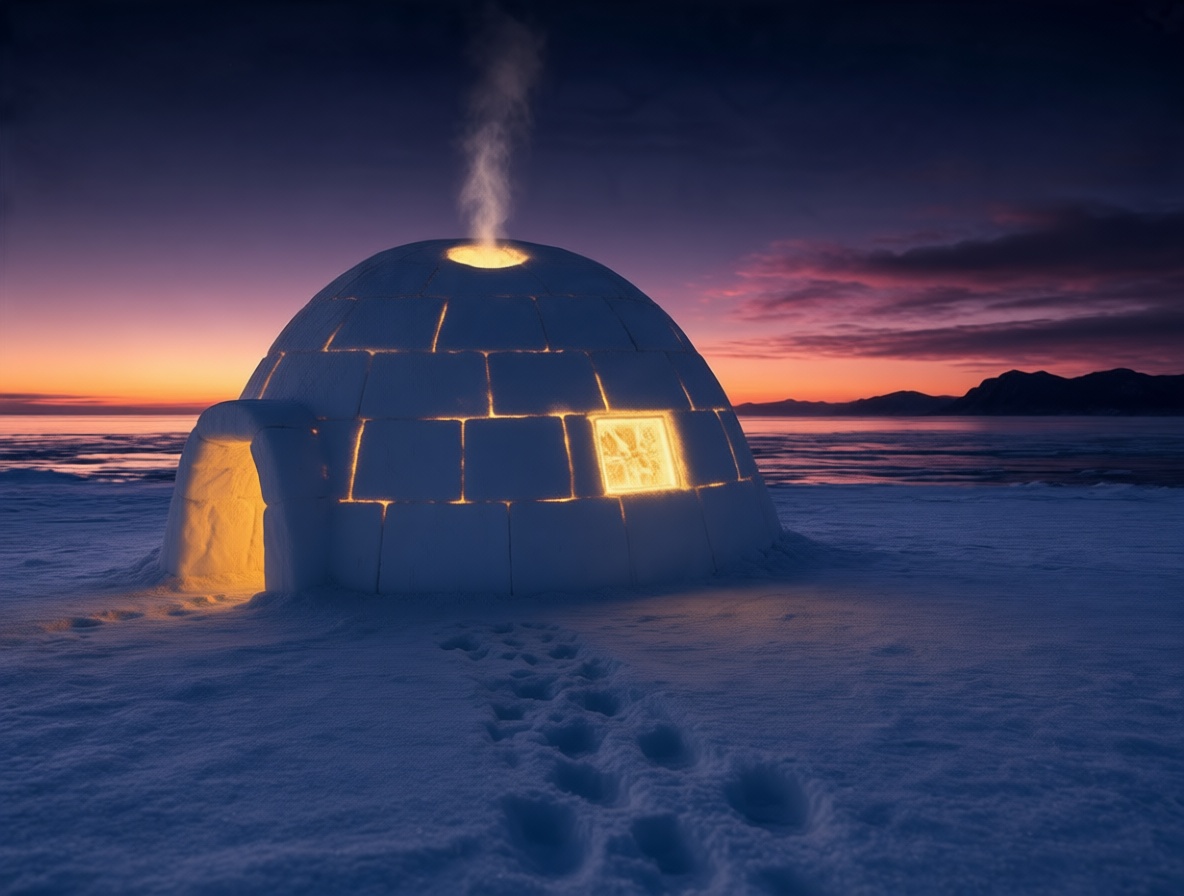
When the temperature outside drops to minus 45 °C (minus 49 °F), a dome of packed snow can be a place where people sleep, cook and raise children. Behind the postcard image is one of the cleverest pieces of architecture in the world, and a story more complicated than most people think.
Picture a night on the sea ice of the Canadian Arctic. The wind is howling, the thermometer reads minus 45 °C (minus 49 °F), and the nearest tree is hundreds of kilometers away. A family crawls through a low tunnel into a dome of snow blocks, and a stone lamp is lit. Inside, the temperature can climb from minus 7 °C (19 °F) to as much as 16 °C (61 °F), warmed by body heat alone. It is called an igloo, and it is perhaps the most famous house in the world. It is also one of the most misunderstood.
Not Every Inuit Lived in One
The usual story goes like this: there is no wood or stone in the Arctic, so the Inuit built houses of snow. The reality is more nuanced.
Early Inuit, known to archaeologists as the Thule, built sturdy winter houses partly dug into the ground, using stone, earth, moss and the bones of whales, with driftwood and sod when they could find it. In summer, they lived in tents sewn from skins.
Snow houses were used too, but they were mostly a shelter for hunting and traveling, and in winter and early spring many Thule and Historic Inuit did live in them. Although igloos are often associated with all Inuit, they were traditionally built only by the people of Canada’s Central Arctic and the Qaanaaq area of Greenland.
Other Inuit tended to use snow to insulate houses made of whalebone and hides. In Alaska, for example, sod houses were the norm.
The word itself has a wider meaning. In Inuktitut, iglu means a house or home of any material, including tents, sod houses and modern buildings. A snow house has its own word in some dialects: igluvijaq.
As for where the idea came from, nobody knows for sure. Archaeologists have found snow knives at sites of the Dorset culture, the people who preceded the Thule, which suggests they may have built with snow before about 1000 CE. Snow houses leave little trace, so the record is thin.
How You Build One
An igloo is built from blocks of wind-packed snow, not fresh powder. The best snow has been blown by the wind, which compacts it and interlocks the ice crystals.
Snow that has settled gently in still weather is no use. The builders cut rectangular blocks with a snow knife, traditionally made of bone or horn and later of metal, and the trench left where the blocks were cut often serves as the lower half of the shelter.
The blocks are stacked in an ascending spiral, each leaning on the one below, and the dome rises without any frame. The shape is not a perfect hemisphere but a catenary, a curve closer to a paraboloid, in which the forces are mostly compressive.
That makes the structure less likely to buckle as the snow ages and settles. Builders fill the gaps with loose snow and leave a hole at the entrance and at the top so heat and air can escape.
Sometimes a block of clear freshwater ice is set into the wall as a window.
Traditionally, there were three kinds. The smallest were temporary shelters, used for a night or two on hunting trips.
Medium-sized igloos were semi-permanent homes for one or two families, often clustered into villages. The largest were built in pairs and could have up to five rooms, housing 20 people for feasts and dances.
One of the largest ever built in Canada was made in 2005 at the Puvirnituq Snow Festival: five meters (16 feet) tall and almost 40 meters (130 feet) around, it took about a week to build and held more than 400 people.
Stronger Than It Looks
A properly built igloo can support the weight of a person standing on its roof. And the structure gets stronger after it is built.
Traditionally, a builder could deliberately consolidate the dome by lighting a large flame in the qulliq, a stone oil lamp, briefly heating the interior so the walls melted slightly and then settled.
Body heat can do the same, though more slowly. The melting and refreezing builds up a layer of ice that adds to the igloo’s strength.
Warm, or Just Less Cold?
Snow is an excellent insulator because the air pockets trapped in it slow the escape of heat. Walls of hard snow hold in both body heat and the warmth of the qulliq.
The result is relative, not tropical. According to the Canadian Encyclopedia, temperatures inside igloos are often just above freezing, though they can reach about 15 °C (59 °F), depending on how many people are inside and whether there is a lamp.
The design does the rest. Because warm air rises and cold air settles, the entrance tunnel sits lower than the living area and acts as a cold trap, while the sleeping platform is raised to catch the heat.
Inuit living around the Davis Strait lined the interior with skins, which could raise the temperature from about 2 °C (36 °F) to between 10 and 20 °C (50-68 °F).
And people dressed for it: traditionally, they kept their fur-lined clothes on during the day, and at night slept on or wrapped in heavy furs.
What About Polar Bears?
It is a popular belief that an igloo can protect a family from the Arctic’s largest predator. What can be said is this: polar bears hunt mainly by smell, and can detect seal breathing holes covered by 90 centimeters (3 feet) or more of ice and snow, from up to a kilometer (0.6 miles) away. A wall of snow does not hide a family from a bear’s nose.
Polar bears are also persistent around human buildings. A hungry bear, for instance, may try to break into a house attracted by seal oil, an Iñupiaq hunter told researchers, and in 1992, a bear broke down the door of a house in Point Lay, Alaska, as a village reverend and his wife kept it at bay for nearly half an hour.
Malnourished bears are the ones most likely to attack campsites and settlements. For the Inuit, protection came from vigilance, dogs and weapons, not from the snow.
A Fading Craft
Not long ago, igloos were still home to many families. Well into the 1950s, Canada’s Inuit followed ancient ways, living off the land, and temperatures around a sleeping platform could be well above freezing even when it was 30 below (minus 34 °F) outside.
Today, most live in modern houses, and building an igloo is a skill some elders worry is being lost. It survives in hunting trips, snow festivals, emergency shelters and cultural education.
Sleeping in One Today
You can, in fact, sleep in an igloo, though not usually an Inuit one. A whole industry of igloo and ice hotels has grown up, and they are not all the same.
In most cases, prices start between £120 and £380 per person per night, reaching £500 or more for luxury suites. Guests are typically given a sleeping bag and an insulated sheet, and many resorts offer a conventional warm room as a backup.
What the Igloo Teaches
The igloo is a lesson in using what is available. It needs no wood, no stone and no imported material: only snow, a knife, and an understanding of how heat moves. It was never the home of every Inuit, nor the safe haven of legend. But as a piece of design, built in hours and gone in spring, it remains one of the most elegant answers ever found to the question of how to live in the cold.
Sources:
- René R. Gadacz, “Igloo,” The Canadian Encyclopedia: thecanadianencyclopedia.ca/en/article/igloo
- The Canadian Encyclopedia, “Early Inuit (Thule Culture)”: thecanadianencyclopedia.ca/en/article/thule-culture
- The Canadian Encyclopedia, “Early Inuit (Thule) Winter House”: thecanadianencyclopedia.ca/en/article/thule-winter-house
- The Canadian Encyclopedia, “Architectural History of Indigenous Peoples in Canada”:thecanadianencyclopedia.ca/en/article/architectural-history-early-first-nations
- Richard L. Handy, “The Igloo and the Natural Bridge as Ultimate Structures,” Arctic 26(4), 1973: journalhosting.ucalgary.ca/index.php/arctic/article/view/65978
- Craig S. Smith, “A Lost Art in the Arctic: Igloo Making,” The New York Times (June 21, 2017), via Alaska Dispatch News: https://www.adn.com/arctic/2017/06/29/a-lost-art-in-the-arctic-igloo-making/
- Heritage Newfoundland and Labrador, “The Thule”: heritage.nf.ca/articles/indigenous/thule.php
- University of Lethbridge Digitized Collections, “The Thule” (Canadian Arctic):ulethbridge.ca/lib/digitized_collections/ourheritage/Great_Adventures/Marine_Expedtions/Northwest_Passage/Canada_Arctic/NP5_5_thule.html
- Polar Bears International, “A Native Lens on Polar Bears” (2017): polarbearsinternational.org/news/article-research/a-native-lens-on-polar-bears
- BearSmart, “Safety in Polar Bear Country”: bearsmart.com/play/safety-in-polar-bear-country/
- Outdoor Life, “Polar bear close calls”: outdoorlife.com/adventure/polar-bear-close-calls
- Natural Habitat Adventures, “Surprising polar bear facts”: nathab.com/blog/surprising-polar-bear-facts
- Lonely Planet, “Best ice hotels”: lonelyplanet.com/articles/best-ice-hotels
- The Points Guy, “Best igloo hotels”: thepointsguy.com/guide/best-igloo-hotels/
- Wikipedia, “Igloo”: en.wikipedia.org/wiki/Igloo