Lava lakes, acid pools and a crust that tore open in days. The Afar Triangle is one of the most spectacular places on Earth, one of the hardest to reach and, right now, one of the riskiest.
At the northern tip of Ethiopia’s Great Rift Valley, the ground is not so much a surface as a work in progress. Three tectonic plates are pulling apart here, and the land between them has been stretched so thin that it has sunk well below sea level.
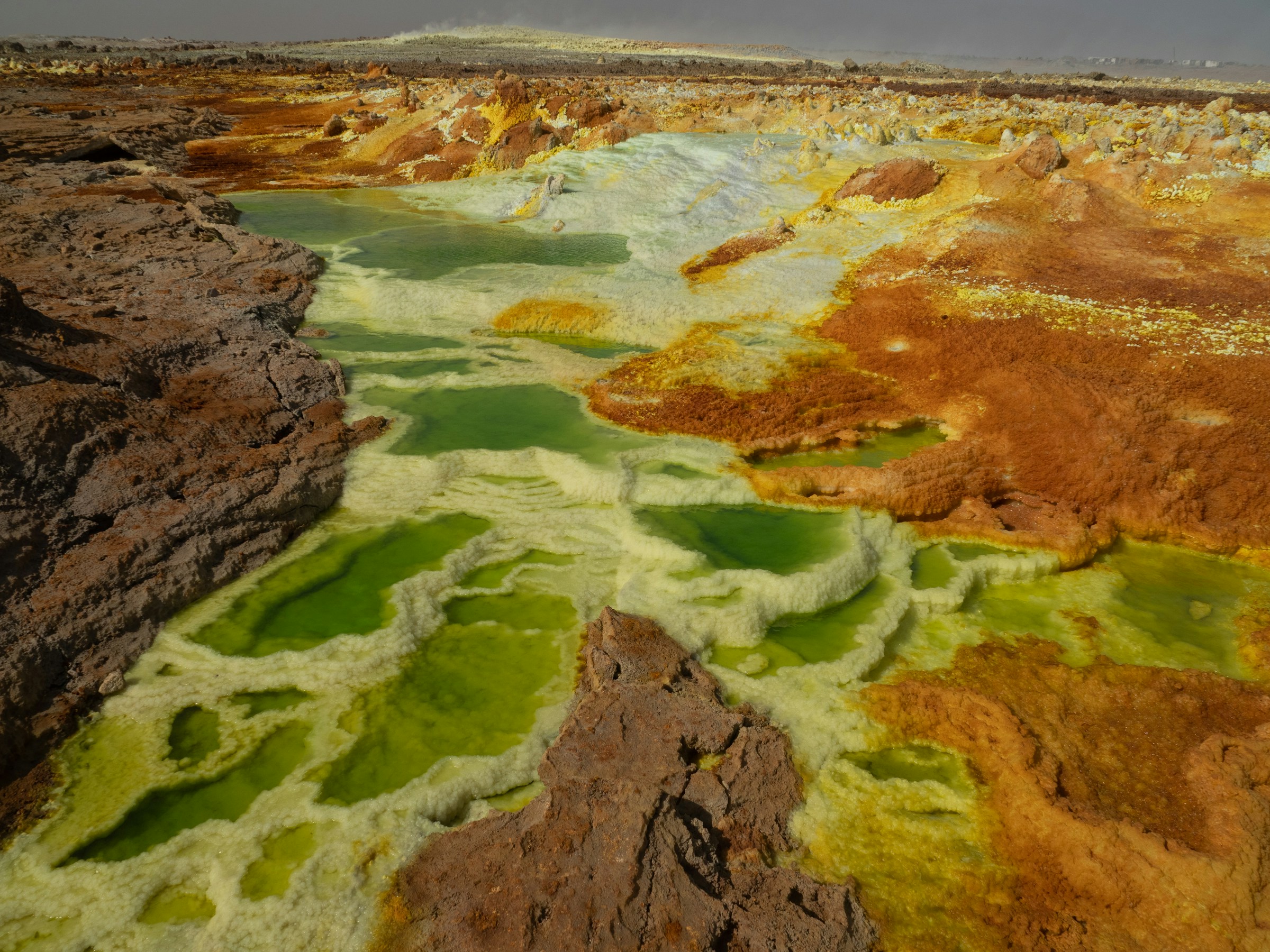
Sulfur-stained hot springs bubble in colors that look digitally enhanced, a volcano holds one of the few permanent lava lakes on the planet, and the air is so hot that the region sits on a short list of the most extreme inhabited places on Earth.
In recent years, that combination has made the Danakil Depression a magnet for photographers, adventure travelers and online content creators. It has also made it one of the most misunderstood places in Africa.
Where Three Plates Meet
The Afar Triangle, also called the Afar Depression, is the product of the Afar Triple Junction, where the rifts that form the Red Sea and the Gulf of Aden come ashore and meet the East African Rift.
The depression spans parts of Ethiopia, Eritrea and Djibouti and contains the lowest point in Africa, Lake Assal in Djibouti, at 155 meters below sea level. The Danakil Depression, its northern section, lies about 125 meters below sea level, between the Ethiopian Plateau and the Danakil Alps.
The Awash River, which flows down from the highlands, never reaches the sea, and instead dries up in a chain of salt lakes.
The spectacle is a result of the Earth being stretched. The floor of the depression is mostly basalt, and one of its volcanoes, Erta Ale, is among the few in the world with an active lava lake.
A Crack That Opened in Days
Geologists have watched the process unfold in real time. In September 2005, a series of fissures suddenly opened along a 60-kilometer section of the Afar rift near the Dabbahu volcano, accompanied by earthquakes and ash clouds that darkened the air for three days.
In a matter of days, the ground split open by up to 8 meters, while the land between the cracks sank about 2 meters. The only reported casualty was a camel that fell into a fissure.
Researchers say the 2005 event was an episode of the slow process that will eventually split the Horn of Africa from the rest of the continent.
The Arabian plate has been moving away from Africa at less than an inch a year for about 30 million years, and the Red Sea and Gulf of Aden are expected to eventually flood the depression, forming a new ocean.
It is a process that takes millions of years: most estimates put it at about 10 million years, though some scientists have argued for a shorter time.
The region is not done surprising anyone. On November 23, 2025, the Hayli Gubbi volcano in Afar erupted for the first time in nearly 12,000 years, according to the Smithsonian’s Global Volcanism Program.
Ash rose up to 14 kilometers, and drifted over Yemen, Oman, India and northern Pakistan. No casualties were reported, but ash covered nearby villages, and local officials worried about the herders’ livestock.
The Heat
The word most often attached to the Danakil is “hottest,” but the title needs some precision. Dallol, a former town in the depression, holds the record for the highest average annual temperature of any inhabited place on Earth: 34.6°C, recorded between 1960 and 1966.
In that period, the average high was 41.2°C, the hottest month averaged 46.7°C, and the highest temperature ever recorded was 49°C.
Tour operators routinely cite 50°C. It is not the place with the highest air temperature ever measured, which belongs to Death Valley, California, at 56.7°C. The Danakil’s distinction is that it is hot all the time.
A Place Where People Live
It is easy to imagine the Danakil as empty, but it is home to the Afar, a Muslim people who straddle the borderlands of Ethiopia, Eritrea and Djibouti. Most are pastoralists who herd camels, sheep, donkeys and cattle. A minority make a living from salt.
At Lake Asale, hundreds of men gather every morning and cleave the dry lakebed with hand axes to extract salt, as their fathers and grandfathers did. Camel caravans have carried the slabs to market since the sixth century.
The salt was once so valuable that it served as currency, although today each slab sells for only a few cents. The caravans now end at Berhale, a trading town connected to the regional capital by a tarmac road, from which trucks carry the salt as far as Kenya.
The new road has also brought restaurants, hotels and tourists to the area, along with foreign companies interested in mining potash.
Some miners worry the change could threaten their way of life. Others, like one named Indris Ibrahim, say the lake is their farmland, and they have nothing else.
The same rift that produces this landscape has also yielded some of the world’s oldest hominin fossils, which has prompted some paleontologists to propose that this is where the human species first evolved.
The Age of the Influencer
For visitors, the draw is visual. Dallol’s hydrothermal field is a patchwork of yellow, green and orange, and its salt formations and acid pools look more like Mars than Africa.
At Erta Ale, travelers have traditionally hiked up at night to camp near the crater rim and look down on the glowing lava.
Standard three-day tours were priced from about $400 on booking platforms, typically starting from Mekelle in the neighboring region of Tigray or Semera, the Afar capital.
It was never ordinary tourism. Independent travel is not permitted: Afar’s regional authorities require permits, licensed guides and armed escorts, and operators travel in convoys of 4×4 vehicles.
The sleeping arrangements are basic, and the heat and volcanic gases are real hazards. The fumes at the fissure opened in 2005 smell of rotten eggs, and Hayli Gubbi’s eruption released a large sulfur dioxide plume.
The Reality Behind the Frame
The more pressing risk is political. The FCDO advises against all travel to the parts of Afar within 20 kilometers of the Eritrean border and within 50 kilometers of the Tigray region, and against all but essential travel to the rest of Afar.
As of its latest update, foreign nationals are unable to travel to airports in Afar because of restrictions by Ethiopian authorities, and all civilian flights to and from Tigray have been suspended.
Canada advises its citizens to avoid all travel to Afar, citing armed conflict and the possibility of cross-border tensions with Eritrea escalating, as well as residual landmines.
The picture is not identical across governments. The U.S. State Department, which rates Ethiopia at Level 3, says not to travel within 30 kilometers of the Afar border with Eritrea, though the immediate border zone technically excludes parts of the Danakil Depression itself – even so, many tour operators have now urged customers to postpone. The FCDO also warns that travel insurance may be invalidated if you travel against its advice.
The Danakil, in other words, is a place that is easy to idealize in a social media feed and hard to visit in real life. Its beauty is real, but it rests on a landscape that is unstable in more than one sense: the crust beneath it is tearing, and the region around it is in conflict.
A World in the Making
What makes the Danakil so compelling is not only its colors. It is the sense that you are looking at something unfinished, a part of the planet caught in the act of becoming something else.
In 10 million years, the lava lakes and salt pans may lie under a new sea. In the meantime, people are cutting salt, herding camels, and living in one of the harshest environments on Earth, a reminder that a place that looks like hell on a screen can also be a home.
Sources:
- UK Foreign, Commonwealth & Development Office, “Ethiopia travel advice: Regional risks”: gov.uk/foreign-travel-advice/ethiopia/regional-risks
- U.S. Department of State, “Ethiopia Travel Advisory” (Aug. 27, 2026): travel.state.gov/en/international-travel/travel-advisories/ethiopia.html
- Government of Canada, “Ethiopia travel advice”: travel.gc.ca/destinations/Ethiopia
- Wikipedia, “Danakil Depression”: en.wikipedia.org/wiki/Danakil_Depression
- Wikipedia, “Afar Triangle”: en.wikipedia.org/wiki/Afar_Triangle
- Wikipedia, “Erta Ale”: en.wikipedia.org/wiki/Erta_Ale
- COMET / NERC, https://comet.nerc.ac.uk/about/our-projects/riftvolc/
- NBC News, “Giant crack in Africa may create a new ocean” (2009): nbcnews.com/id/33605604
- Phys.org, “Birth of a new ocean”: phys.org/news144671445.html
- CORDIS, “Envisat data reveals birth of ocean”: cordis.europa.eu/article/id/26053-envisat-data-reveals-birth-of-ocean
- Africanews / AP, “Volcano in northern Ethiopia erupts for the first time in 12,000 years” (Nov. 24, 2025): africanews.com/2025/11/24/volcano-in-northern-ethiopia-erupts-for-the-first-time-in-12000-years/
- Al Jazeera, “Ethiopian volcano erupts after lying dormant for 12,000 years” (Nov. 24, 2025): aljazeera.com/news/2025/11/24/ethiopian-volcano-erupts-after-lying-dormant-for-12000-years
- Agence France-Presse via Arab News, “Modern life intrudes on Ethiopia’s ancient salt trade” (Apr. 2017): arabnews.com/node/1085506
- Al Jazeera, “Endangered camel caravans of the Ethiopian salt mines” (Jan. 2016): aljazeera.com/gallery/2016/1/13/endangered-camel-caravans-of-the-ethiopian-salt-mines
- Kuwait Times / AFP, “Modern life intrudes on Ethiopia’s ancient salt trade”: kuwaittimes.com/modern-life-intrudes-ethiopias-ancient-salt-trade/
- Ovago, “Danakil Depression Ethiopia: Travel Guide 2026” (permits and armed escorts): ovago.com/en-us/blog/journey-ideas/danakil-depression-ethiopia-travel-guide/
- Tripadvisor, “Danakil Depression” (tour listings and prices): tripadvisor.com/Attraction_Review-g2193229-d2389833-Reviews-or130-Danakil_Depression-Afar_Region.html
- European Space Agency, “Earth from Space: The Danakil Depression”: esa.int/media/earth-from-space-the-danakil-depression-en-378326
- Geotourism (AGH University), on the geomorphology and tourism of the Danakil;