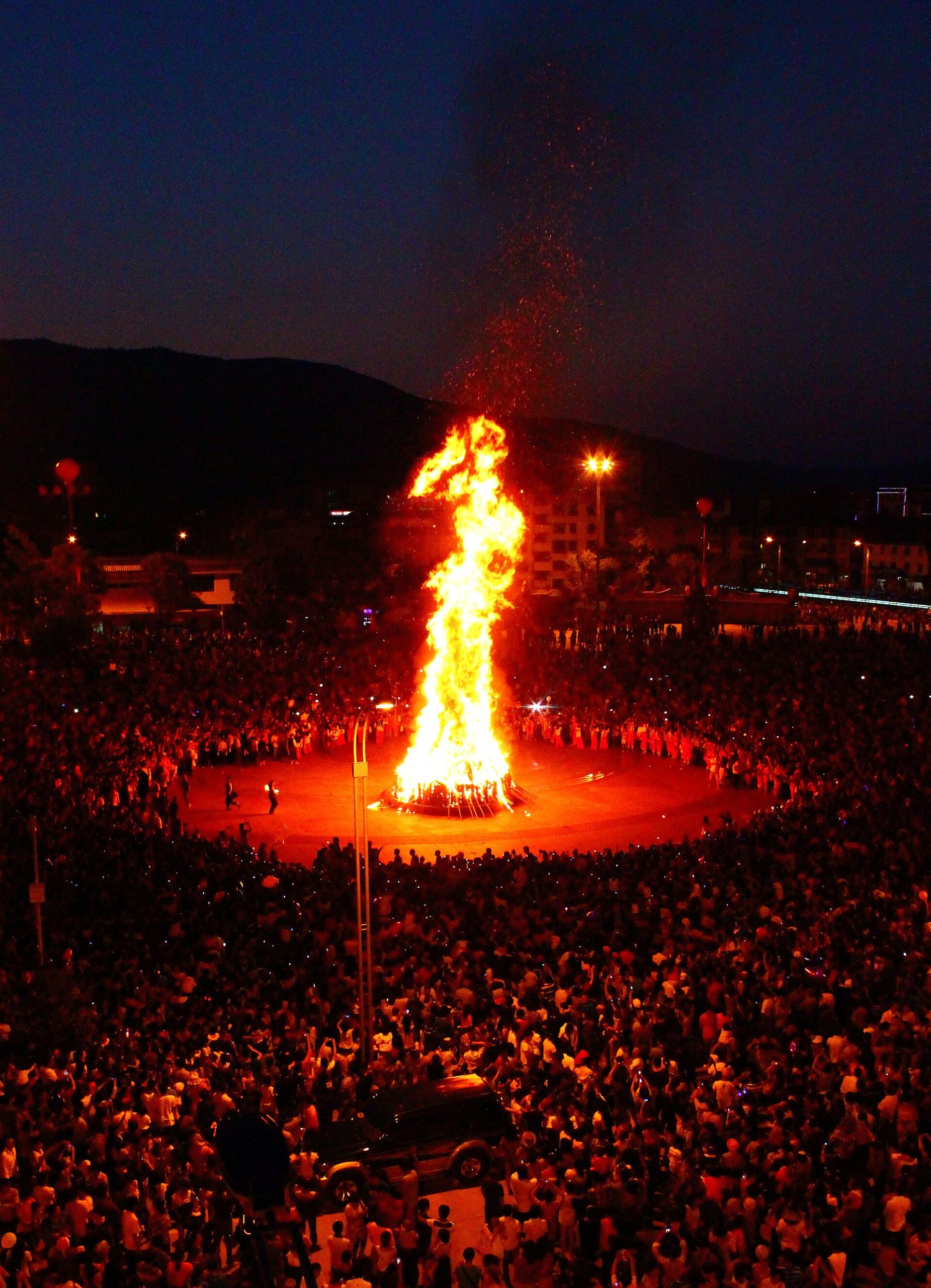
Thousands of pine torches lighting up a mountain night, drums echoing across the valley, and an entire region turning itself over to days of fire, wrestling, and song. This is how southwest China’s ethnic minorities celebrate the height of summer.
2,000+ yrs: documented history of the festival
9 million: Yi people in southwest China
Aug 17-24: 2026 public holiday window, Liangshan
700,000+: attendees at a single prefecture’s celebration
Picture a mountain valley at dusk, the kind of light that turns everything gold for ten minutes before the dark takes over. Then, all at once, it doesn’t get dark at all.
Thousands of pine torches flare to life across the hillsides, passed hand to hand from a single central bonfire until an entire town is glowing. Drums start. The scent of burning pine resin drifts across the crowd.
Somewhere, a horse race is about to begin, and somewhere else, two young men are squaring up for a wrestling match that’s been a part of this night for over two thousand years.
This is the Torch Festival – sometimes called the “Oriental Carnival,” a fair comparison to Rio or the Oscars in terms of scale and significance, except that this celebration belongs almost entirely to the ethnic minorities of southwest China.
For outsiders, it remains one of the country’s least-known major festivals. For the millions who celebrate it, it’s one of the most important nights of the year.
Where to Find It, and When
The Torch Festival is centered on two regions: the Liangshan Yi Autonomous Prefecture in Sichuan Province, and the area around Lijiang, Dali, and Chuxiong in Yunnan Province.
Liangshan is the heartland – home to roughly two million Yi people, the largest concentration of the ethnic group anywhere in China, out of a national Yi population of around nine million.
Xichang, the prefecture’s capital, becomes the unofficial epicenter of the entire celebration, its streets and lakeshores lit by fireworks and torchlight for several nights running.
The date follows the Yi lunar calendar rather than the standard Gregorian one, falling on the 24th or 25th day of the sixth lunar month – which typically places it in late July or August.
In 2026, the official public holiday in Liangshan Prefecture runs from August 17 through August 24, corresponding to the 24th day of the sixth lunar month.
For travelers planning ahead, this makes the festival a genuine late-summer event – peak heat, peak crowds, and peak fire, all at once.
As with most lunar-calendar festivals, it’s worth double-checking the exact dates closer to your travel window, since regional governments sometimes adjust the public holiday schedule.
A Legend Over Two Thousand Years Old
The festival’s roots reach back more than two millennia, with some scholars tracing its earliest forms to the ancient Kingdom of Nanzhao and practices recorded as far back as the Tang dynasty.
But its enduring popularity owes the most to a single Yi legend – the story of Atilaba. According to the most widely told version, a heavenly strongman named Sireabi challenged the earthly wrestler Atilaba to a match.
Atilaba defeated him twice. Humiliated, Sireabi was killed in their final bout, and the heavenly spirits, enraged at his death, sent a devastating plague of locusts down to earth to destroy the crops and punish humanity.
On the 24th day of the sixth lunar month, Atilaba felled great stands of pine trees, fashioned them into torches, and used the fire to drive back the locust swarm, saving the harvest and the people who depended on it. Ever since, the Yi have lit torches on that same night, in his honor.
More Than One Origin Story
The Yi aren’t the only ones who claim the festival. Among the Naxi people of Lijiang, the legend instead involves a wrestling match between humans and the God of Heaven himself – a human victory celebrated by lighting the earth with torches in gratitude.
The Bai people of Dali tell a third version, where fire wards off plagues and evil spirits that surface during peak summer heat.
Three ethnic groups, three different stories, the same instinct: when the crops and the community are at risk, you answer with fire.
Fire, across all these traditions, carries the same core symbolism – purification, protection of the harvest, victory over malevolent forces, and a collective wish for prosperity in the year ahead. It’s a near-universal human impulse, dressed here in a specifically Yi, Naxi, and Bai set of stories.
Three Days, Three Very Different Moods
DAY ONE
Blessing the home
The festival opens quietly, with families lighting individual torches and carrying them around their houses, fields, and livestock pens.
The act is meant to cleanse each space of lingering misfortune and bless the year’s harvest before the larger celebration begins.
In some Yi communities, this ritual is led by a bimo – a traditional priest – who performs the torch-lighting ceremony at dawn.
DAY TWO
The ethnic carnival
This is the day of competition. Open fields become arenas for bullfighting, goat wrestling, horse racing, and traditional Yi wrestling, called “Tuolu” in the Yi language – a sport directly tied to the Atilaba legend, with young men competing for the title in front of cheering crowds.
Just as central is the Yi beauty contest: young men and women are judged not just on traditional dress, but on dancing, singing, and a set of values tied to the legendary figures Atilaba and Ashimo – strength and integrity for men, kindness and grace for women.
The contest has earned the celebration an affectionate nickname in some circles: the “Oriental Valentine’s Day,” for the courting and flirtation that often follows under the cover of darkness.
DAY THREE
The bonfire climax
The festival’s signature moment. As night falls, massive communal bonfires are lit in town squares and open meadows, and entire communities gather around them – dancing in wide circles, leaping over the flames for luck and good health, and performing traditional hand and arm dances, sometimes called Eagle Dances, that mimic the movements of birds in flight.
Songs pass from voice to voice late into the night, accompanied by traditional instruments like the yueqin and sanxian. Roasted meats, rice wine, and local delicacies circulate freely among neighbors and visitors alike – for one night, social distinctions soften, and the entire community shares the fire equally.
A Living Tradition, Recognized Nationally
In 2006, the Torch Festival was formally inscribed on China’s first National List of Intangible Cultural Heritage, and the Liangshan Yi Torch Festival in particular has been named one of China’s Top Ten Folk Festivals.
Since 1993, the Liangshan prefectural government has supported a more organized, modern staging of the celebration, formalizing the wrestling matches, horse races, and beauty contest into a structured public event – without losing the older, more intimate household rituals that still open each celebration.
The festival has even traveled beyond China’s borders. In August 2008, the Overseas Chinese Ethnic Minorities Federation of America staged a three-day Torch Festival in Los Angeles, complete with its own fire-worship, fire-transmission, and fire-sending ceremonies – a small but telling sign of how far this tradition now reaches.
Why It’s Worth the Trip
In a country whose festival calendar is dominated, in most outsiders’ minds, by Lunar New Year and the Mid-Autumn Festival, the Torch Festival remains a striking exception – loud, communal, and rooted in a culture most visitors to China never encounter directly.
It is one of the clearest windows available into how the Yi, Naxi, and Bai peoples have kept their identity vivid and self-renewing inside a rapidly modernizing country, not as a museum piece but as something still genuinely lived, every single summer.
For travelers willing to time a trip around the lunar calendar, the reward is substantial: a night when fire takes over an entire valley, drums carry for kilometers, and a two-thousand-year-old legend about a wrestler, a plague of locusts, and a stand of burning pine trees becomes, for a few hours, something you can stand inside.
References:
- Wikipedia – “Yi people” (population figures, regional distribution). en.wikipedia.org
- Wikipedia – “Torch Festival” (date, Liangshan government sponsorship since 1993). en.wikipedia.org
- China Educational Tours – “China Public Holiday Calendar 2026” (official 2026 Torch Festival dates, Aug 17-24). chinaeducationaltours.com
- China Vistas – “Liangshan & Lijiang: Dancing Flames and Ethnic Legends of the Torch Festival” (Naxi and Bai origin myths). chinavistas.com
- Baidu Baike – “Torch Festival” (Atilaba/Ashimo beauty contest, “Oriental Valentine’s Day”). baike.baidu.com
- Baidu Baike – “Torch Festival” (2006 National Intangible Cultural Heritage listing; 2008 Los Angeles diaspora celebration). baike.baidu.com


