Count Dracula was invented by an Irish novelist in the 1890s. The man behind the name was real, he ruled a small principality in the 15th century, and the evidence he left behind is as disturbing as any novel.
In June 1462, one of the most powerful armies in the world marched toward a small Wallachian capital called Târgoviște and found it nearly empty. The Ottoman sultan, Mehmed II, had conquered Constantinople nine years earlier.
According to the accounts that survive, the approach to the town was lined with impaled bodies, thousands of them, left to rot in the summer heat. The man who had arranged the display was the prince of Wallachia, Vlad III, whom his enemies called Dracula and history calls Vlad the Impaler.
Almost everything about that scene has been disputed since, from the number of corpses to whether the sultan really turned back sickened.
What is not disputed is that a man named Vlad lived, ruled and killed on an enormous scale, that the stories about him were already spreading across Europe within a generation, and that a Victorian novelist later borrowed his name for a vampire. The truth about the castle, the grave and the monster turns out to be stranger than the myth.
A Boy From the Borderlands
Vlad was born around 1431, most likely in the fortified town of Sighișoara, in Transylvania, then part of the Kingdom of Hungary. The traditional birthplace is not conclusively proven, but the town’s medieval citadel has claimed him ever since.
His father, Vlad II, was a Wallachian nobleman living in exile, and that same year, according to historians, he was inducted into the Order of the Dragon, a chivalric order founded by Sigismund, king of Hungary and later Holy Roman Emperor, to defend Christian Europe against the Ottomans.
The order gave Vlad II a nickname, Dracul, “the Dragon,” and his son inherited it as Drăculea, “son of the Dragon,” which became Dracula. In modern Romanian, drac also means devil, a coincidence that would later prove irresistible to writers.
Vlad’s youth was a lesson in how little a prince’s life was worth. He and his younger brother Radu were held at the Ottoman court as guarantees of their father’s loyalty. In 1447, Wallachian boyars, the country’s landed nobles, murdered his father and his elder brother Mircea.
Vlad seized power for the first time in 1448, lost it within weeks, and returned for his main reign, from 1456 to 1462, with Hungarian backing and a grudge against the nobility.
The Impaler
Impalement, driving a stake through a living person, was his signature punishment, and it gave him the name by which he is known: Vlad Țepeș, “the Impaler.”
The nickname appears to have come after his death. Accounts from the period describe him purging the boyars he blamed for his family’s deaths and raiding Saxon towns in Transylvania.
His war with the Ottomans is better documented, and some of it survives in his own words. In February 1462, Vlad wrote to the Hungarian king, Matthias Corvinus, boasting of a winter campaign south of the Danube.
He reported having killed “23,884 Turks and Bulgarians,” and that figure did not include those burned in their homes. Historians point out that many of the victims were Bulgarian peasants rather than soldiers, and Vlad himself admitted as much.
Four months later, with the sultan’s army at his doorstep, he launched a raid on the Ottoman camp near Târgoviște on the night of June 16 to 17, 1462, an attempt to assassinate Mehmed II.
It failed, but it became the most celebrated episode of his reign. Later accounts claim the sultan then retreated after seeing the impaled bodies outside the city.
Some retellings claim 20,000 corpses; scholars treat such round numbers with skepticism, since many of the sources are hostile or secondhand.
The campaign was a military loss. Vlad’s own brother Radu, raised at the Ottoman court, was installed on the throne, and Vlad fled to Poenari, then to Hungary, where Corvinus imprisoned him. He would spend roughly a dozen years in captivity, much of it at Visegrád.
The First Bestseller About a Monster
While Vlad sat in a Hungarian prison, a reputation was being manufactured about him. Beginning in the 1480s, German-language pamphlets printed in Nuremberg, Bamberg, Augsburg and Strasbourg described a prince who feasted among the dying, boiled victims alive and impaled mothers with their children.
They are often described as among the first bestsellers in German-speaking Europe. A famous woodcut shows him at a banquet table, surrounded by stakes.
Historians stress that these stories came from his political enemies, including the Transylvanian Saxons and, some argue, the court of Corvinus, which had a reason to justify why it had imprisoned a Christian ally. The pamphlets are real evidence of what Europeans believed about Vlad. They are weaker evidence of what he did.
The Man Who Died Twice
Vlad regained his throne in the autumn of 1476 with Hungarian support. Within weeks he was dead. Britannica says he was ambushed by an Ottoman patrol and killed north of Bucharest, but the sources disagree.
Some say he was assassinated by disloyal boyars, another account that his own troops mistook him for a Turk. The exact date is unknown, though he was dead by January 1477. According to some accounts, his head was sent to Constantinople.
His burial place has been argued about for centuries. Tradition holds that he lies at Snagov Monastery, on an island in a lake north of Bucharest.
When archaeologist Dinu V. Rosetti dug beneath the tombstone in the early 1930s, he reportedly found no burial, only animal bones.
A rival theory points to Comana Monastery, which Vlad founded in 1461, where excavators in the 1970s found an unidentified headless skeleton. Neither has been proven, and the plain answer to where Vlad the Impaler is buried is that nobody knows.
Two Draculas
By the 17th century the Vlad of the German pamphlets had a rival. In Romanian oral tradition, and in a Slavic-language manuscript known as the Tale of Prince Dracula, attributed to an envoy named Fyodor Kuritsyn, Vlad was a harsh but just ruler who stamped out theft and corruption.
The best-known legend tells of a golden cup left at a public fountain in Târgoviște that no one dared steal. Historians regard the story as likely embellished, but it explains why many Romanians still regard him as a national hero, a defender against the Ottomans, rather than a monster.
At Poenari, local folklore preserved darker tales. Romanian chronicles claim that Vlad forced captured boyars and their families to rebuild the fortress.
Another legend says his wife flung herself from a tower into the river below during the Ottoman siege of 1462, rather than be taken, giving the stream its name, Râul Doamnei, “the Lady’s River.” Skeptics note that the geography does not quite work, and the story appears in several versions.
Where Vampires Really Came From
Meanwhile, in Transylvanian villages, a completely different set of stories about the dead was being told, and none of them concerned Vlad.
Romanian folklore describes the strigoi, a restless dead person who returns to torment relatives and neighbors, and the moroi, a closely related spirit. Folklorists distinguish living strigoi, who are witches, from dead ones, who are corpses that rise from their graves.
The remedies were physical and sometimes horrifying: garlic and incense at doors and windows, and, if a grave was suspected, exhumation, followed by a stake through the heart, beheading, or burning the heart.
Some traditions called for mixing the ashes with water and giving them to the sick. The practices are not entirely a thing of the past.
In 2004, villagers in Marotinu de Sus, in southern Romania, dug up a recently buried man, burned his heart and drank the ashes in water, according to international press reports at the time, and police charged six people.
How a Prince Became a Vampire
None of that touches Vlad until 1890. That summer, an Irish theater manager named Bram Stoker was on vacation in Whitby, a port on England’s northeast coast, where he borrowed a rarely read book from the local library: William Wilkinson’s An Account of the Principalities of Wallachia and Moldavia (1820).
In it, a footnote states that “Dracula” in the Wallachian language means “devil.” Stoker copied the line into his notes, capitalizing the word, crossed out “Count Wampyr” everywhere it appeared in his working papers, and wrote Dracula instead.
That footnote appears to be Stoker’s only documented source on the historical figure. His surviving notes, discovered at the Rosenbach Museum and Library in Philadelphia, show no sign that he knew about the impalements, the nickname or Vlad’s full name.
Dracula scholar Elizabeth Miller and others note that nothing in them shows he knew of Vlad’s cruelty, and that the idea of Vlad as the “real Dracula” was popularized chiefly by the 1972 book In Search of Dracula by Radu Florescu and Raymond McNally.
Stoker drew on folklore for the rest. Much of what he knew about Transylvanian beliefs came from the 1885 essay “Transylvanian Superstitions” by Emily Gerard, which described the nosferatu, Romanian vampires, living and dead. He never visited Romania. The novel was published in London on May 26, 1897.
The Castle on the Postcards
The result is a landscape in which the most famous Dracula site has almost nothing to do with him. Bran Castle, perched on a rock above a mountain pass near Brașov, is sold around the world as Dracula’s Castle.
It was authorized by King Louis I of Hungary in 1377, for the Saxons of Brașov, as a defense against Ottoman expansion. In 1920, the city handed it over to Queen Marie of Romania, who restored it as a summer residence, and it opened as a museum in 1956.
Britannica notes that Vlad never ruled there, though some sources claim he was held prisoner for two months, a story modern historians have largely debunked. There is no evidence Stoker even knew the castle existed.
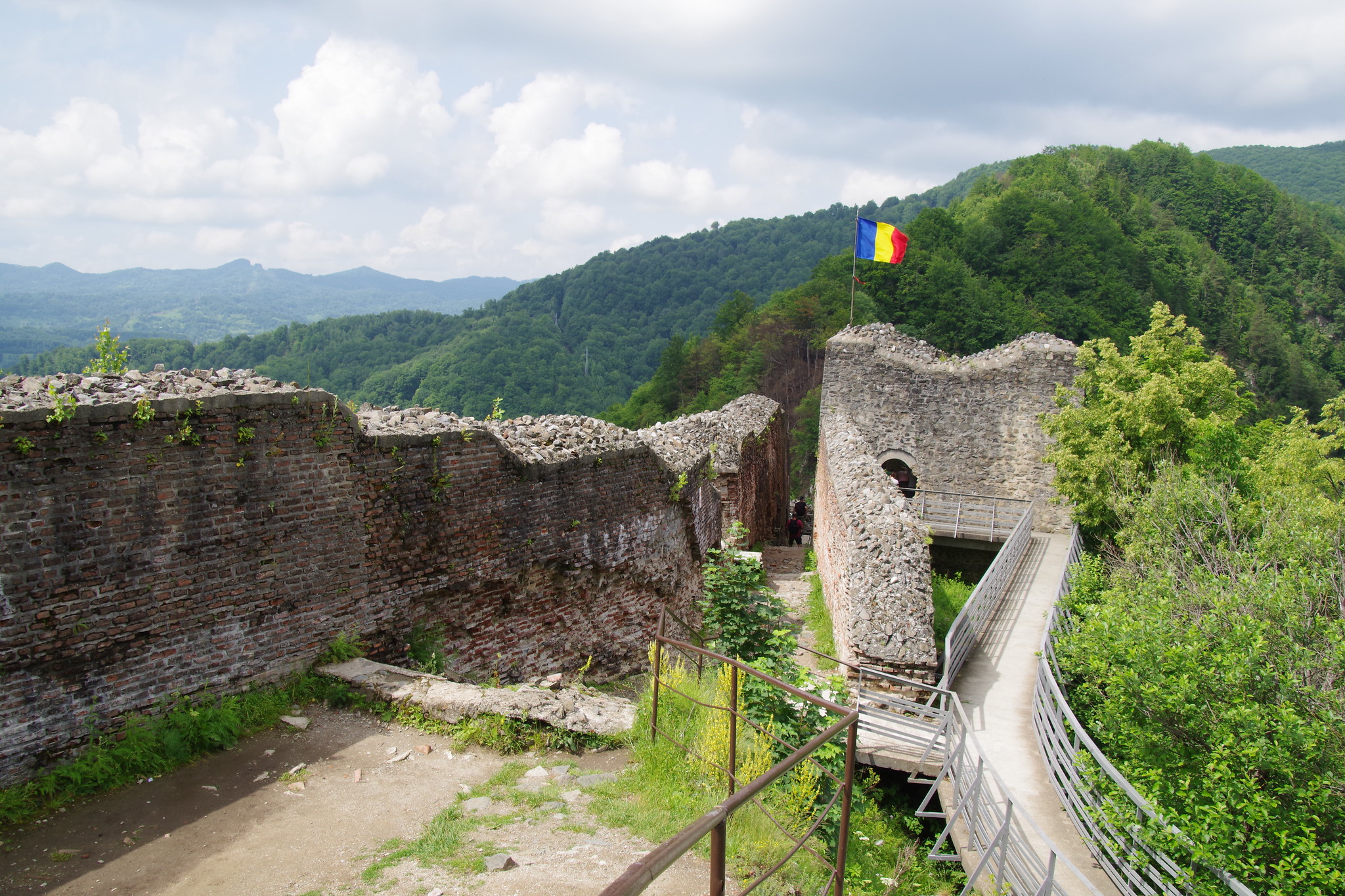
The fortress with the real claim is Poenari, a ruin on a cliff above the Argeș River. Vlad rebuilt the old citadel there in the late 1450s or early 1460s, and it served as his stronghold during the Ottoman invasion.
Reaching it requires climbing roughly 1,480 concrete steps through the forest. Part of the castle collapsed into the river in a landslide triggered by an earthquake on January 13, 1913, and further quakes in 1940 and 1977 did more damage.
Today there is little left but fragments of walls and views over the gorge, with no museum and far fewer crowds than at Bran.
What Survives
For a man who has been dead for more than five centuries, the physical evidence is thin but real. There are Vlad’s own letters, including the February 1462 dispatch to Corvinus, in addition to Ottoman and Byzantine chronicles, the German pamphlets and the Slavic tale.
There are fortresses, monasteries and the house in Sighișoara. What is missing is the thing the legend demands most: a body.
That may be the most fitting ending for a figure who exists mostly in stories. The prince who was said to have been buried in a hidden tomb has no known grave, the castle called his home was never his, and the vampire who carries his name was assembled from a footnote, a folklore essay and a Victorian writer’s imagination.
Sources: Britannica, “Vlad the Impaler” and “Bran Castle”; Wikipedia, “Vlad the Impaler,” “Vlad the Impaler’s expedition across the Danube,” “Night attack at Târgoviște,” “Poenari Castle,” “Râul Doamnei,” “Snagov,” “Strigoi,” “Nosferatu (word),” and “William Wilkinson (diplomat)”; National Geographic History, “Vlad the Impaler’s thirst for blood was an inspiration for Count Dracula”; Gizmodo, “No, Bram Stoker Did Not Model Dracula On Vlad The Impaler” (reporting on Elizabeth Miller’s research); Mental Floss, “10 Blood-Curdling Facts About ‘Dracula'”; Rough Guides, “Visiting Vlad the Impaler, Romania”; Europe Up Close, “Tracking Down Dracula at Snagov Monastery” and “Poenari Castle and the Myth of Dracula”; Romania Atlas, “Dracula in Romania: Vlad the Impaler and the Real Places”; Emily Gerard, “Transylvanian Superstitions,” The Nineteenth Century (1885); William Wilkinson, An Account of the Principalities of Wallachia and Moldavia (1820); Radu Florescu and Raymond McNally, In Search of Dracula (1972); international press reports on the 2004 Marotinu de Sus exhumation.