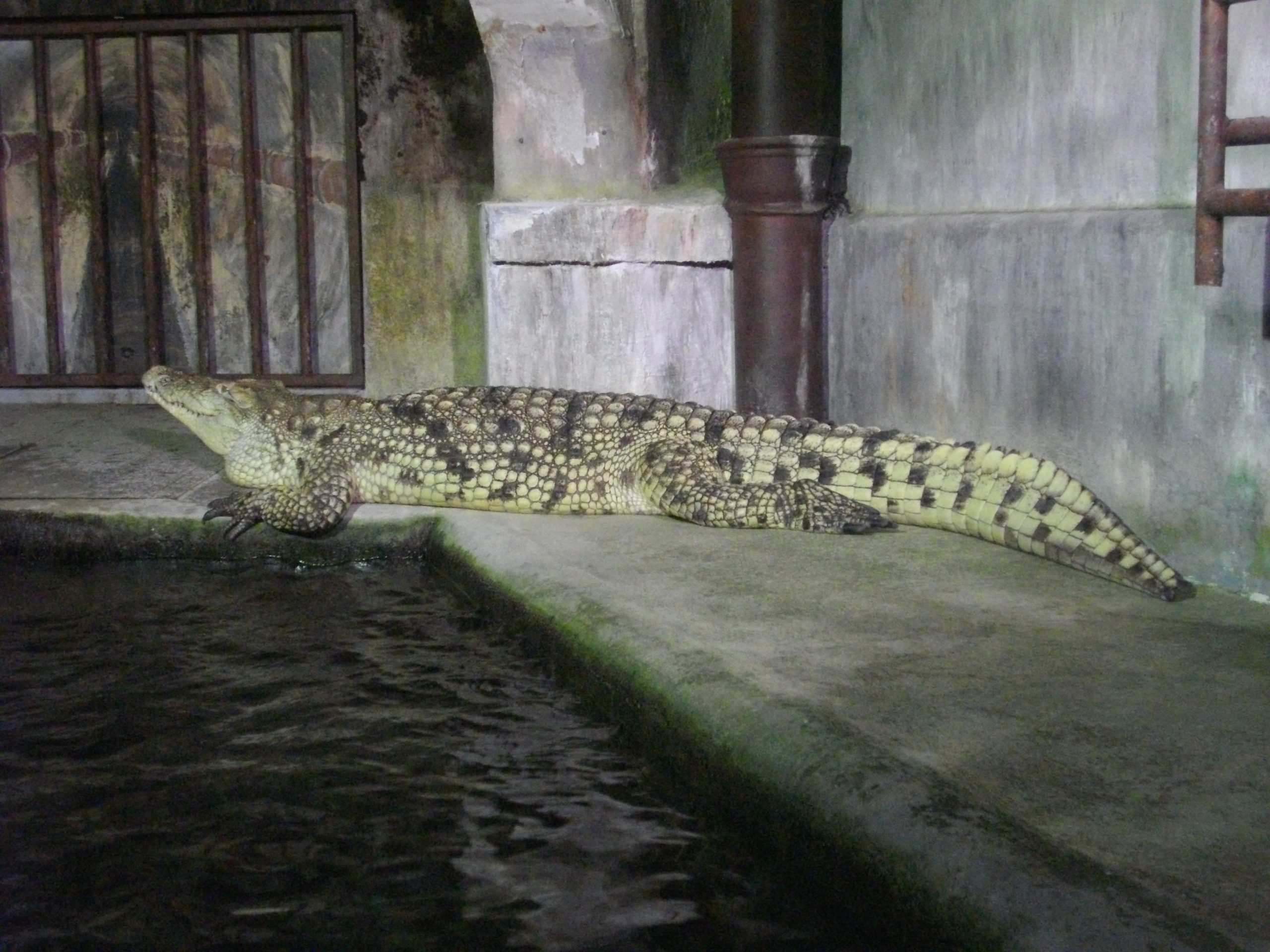
In March 1984, sewer workers beneath central Paris found something that was supposed to exist only in stories. Her name was Éléonore, and she lived for 37 more years.
Everyone has heard the story. Somebody buys a baby alligator on vacation, gets bored of it, and flushes it down the toilet.
Years later, a huge, pale, blind beast stalks the sewers beneath a big city, feeding on rats and frightening the workers who go down to inspect the pipes.
In nearly every telling, the city is New York. Then, on March 7, 1984, the story turned up in Paris.
“Something Is Moving in the Water”
That morning, sewer workers, known in French as égoutiers, were working in the tunnels near the Pont-Neuf, beneath the rue du Pont-Neuf, just a short walk from the Seine and some of the most photographed streets in Europe. In the dark, they saw a shape moving through the water. They called the fire brigade.
Archival footage from the French national archive INA, dated March 7, 1984, shows a commander named Godard crouched at a sewer opening beneath the bridge, looking down. Firefighters went down and captured the animal.
It was a reptile about 70 to 80 centimeters long, roughly the length of a baguette. It was a young female Nile crocodile, estimated to be between two and four years old.
No one has ever established where she came from. The most common explanation is a discarded exotic pet, but the French reports are clear that this is a guess: how she ended up in the Paris sewers has never been confirmed.
How Did She Survive?
Veterinarians who examined her at the menagerie of the Jardin des Plantes, where she was taken to be identified, concluded that she had probably been living in the sewers for one to two months.
They reasoned that the temperature in the tunnels was relatively mild and that food was plentiful: rats, in particular, along with food waste.
That timeframe is worth noting, because it separates fact from legend. Fact-checkers who have examined the New York version of the story say a sewer is a poor long-term home for a cold-blooded animal, since it is cold in winter and contaminated with bacteria from human waste, and sewer workers there say there is no hidden population of alligators living underground.
A young crocodile could survive for weeks, even a couple of months. A permanent colony of giants, as the legend claims, remains a fantasy.
The World Below the Street
Paris, though, has always been an unusually welcoming place for underground stories. The modern sewer system was designed in the 1850s by Baron Haussmann and the engineer Eugène Belgrand, who expanded a network of about 140 kilometers by roughly four times in the years that followed.
Victor Hugo gave the old sewers a starring role in Les Misérables, describing them as the digestive system of a great city. Visitors have been touring parts of them since the 19th century.
Today the network is usually described as roughly 2,400 kilometers long, with figures between 2,100 and 2,600 kilometers depending on how it is counted, and it is maintained by several hundred sewer workers.
The tunnels are large enough to walk through, and each has its own street sign mirroring the street above. The Paris Sewer Museum, near the Pont de l’Alma, lets visitors walk a section of the system.
The Legend That Came Before
The idea of alligators in the sewers is much older than the Paris capture. The best-known version dates to New York in the 1930s.
According to a folklorist’s account, the city’s sewer commissioner, Teddy May, told reporters that his inspectors had seen alligators about two feet long in 1935, and that he sent men down to hunt them with poisoned bait and .22 rifles, declaring the sewers clear in 1937. Skeptics have questioned how much of that was true, and some think May himself embroidered the tale.
The story then escaped into the culture. Robert Daley’s 1959 book The World Beneath the City described a giant albino alligator, Thomas Pynchon put sewer alligators in his 1963 novel V., and a 1980 horror film, Alligator, produced a mutant version.
New York even marks an informal “Alligator in the Sewer Day” every February 9. A baby alligator was caught in a Queens sewer in 2010, and similar rescues turn up regularly in Florida and elsewhere, but fully grown sewer alligators remain unproven.
That is why Paris matters. It is not the only documented case of a reptile found in a city sewer, but it is a well-documented one involving a crocodile, with a date, a place, and video of the people who caught her.
A Star in Brittany
After the Jardin des Plantes confirmed she was a Nile crocodile and a female, she was sent to the aquarium in Vannes, a city in Brittany, which opened its doors in July of that same year.
The staff built her a special enclosure that reproduced a Parisian sewer, so she would not feel out of place. They named her Éléonore, though the aquarium and many press reports use the English spelling, Eleanor.
She stayed in Vannes for about 36 years, the only crocodile in the building, and became one of its best-known residents.
Over the decades, she grew from a 70-centimeter juvenile to a powerful adult. Accounts of her size range from about 3 meters to more than 4 meters, and she weighed around 200 kilograms.
When the aquarium closed in 2020, she was moved on December 20 to La Ferme aux Crocodiles, a crocodile park in Pierrelatte, in southern France, about 900 kilometers away. There, for the first time since she was found, she was among her own kind.
An Unexpected Ending
Éléonore died there in May 2021 (some sources say June), at the age of about 38. The cause was never established. According to French reports, park staff suspected an attack by a male crocodile during breeding season, though that has not been confirmed.
Crocodiles in captivity can live for many decades and by some estimates up to a century, which makes her death a surprising ending to an extraordinary life.
Her story is now part of Paris sewer lore, mentioned by the city and its sewer museum alongside the tales of Hugo and Belgrand.
It also stands as a rare case of a legend that was mostly wrong, but not entirely. There was never a hidden world of giant crocodiles beneath the boulevards.
There was one young crocodile, a team of startled sewer workers, and a few weeks in the dark that made her famous.
Sources: Sortiraparis, “Did you know? A Nile crocodile once lived in the Paris sewers”; Paris Zigzag, “Incroyable mais vrai ! Saviez-vous qu’un crocodile a vécu dans les égouts de Paris ?” and a second Paris Zigzag article on the crocodile; France Pittoresque, “Le crocodile des égouts de Paris lézarde à Vannes depuis 30 ans” (including references to INA archival footage dated March 7, 1984); The Epoch Times (French edition), “Drôme: Eleanor, la crocodile des égouts de Paris, a rejoint la Ferme aux crocodiles” (December 2020); French Glimpses, “A crocodile in the sewers of Paris!” (2021); Observatoire français des crocodiliens (OFCC), “Le crocodile des égouts de Paris”; Wikipedia (French), “Aquarium de Vannes”; Wikipedia, “Sewer alligator,” “Paris Sewer Museum” and “Eugène Belgrand”; Corey Kilgannon, “The Truth About Alligators in the Sewers of New York,” The New York Times (2020), and Snopes, “Can Alligators Live in Sewers?”; George Fergus, “More on Alligators in the Sewers,” Journal of American Folklore; Atlas Obscura, “Musée des Égouts (Paris Museum of Sewers)”; Literary Hub, excerpt on the sewers of Paris; AOL/NBC Insider, “The Time a Massive Crocodile Was Discovered in the Sewers of Paris.”