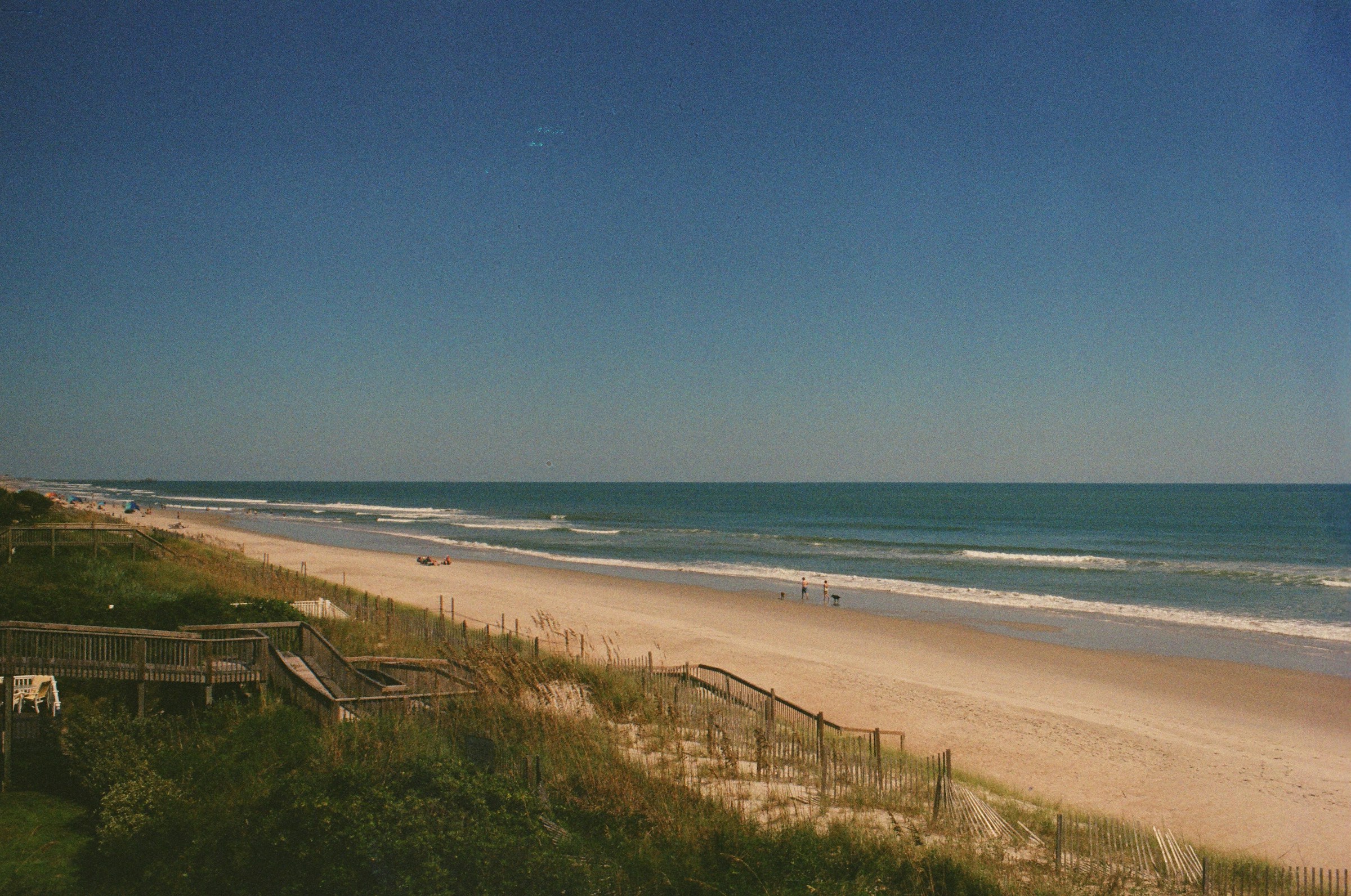
A drone captured what appeared to be hundreds – possibly thousands – of sharks moving through the shallow waters off Masonboro Island. Marine scientists say the spectacle is far less mysterious than it looks.
On the morning of August 15, 2026, a local resident named Adam Pflum sent a drone over the waters off Masonboro Island, a barrier island near Wilmington, North Carolina. What the drone saw was extraordinary.
Below the surface, hundreds of sharks were moving through the shallow coastal water, some apparently only a short distance from shore.
The footage quickly spread through local and national media, turning an ordinary stretch of North Carolina coastline into one of the internet’s most startling wildlife scenes of the summer.
But while the video looks like something out of a shark documentary, marine scientists say there is a much more natural explanation.
The sharks aren’t suddenly invading North Carolina’s beaches. They’re using a coastal ecosystem that has been part of their seasonal world for generations.
What You’re Actually Seeing
The first thing to understand is that the exact species in the video has not been definitively established.
The sharks appear to be roughly 4 to 5 feet long, and several coastal species found in North Carolina can fit that description.
Blacktip sharks, sandbar sharks and blacknose sharks are among the species known to use the region’s coastal waters.
North Carolina’s waters are an important habitat and migration corridor for sharks, and the state’s shallow coastal areas serve as nursery or feeding habitat for several species.
Atlantic blacktip sharks, for example, are commonly found along beaches, in bays, estuaries and near river mouths.
NOAA Fisheries says they can range from Virginia southward and migrate much farther north during warmer periods.
That makes a large concentration of sharks near the Carolina coast far less surprising to marine biologists than it is to someone looking down from a beach.
Why Are So Many Sharks So Close to Shore?
The answer is probably a combination of season, temperature and food. North Carolina sits along an important migratory corridor for marine species.
As waters warm during the summer, a variety of sharks move into the Carolinas, while the coastal zone provides productive feeding and nursery habitat.
The state’s own marine-resource authorities note that nearshore waters provide important pupping grounds for several shark species, including Atlantic sharpnose, bonnethead and, to a lesser extent, blacktip sharks.
There is another piece of the puzzle: the fish. Sharks do not have to travel far offshore to find food when baitfish are concentrated in the shallow coastal zone.
North Carolina’s surf zone is an important foraging area for numerous fish species, while sharks and rays are among the predators that use these habitats.
In other words, what looks from above like a coordinated invasion may simply be a highly productive feeding ground.
The Sharks Have Probably Been There All Along
This may be the most interesting part of the story. People have not suddenly discovered that hundreds of sharks can swim near North Carolina beaches.
They’ve discovered how easy it is to see them. For someone standing on the beach, the ocean can look almost empty.
You might see a few waves, a school of baitfish or the occasional fin. But you’re looking at only a tiny section of the water’s surface.
A drone changes the perspective completely. From several dozen feet above the ocean, the camera can reveal animals that would be nearly invisible from shore.
The combination of height, angle and sunlight can turn apparently opaque water into a window onto the ecosystem below.
And modern consumer drones have put that perspective into the hands of ordinary people. The Masonboro Island video is a perfect example.
A scene that might once have required a helicopter, research aircraft or a professional wildlife expedition was captured by a local resident on a Saturday morning. Within days, it was being viewed by audiences far beyond North Carolina.
Social Media Is Changing What We Think Is “Rare”
There is another reason these encounters feel increasingly common. The ocean is generating a lot more video than it used to.
Every beach town now has residents, surfers, fishermen, boaters and drone operators carrying cameras capable of recording remarkably detailed footage.
When something unusual appears, it no longer remains a local observation. It can become a global news story within hours.
That creates an interesting paradox. We may not necessarily be seeing dramatically more unusual wildlife behavior. We may simply be seeing more of the behavior that was already happening around us.
The Masonboro footage is particularly powerful because it gives viewers an aerial perspective that humans almost never get from the beach. Suddenly, the hidden traffic beneath the waves becomes visible.
North Carolina Is Shark Country – Even If It Doesn’t Always Look Like It
North Carolina’s coastline is an important part of the life cycle of numerous shark species.
The North Carolina Shark Conservancy describes the state’s coastal waters as a critical migratory corridor for transient sharks as well as habitat for resident species.
The organization also notes that shark populations overall have declined substantially over the past half-century, although some species have shown signs of recovery.
Government research tells a similar story. Studies and fisheries assessments have documented seasonal movements of sharks along the Atlantic coast, with North Carolina playing an important role in these migrations and in nearshore habitat use.
That means the sight of a large group of sharks off Masonboro Island isn’t necessarily evidence that something unusual is happening to the ocean. In many ways, it is evidence that the ocean is functioning exactly as it should.
What About Climate Change?
It is tempting to connect every unusual wildlife sighting to warming oceans, but the reality is more complicated.
Ocean temperatures influence the distribution and seasonal movements of many marine species, and North Carolina has already documented changes in where some fish and other marine organisms are found as environmental conditions change.
The state’s climate assessment notes that warming conditions can alter species ranges and migration patterns.
But that does not mean climate change caused the Masonboro Island shark gathering. There is currently no evidence establishing that connection for this particular event.
The safer conclusion is that seasonal migration, suitable water temperatures, available prey and the region’s importance as coastal habitat provide a much more immediate explanation.
And Then There Was Something Else in the Video
The sharks weren’t the only animals that caught viewers’ attention. Near the end of Pflum’s footage, what appears to be a large ray can be seen moving through the water.
Local reports described it as possibly a manta ray or stingray, although the footage alone does not establish the animal’s exact identity. That detail is almost fitting.
The same shallow waters that attract schools of fish can bring together a surprisingly diverse collection of predators and other marine animals. From the beach, it can look like nothing is happening. From above, it’s a completely different story.
The View From the Beach Is Only Half the Ocean
The Masonboro Island footage offers a useful reminder about how little of the marine world humans actually see.
A swimmer may enter the water believing the ocean around them is relatively empty. A drone can reveal dozens – or hundreds – of animals moving just beneath the surface.
Sharks are a natural part of North Carolina’s coastal ecosystem, and the state has extensive rules governing shark fishing and conservation.
Several species are prohibited from recreational or commercial possession, while others are subject to federal management. The spectacular video therefore tells two stories at once. One is about sharks. The other is about technology.
For centuries, the ocean hid much of its activity simply because humans couldn’t look at it from the right angle.
Now, increasingly inexpensive cameras are giving us eyes in the sky. And sometimes, what those eyes reveal is a scene that was probably unfolding beneath the waves long before anyone thought to film it.
Hundreds of sharks near a North Carolina beach may look like a new phenomenon. But the more likely explanation is much simpler: we finally had the right view.
Sources:
- WBTV / WECT: Reporting on Adam Pflum’s August 15 drone footage over Masonboro Island and the hundreds or potentially thousands of sharks visible in the video. (https://www.wbtv.com)
- North Carolina Shark Conservancy: Information on North Carolina as a shark migration corridor and the conservation status of shark populations. (ncsharks.org)
- NOAA Fisheries: Species information and habitat patterns for Atlantic blacktip sharks. (NOAA Fisheries)
- North Carolina Department of Environmental Quality, Division of Marine Fisheries: Information on sharks, coastal habitats and shark nursery areas in North Carolina. (NC Department of Environmental Quality)
- North Carolina Department of Natural and Cultural Resources: Research and educational material on sharks and their importance to North Carolina’s coastal ecosystem. (NC DNCR)
- NOAA Fisheries / SEDAR: Research documenting seasonal shark movements and the importance of North Carolina coastal waters. (NOAA Fisheries Media)


