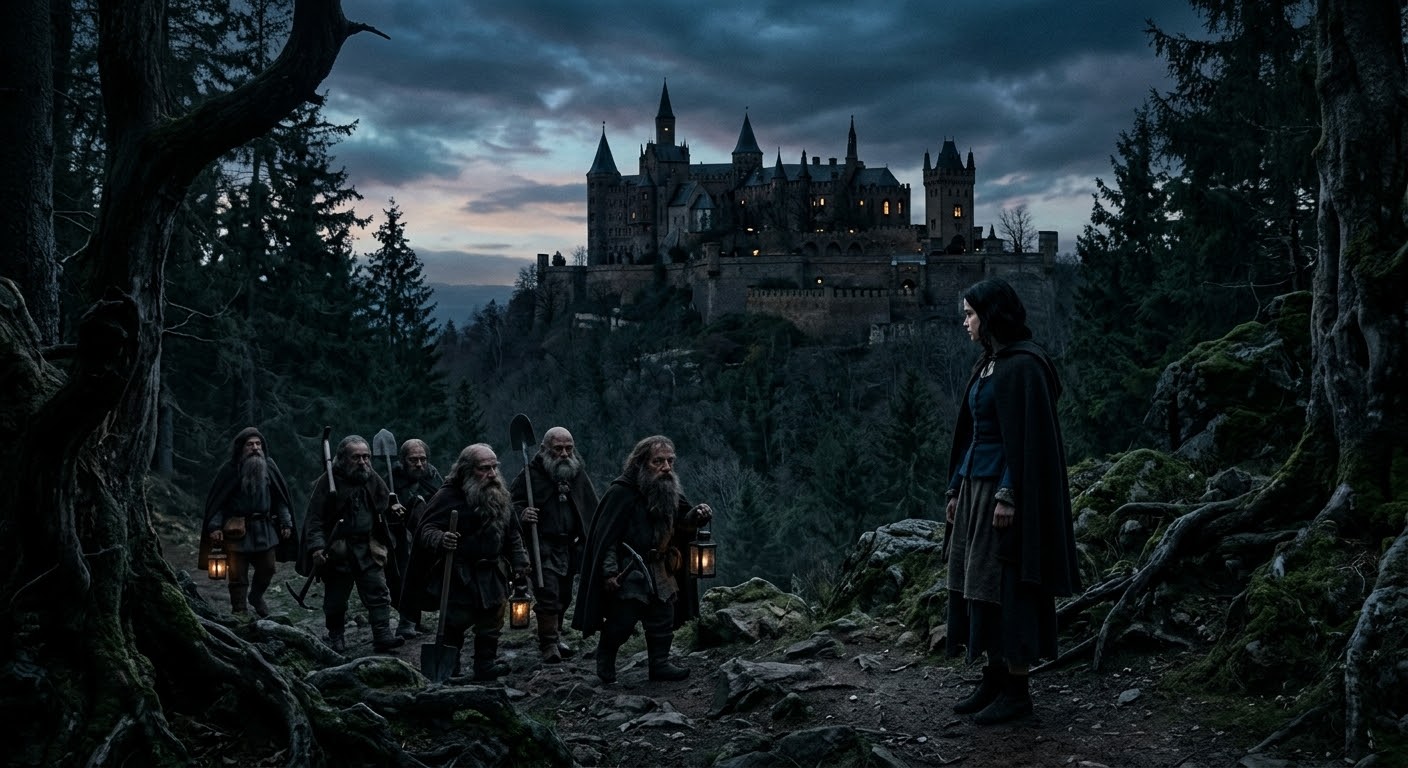
Two German towns claim she lived there. A countess who died at twenty-one, a baroness with a domineering stepmother, a village of child miners and a joke told in a pub. Behind the world’s most famous fairy tale is a story of real people – though perhaps not the ones we think.
Every year, tourists walk through a village in central Germany that calls itself “Snow White Village.” Some 250 kilometers to the south, in Bavaria, a castle displays a mirror said to be the original magic mirror. Both towns say Snow White was a real girl who lived and died there. Both cannot be right. Scholars say neither is.
Older Than Disney, and Darker
Before it was a cartoon, “Snow White” was a dark story. The Brothers Grimm published it in 1812, in the first edition of their collection, as tale 53, titled “Sneewittchen.”
They did not invent it: according to the scholar Christine Shojaei Kawan, their version combines stories from at least three informants, among them their friend Marie Hassenpflug, and the Grimms knew of eight other German variants.
A version by Johann Karl August Musäus appeared as early as 1782, and similar tales turn up as far afield as Italy and Southeast Asia.
The first edition was not friendly to children. In the original 1812 text, the villain is Snow White’s own mother; she becomes a stepmother only in the 1819 edition.
The ending was brutal either way: the queen is forced to put on red-hot iron shoes and dance until she drops dead.
Folklorists have long suspected that the story blends older motifs. Beginning in 1915, Ernst Böklen traced elements borrowed from other tales: a sleeping heroine, a house in the woods, a cruel family member.
One scholar even compared it to the Roman myth of a beautiful woman named Chione, whose name means “snow” in Greek.
Candidate One: The Countess Dead at Twenty-One
The first real-life Snow White was proposed in 1994 by the German historian Eckhard Sander, in a book titled Schneewittchen: Märchen oder Wahrheit? (Snow White: Fairy Tale or Truth?).
According to the Wikipedia article on the tale’s origin, he began his search after hearing a tour guide say that the workers of a mining town had inspired the seven dwarfs.
His candidate was Margaretha von Waldeck, born around 1533, the daughter of Count Philip IV of Waldeck-Wildungen. According to the city records of Bad Wildungen, she was famed for her beauty.
After her mother died, her father married Katharina von Hatzfeld, a woman described as strict, and Margaretha was sent away to be raised at other courts.
In 1549 she went to Brussels, to the court of Mary of Hungary, governor of the Habsburg Netherlands – a placement partly meant to help her father’s diplomacy with Emperor Charles V.
At court, several powerful men vied for her attention, among them Lamoral, Count of Egmont. The emperor’s son, the future Philip II of Spain, arrived in 1549 and reportedly pursued her during the few months he was there. An official match was impossible: she was a Lutheran.
Three surviving letters from Margaretha to her father show that her health declined over the following years. She died on March 15, 1554, aged about twenty-one. The Waldeck chronicles suggested she had been poisoned.
There the evidence ends. No archival document proves a murder, and no hard evidence of a plot survives. The theory’s central villain does not fit either: Margaretha’s stepmother died in 1546, eight years before she did, and her father did not remarry until October 1554.
Where the Dwarfs Come From
The other half of Sander’s argument is the mines. Margaretha’s father owned several copper mines, and most of the workers were children.
Sander suggested the seven dwarfs were inspired by them: the child laborers of the mining village of Bergfreiheit lived in groups of about twenty in a single-room house, much like the dwarfs in the story.
Today Bergfreiheit is a district of Bad Wildungen and calls itself Schneewittchendorf – Snow White Village.
Sander also proposed that other parts of the tale were drawn from local folklore and from members of Margaretha’s family, with a sister-in-law and a niece standing in for the wicked queen.
Candidate Two: The Baroness Born in a Pub Joke
The second candidate has an unusual origin. Karlheinz Bartels, a pharmacist from Lohr am Main in Bavaria, belonged to a “study group” of friends who met regularly in a local pub.
Inspired by an earlier hoax that traced the supposed real-life roots of Hansel and Gretel, he came up with a tongue-in-cheek theory: Snow White was Maria Sophia von Erthal, an eighteenth-century baroness from Lohr.
The supporting details were ingenious. Her father remarried after her mother’s death, and a surviving letter from the stepmother, Claudia Elisabeth von Reichenstein, suggested a woman who was domineering and favored her own children.
Lohr was famous for its mirror manufacture, and a mirror in Lohr Castle is said to be the model for the magic mirror.
A nearby mining town, Bieber, set among seven mountains, supplied the dwarfs. The glass coffin was linked to the region’s glassworks, the poisoned apple to the nightshade that grows there.
Despite its joking origins, the theory became a marketing tool. A Snow White exhibit opened at the Spessart Museum in Lohr Castle in 1992, and in 2019 a gravestone said to belong to Maria Sophia surfaced.
The Scholars’ Verdict
Nearly all serious scholars reject both theories. Professor Donald Haase called the attempts to link the story to a historical figure “pure speculation and not at all convincing.”
Ruth Bottigheimer pointed out that Maria Sophia von Erthal was born too late to have influenced the tale, since motifs like the glass coffin already appear in literature by the seventeenth century.
The Lohr theory, in particular, is recognized as a joke. Professional folklorists likewise view Sander’s theory as unlikely.
Why We Want It to Be True
The appeal is not hard to understand. The fairy tale grew out of real fears: stepmothers and inheritance, the jealousy of the powerful, poison in an age of poisoners, and children working underground.
There is no proof that any single woman inspired Snow White – but in the lives of Margaretha and Maria Sophia, there are real girls who might have recognized themselves in the story.
The fairy tale probably did not come from one place or one person. It was passed on and adapted over centuries by people who knew what it meant to fear a rival, a stepparent or the dark of the forest. That may be the truest thing about it.
Sources:
- Wikipedia, “Origin of the Snow White tale”: en.wikipedia.org/wiki/Origin_of_the_Snow_White_tale
- Wikipedia, “Margaretha von Waldeck”: en.wikipedia.org/wiki/Margaretha_von_Waldeck
- Wikipedia, “Evil Queen” (1812 and 1819 versions): en.wikipedia.org/wiki/Evil_Queen
- Sander, Eckhard, Schneewittchen: Märchen oder Wahrheit? Ein lokaler Bezug zum Kellerwald (1994)
- Dekker, Gudrun Anne, Schneewittchen: blonde Tochter einer Adligen aus Ostfriesland: Eine historische Spurensuche (2013)
- Lauer, Bernhard, “Wem gehört ‘Schneewittchen’?”, Hessische Blätter für Volks- und Kulturforschung 44 (2009)
- Vorwerk, Wolfgang, “Das ‘Lohrer Schneewittchen’: Zur Fabulologie eines Märchens” (2015)
- Bartels, Karlheinz, Schneewittchen: Zur Fabulologie des Spessarts (2012)
- Stewart, Sara, “Snow White becomes a girl-power icon,” New York Post (March 25, 2012): nypost.com/2012/03/25/snow-white-becomes-a-girl-power-icon/
- Fox News, “‘Snow White’ gravestone surfaces in Germany” (Aug. 6, 2019): foxnews.com/science/snow-white-gravestone-surfaces
- Zipes, Jack (trans.), The Original Folk and Fairy Tales of the Brothers Grimm (Princeton University Press, 2014)
- Colin Burrow, “Ogres Are Cool,” London Review of Books (2025): lrb.co.uk/the-paper/v47/n05/colin-burrow/ogres-are-cool


