It swims slower than a person strolling, may live for four centuries and has never, as far as science can confirm, attacked a human. The Greenland shark is the shark that breaks the rules.
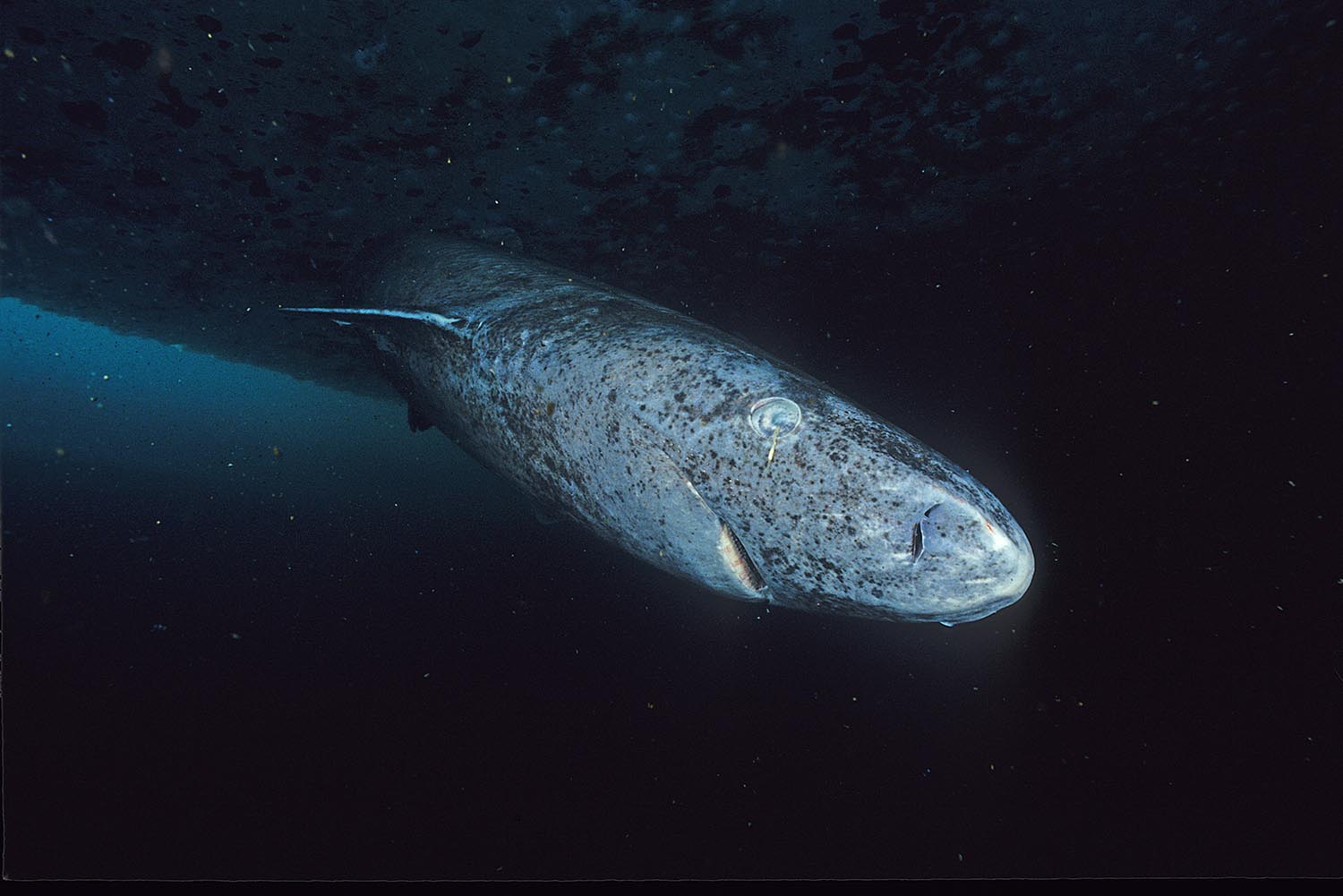
Under the ice of Canada’s Lancaster Sound, a dark shape drifts through the gloom. It is five meters long and moves at a pace slower than a walk.
Its eyes are clouded by parasites, its snout is blunt, and its fins are small. It does not look like the shark of the movies. It may, however, have been alive when Isaac Newton was.
As for the animal kingdom, the Greenland shark shatters two myths – that sharks are mindless killers, and that the longest-living animals on Earth are turtles.
Myth One: Sharks Are Mindless Killers
Of all the species of sharks, only a few are responsible for most bites on people. The Florida Museum’s International Shark Attack File, which tracks the data, confirmed 65 unprovoked bites worldwide in 2025, nine of them fatal.
The “big three” species behind most serious bites are the white shark, the tiger shark and the bull shark. The Greenland shark is not among them.
Myth Two: Nothing Outlives a Tortoise
Tortoises do live a long time. Jonathan, a Seychelles giant tortoise on the island of Saint Helena, is 193 in 2026 and is the oldest-known living land animal.
But the Greenland shark does better. In a 2016 study in Science, researchers led by Julius Nielsen of the University of Copenhagen dated the eye lenses of 28 females, using radiocarbon in proteins formed before birth.
They concluded that the sharks live at least 272 years, and the largest, a five-meter female, was most likely about 392, with a range of 272 to 512 years. That makes it the longest-lived vertebrate known, ahead of the bowhead whale at around 211 years.
One caveat: some scientists note that the dating relies on assumptions about how nuclear bomb fallout reached the deep sea, and that the exact estimates could be inflated.
Even the more conservative reading still puts the oldest sharks at 200 years or more. And one point of precision: the longest-lived animal of all is not a vertebrate. The ocean quahog, a clam nicknamed Ming, was dated to 507 years.
A Shark Built for the Cold
The Greenland shark, Somniosus microcephalus, belongs to the family of sleeper sharks, and the name is a clue to its pace.
It lives in the North Atlantic and the Arctic Ocean, preferring water between about -1°C and 7°C. It has been recorded at depths of more than 2,200 meters, and it is the only shark known to patrol beneath the Arctic ice.
It is occasionally found much farther south. In 2013, researchers from Florida State University caught one in the Gulf of Mexico at a depth of 1,749 meters, and in 2022 a large shark caught off Belize was identified as either a Greenland shark or a hybrid with the Pacific sleeper shark.
The species was formally described by the German naturalists Marcus Bloch and Johann Gottlob Schneider in 1801. But the Inuit knew it long before that.
They hunted it through holes in the ice, and their stories tell how the first Greenland shark, Skalugsuak, came to be: a piece of cloth that an old woman had used to dry her hair after washing it with urine was thrown into the sea and turned into a shark. An image tied to the smell of its flesh.
A Centimeter a Year
Greenland sharks are big. Adults typically measure four to five meters, and the largest confirmed specimen is about 6.4 meters, weighing more than a tonne.
But the shark grows only about a centimeter per year, and females probably do not reach sexual maturity until about 150 years of age, at around four meters. Researchers put the figure at 156, give or take 22 years.
Its temperature is another oddity. As an ectotherm, the shark’s body temperature follows its surroundings, and the water it lives in is just above freezing.
That slows everything down. Researchers who attached data loggers to six free-swimming Greenland sharks clocked their average cruising speed at about 0.34 meters per second, roughly one kilometer an hour.
Marine physiologist Peter Bushnell, a co-author of the 2016 study, believes the shark’s long life probably comes from expending very little energy, thanks to its cold body temperature and huge size.
Its flesh tells a similar story. The shark’s tissues are saturated with urea and a compound called TMAO, which help it handle seawater but make the meat toxic when fresh. In Iceland, it is buried, dried and fermented into a traditional dish called hákarl.
A Predator, Rarely a Threat
There is no confirmed case of a Greenland shark attacking a living person. One anecdotal report from around 1859 in Pond Inlet, Canada, describes a human leg in a shark’s stomach, but it was never investigated, and scientists think it was likely scavenging.
The old tales of sharks overturning Inuit kayaks were judged “apparently mythical” by the classic 1948 reference work on the fishes of the Gulf of Maine, which also found no authentic instance of an attack near Iceland.
One reason is geography: these sharks live in waters too cold and too deep for most swimmers. But it would be wrong to call them harmless vegetarians.
Greenland sharks are both scavengers and active predators. In a study of 45 sharks in Svalbard, more than a third of those with stomach contents had eaten seal, and the researchers concluded that the sharks actively prey on seals and fish, in addition to scavenging whale tissue.
Remains of reindeer, horse and even polar bear have turned up in their stomachs, though the polar bear is thought to have been carrion.
Divers have met them. In 2001-2002, two Canadian researchers, Jeffrey Gallant and Chris Harvey-Clark, spent two winters diving through the ice of the Saguenay Fjord in Quebec without seeing a shark.
In May 2003, they found them in the St. Lawrence Estuary: within minutes of entering the water, Gallant was approached by a shark, and it happened on every dive.
The sharks followed the divers with their eyes, could turn and accelerate quickly, and even followed them to the surface.
The researchers concluded that these were not the sluggish, blind scavengers of popular belief, but curious and visually capable animals. There was no attack.
Who Hunts the Hunter?
Few things do. According to the Florida Museum, mature Greenland sharks have no known natural predators, probably because of their size.
Orcas and polar bears are often mentioned as possible enemies, but no source documents either one hunting an adult Greenland shark.
In fact, the shark’s only known enemies are sometimes the smallest ones: a copepod, Ommatokoita elongata, attaches to the shark’s eyes, and a sea lamprey was once observed feeding on one in the St. Lawrence.
The real threat is us. In the 1940s, as many as 50,000 sharks a year were reportedly caught for their liver oil, and they are still taken in some areas and as bycatch.
In 2020, the IUCN moved the species from “near threatened” to “vulnerable.” A shark that takes a century and a half to mature cannot easily recover.
A Slow Lesson
For a long time, the Greenland shark was an obscure creature of the deep, easy to ignore. Now we know it may be the oldest vertebrate alive, and that it has been swimming through the dark since before the United States existed.
It is a reminder that the animals we are most afraid of are rarely the ones we have most reason to fear, and that the ones we know least may have the most to teach us.
Sources:
- Nielsen, J. et al., “Eye lens radiocarbon reveals centuries of longevity in the Greenland shark,” Science 353 (2016): doi.org/10.1126/science.aaf1703
- Nature News, “Greenland shark found to be at least 272 years old”: nature.com/articles/nature.2016.20406
- National Geographic, “272-Year-Old Shark Is Longest-Lived Vertebrate on Earth”: nationalgeographic.com/animals/article/greenland-sharks-animals-science-age
- Sci.News, “Greenland Sharks are Longest-Lived Vertebrates on Earth”: https://www.sci.news/biology/greenland-sharks-longest-lived-vertebrates-04099.html
- Florida Museum, “Greenland shark” species profile: floridamuseum.ufl.edu/discover-fish/species-profiles/greenland-shark/
- Florida Museum, International Shark Attack File, “2025 worldwide summary”: floridamuseum.ufl.edu/fish/isaf/worldwide-summary
- Florida Museum, “Global shark bites return to average in 2025”: floridamuseum.ufl.edu/science/global-shark-bites-return-to-average-in-2025-with-smaller-proportion-in-the-united-states/
- Discover Wildlife, “10 longest living animals”: discoverwildlife.com/animal-facts/longest-living-animals
- DIVE Magazine, “Greenland sharks: zombies of the deep” (Doug Perrine, 2021): divemagazine.com/marine-life/greenland-sharks-zombies-of-the-deep
- Leclerc, L.-M. et al., “A missing piece in the Arctic food web puzzle? Stomach contents of Greenland sharks sampled in Svalbard,” Polar Biology (2012): doi.org/10.1007/s00300-012-1166-7
- Nielsen, J. et al., “Greenland Shark Stomach Contents and Stable Isotope Values Reveal an Ontogenetic Dietary Shift,” Frontiers in Marine Science (2019): doi.org/10.3389/fmars.2019.00125
- Watanabe, Y. et al. (2012), Greenland shark swimming speeds, Journal of Experimental Biology, summarized by ScienceBlog: scienceblog.com/d-the-greenland-shark-may-live-for-nearly-four-centuries-by-doing-almost-everything-slowly
- Save Our Seas Foundation, “Greenland shark”: saveourseas.com/worldofsharks/species/greenland-shark
- Bigelow & Schroeder, Fishes of the Gulf of Maine (1948), entry for Somniosus microcephalus (via Friends of Merrymeeting Bay): cybrary.friendsofmerrymeetingbay.org/fgom/Somniosus_microcephalus.htm
- X-Ray Mag, “Unlocking the secrets of the Greenland Shark”: xray-mag.com/content/unlocking-secrets-greenland-shark
- Wikipedia, “Greenland shark”: en.wikipedia.org/wiki/Greenland_shark