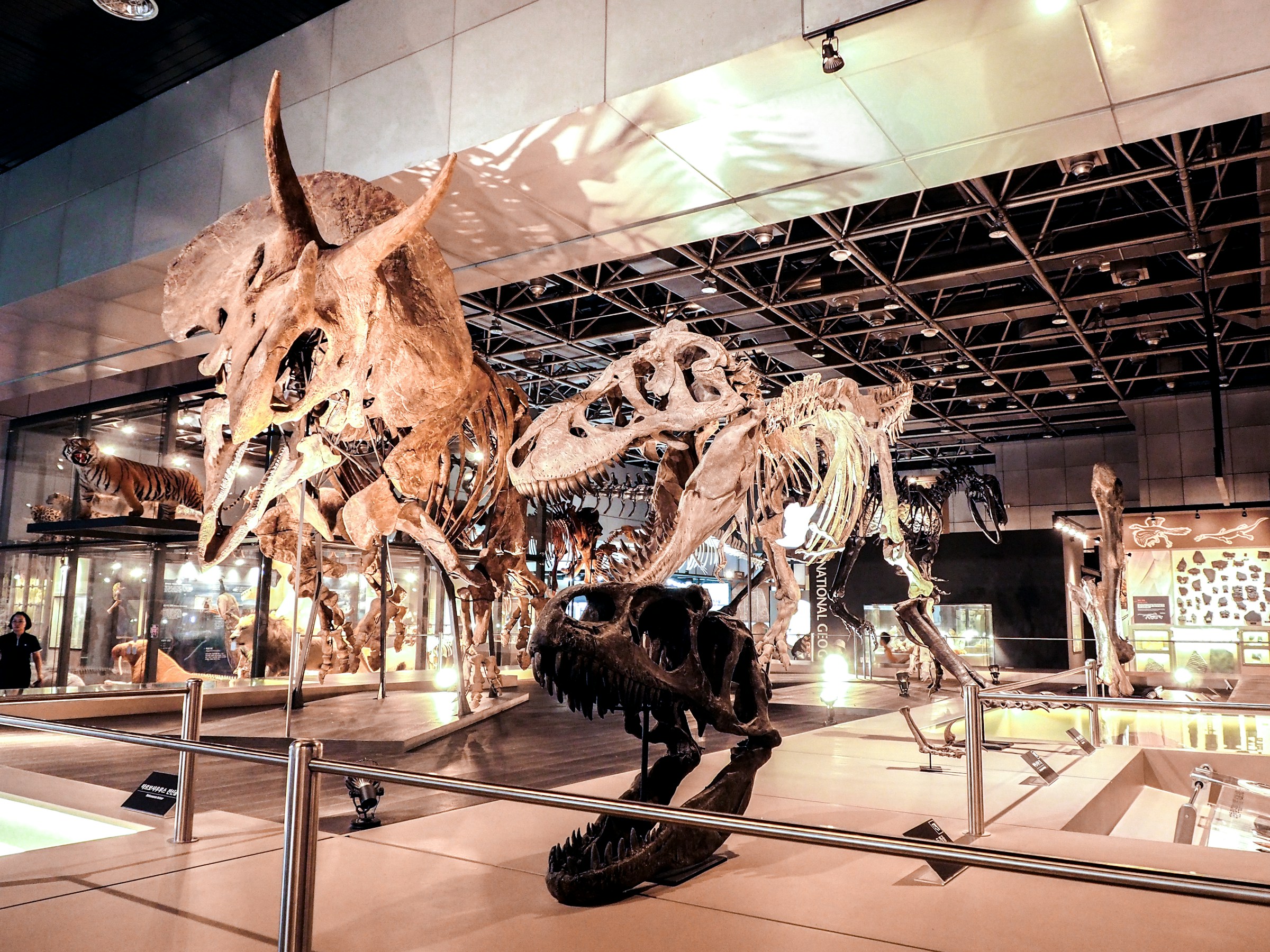
If you compressed the roughly 165 million years of dinosaur history and everything that followed into a single calendar year, dinosaurs would have appeared around January 1 and the non-avian dinosaurs would have vanished in the third week of September – a reign of roughly 165 million years as the planet’s dominant land animals, according to the U.S. Geological Survey.
Modern humans, Homo sapiens, wouldn’t appear until New Year’s Eve, barely hours before midnight. We’ve existed for roughly 300,000 years. They ruled for longer than entire oceans have taken to form and vanish.
It’s worth sitting with that comparison before asking the much bigger question it leads to: what are the actual odds that our species is still around in 100 million years?
Where We Came From
Homo sapiens emerged in Africa at least 300,000 years ago, a conclusion strongly supported by fossil finds at Jebel Irhoud in Morocco, which pushed the previously accepted date for our species’ emergence back by roughly 100,000 years. The fossils and associated material from the site have been dated to about 315,000 years ago.
From there, modern humans spent tens of thousands of years as just one of several human groups sharing the planet – Neanderthals, Denisovans, and others – before becoming the last surviving human species.
We spread out of Africa, developed language, agriculture, cities, and eventually industrial civilization, all within a sliver of time so thin it barely registers on a geological clock. That speed is itself unusual.
The fossil record shows that individual mammal species often have relatively short geological lifespans compared with the 100-million-year horizon we are considering, although estimates vary considerably depending on the species and the fossil record being studied.
Some well-preserved mammalian sequences show many species lasting around a million years or less, while others persist considerably longer. By that measure, Homo sapiens is still, in evolutionary terms, a very young species – arguably still in its opening act.
The Uncomfortable Math of Surviving 100 Million Years
Here’s the blunt version: no serious scientist can calculate a precise probability that Homo sapiens, in its current biological form, will still exist 100 million years from now. The timescale is simply too vast for meaningful statistical forecasting.
But there is a powerful reason to be skeptical that our species will remain biologically unchanged for anything close to that long.
Evolution doesn’t stop because we built civilization. Species change, branch, disappear and are replaced by descendant populations as environments shift and genetic differences accumulate.
Over 100 million years – more than 300 times longer than Homo sapiens has existed – natural evolution alone would be expected to reshape any surviving human lineage substantially, long before you factor in genetic engineering, migration into radically different environments such as space or other planets, or deliberate forms of biological modification.
In other words, the most likely long-term outcome may not be that humanity simply disappears. It may be that whatever survives us eventually becomes something that would no longer technically qualify as Homo sapiens.
Then there is the risk of catastrophe. Toby Ord, the Oxford philosopher and author of The Precipice, estimated the chance of an existential catastrophe over the next century at around one in six.
His estimate is deliberately rough and represents his personal judgment, not a scientific consensus or a measurable probability. He puts particularly large shares of that risk on human-made threats, including unaligned artificial intelligence and engineered pandemics, while estimating the combined risk from natural causes at roughly one in 10,000 per century.
That distinction matters. Ord’s “one in six” is not simply a prediction that humanity will become extinct this century. His definition of existential catastrophe also includes the permanent and drastic destruction of humanity’s future potential.
The problem is what happens when any persistent risk is compounded across deep time.
Surviving 100 million years means surviving roughly one million consecutive centuries without a catastrophe that ends our lineage or permanently destroys its potential.
A risk that looks manageable over one century becomes a very different problem when the same basic challenge repeats across geological time.
Mathematically, long-term survival requires either driving existential risks down dramatically and keeping them there, or eventually getting lucky over an almost inconceivably long sequence of trials.
And Earth itself will not remain the same. Plate tectonics will continue reshaping the planet’s geography. Models of Earth’s deep future suggest that the next supercontinent could form roughly 200-250 million years from now, well beyond the 100-million-year horizon but close enough to illustrate just how radically the planet’s geography changes on geological timescales.
The Sun, meanwhile, will continue to brighten gradually as it ages, altering Earth’s climate over hundreds of millions of years. These processes are slow enough to be irrelevant to human lifetimes but enormous when measured against the lifespan of a species.
And then there are the dice rolls of deep time. Large asteroid impacts are rare on human timescales but inevitable over sufficiently long geological periods. Major volcanic eruptions are similarly part of Earth’s long-term history.
Not every such event would threaten humanity with extinction, but over tens or hundreds of millions of years, the planet will almost certainly experience environmental shocks far beyond anything recorded in human civilization.
The Dinosaur Lesson, Again
None of this is an argument that humanity is doomed on some fixed timeline. It’s a reminder of something dinosaurs would have found just as hard to believe, if they had been capable of believing anything: dominance is not the same as permanence.
Non-avian dinosaurs weren’t a fragile, failing lineage when the asteroid struck 66 million years ago. They had already dominated terrestrial ecosystems for roughly 165 million years and had evolved into an extraordinary diversity of forms.
Their extinction was not the culmination of some obvious evolutionary decline. It was a reminder that success and permanence are entirely different things. If there’s an optimistic reading buried in all this, it’s that extinction and transformation aren’t the same outcome. “Humanity” could outlive Homo sapiens.
Our descendants might be biological, genetically modified, technologically augmented or something that is difficult for us to imagine today.
They might remain on Earth, spread through the Solar System, or eventually become something so different from us that the word “human” would be a historical rather than biological description.
The first outcome – that Homo sapiens itself will remain essentially unchanged for 100 million years – looks extraordinarily unlikely.
The second question is much more interesting: whether something recognizably descended from us will still exist.
And that part is not really a question about 100 million years from now. It is a question about what we do in the next few centuries.
Sources:
Toby Ord, The Precipice: Existential Risk and the Future of Humanity (Bloomsbury, 2020); U.S. Geological Survey, “When Did Dinosaurs Become Extinct?”; Nature, “New fossils from Jebel Irhoud, Morocco and the pan-African origin of Homo sapiens” and “The age of the hominin fossils from Jebel Irhoud”; NASA Goddard Institute for Space Studies, research on Earth’s future supercontinent and climate; Lawton & May, paleontological research on mammalian species longevity.