Imagine a sound so powerful it ruptured the eardrums of sailors 40 miles away. A sound that traveled roughly 4,800 kilometers across open ocean and was still clearly heard as cannon fire on the island of Rodrigues, near Mauritius – a distance equivalent to someone in New York hearing an explosion in Ireland. To this day, it remains the loudest sound ever documented in recorded history.
It began as an ordinary August day in 1883, in the Sunda Strait between Java and Sumatra – warm, humid, unremarkable. Within hours, it would become one of the closest things to a living hell the modern world has ever witnessed.
This is not simply the story of a geological event. It’s the story of the moment nature tore open a portal into something closer to pure terror – reshaping the planet’s climate, erasing entire towns from the map, and leaving scars on the human psyche that would surface in places no one expected, including, art historians believe, on a museum wall in Norway a decade later.
Chronicle of the Catastrophe: August 26-27, 1883
For weeks beforehand, the island of Krakatoa had been muttering its warning. Locals watched black clouds pour from its cones and heard distant, unexplained rumbling that many took for the anger of the gods rather than the language of geology.
The real sequence began on the morning of August 26, when the volcano’s northernmost cone, Perboewatan, started hurling ash roughly 20 miles into the sky. Ships passing through the strait reported pumice and ash raining onto their decks, and a darkness that swallowed the horizon whole.
Then came August 27 – four catastrophic explosions between 5:30 and 10:00 a.m. The first tore apart Perboewatan. The second erupted from Danan, the island’s middle cone.
But it was the third explosion, at 10:02 a.m., that turned Krakatoa into a name that would echo through history: an estimated 310 decibels, a shockwave so violent it circled the entire Earth roughly four times and was recorded on barometers in cities thousands of miles away.
For scale, the atomic bombs dropped on Hiroshima and Nagasaki registered around 248 decibels – meaning Krakatoa’s third detonation was, acoustically, dramatically louder than a nuclear weapon. Two-thirds of the original island simply ceased to exist, swallowed into the collapsing caldera beneath the waves.
The Dark Side of the Disaster
Ghost ships in a black sea. Vessels caught in the strait that morning, including the British ship Charles Bal, found themselves trapped in absolute darkness at midday, pelted by scorching ash, lightning crackling through the ash clouds above them, while the sea itself churned into chaos below. Crews described a world that had, without warning, stopped resembling their own.
Pyroclastic flows that walked on water. Superheated volcanic gas and ash – some estimates place the temperature well above 400°C – didn’t stop at the shoreline. These pyroclastic surges skimmed directly across the ocean’s surface, slamming into the coasts of Sumatra and Java and killing thousands of people in a matter of seconds, with no time to comprehend what was happening to them.
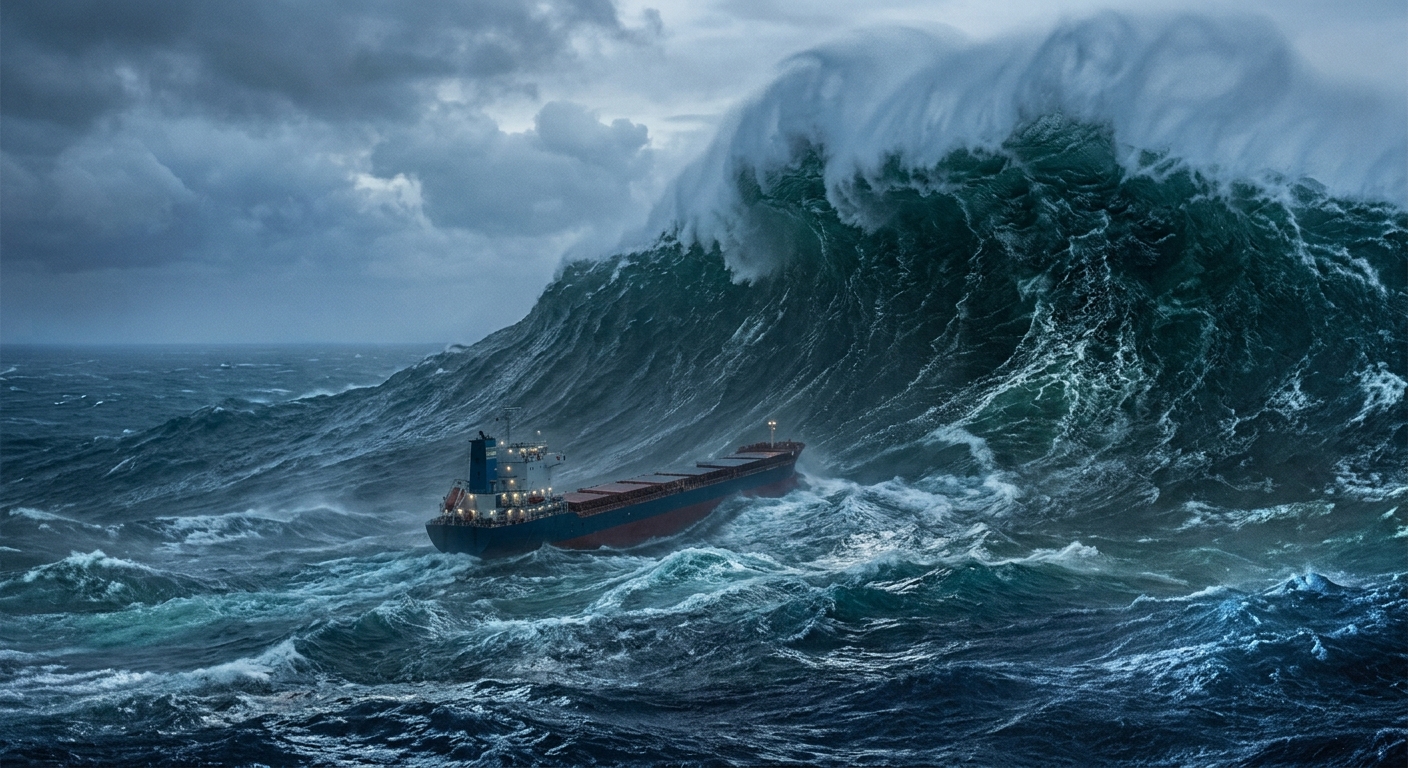
Killer waves. The collapse of the island triggered a series of tsunamis, some described as walls of water taller than 40 meters, that erased more than 150 coastal villages in a single night. In one of the eruption’s more haunting footnotes, bodies from the disaster were later found washed ashore in East Africa – carried thousands of miles across the Indian Ocean, weeks after the eruption, on currents that seemed to refuse to let the dead stay lost. Altogether, the eruption and its tsunamis are estimated to have killed more than 36,000 people, the overwhelming majority from the waves rather than the eruption itself.
The Hidden Aftermath: A World Cast Into Shadow
Sulfur dioxide hurled into the stratosphere spread into a global veil, blocking enough sunlight to cool average temperatures worldwide by roughly 0.5 to 1.2°C for several years afterward – a striking reminder of how directly a single geological event can rewrite the planet’s climate.
Witnesses across the globe reported the sun appearing green or blue through the haze, and the moon taking on a deep blood-red hue.
For months after Krakatoa, sunsets across Europe and North America turned an apocalyptic blood-red, so vivid that fire brigades in some cities were called out under the mistaken belief that the horizon itself was burning.
A decade later, in 1893, Norwegian painter Edvard Munch completed The Scream – and many art historians now believe the painting’s violently orange, blood-streaked sky is Munch’s memory of the volcanic sunsets that lingered over Oslo in the wake of Krakatoa’s eruption.
It’s a genuinely strange thought: one of the most recognizable images of psychological anguish in modern art may, quite literally, have a volcano’s fingerprints on it.
Krakatoa’s eruption happened to coincide with the rollout of a new undersea telegraph cable network – meaning, for the first time in history, news of a catastrophe could travel around the planet in near real time rather than over weeks by ship.
The result was arguably the world’s first global media event: a wave of urgent, often exaggerated dispatches that reached newspapers on multiple continents within days, laying the groundwork for the instant, borderless news cycles we now take for granted.
The Sleeping Monster: Anak Krakatau, “Child of Krakatoa”
The story doesn’t end with the eruption. In 1927, submarine eruptions within the collapsed caldera pushed a new volcanic island above the waterline – Anak Krakatau, “Child of Krakatoa,” rising quite literally from the ashes of its parent. The young volcano has been growing steadily ever since.
Its modern threat is not hypothetical. In December 2018, a sudden flank collapse on Anak Krakatau triggered an undersea landslide and, with it, a tsunami that struck the coasts of Java and Sumatra without warning, killing more than 400 people.
There was no major eruption to serve as a warning sign – just the mountain quietly giving way beneath itself, a chilling demonstration that the danger beneath the Sunda Strait never fully went to sleep.
Krakatoa remains one of history’s starkest reminders of how fragile human civilization truly is against planetary-scale forces – a single morning capable of darkening skies worldwide, cooling the entire planet, and rewriting the way news itself would travel forever after.
Beneath the calm waters of the Sunda Strait, the monster is still breathing. And sooner or later, it will decide it’s time to wake up again.
Sources:
- Wikipedia, “1883 eruption of Krakatoa,” en.wikipedia.org
- WBUR, “Krakatau: The loudest sound in recorded history,” wbur.org
- All That’s Interesting, “The 1883 Krakatoa Eruption: The Explosion Heard Round The World And The Loudest Sound Ever,” allthatsinteresting.com
- Geography Worlds, “Krakatoa Guide: 1883 Eruption & Anak Krakatau,” geographyworlds.com
- Penn State EARTH 107, “Krakatoa 1883: West of Java!” courses.ems.psu.edu
- CNN/Reuters, “Why the sky was red in Munch’s ‘The Scream,‘” (December 10, 2003)