Sheer sandstone cliffs, waterfalls that vanish into mist and summits that few people have ever seen. The tabletop mountains of South America gave Arthur Conan Doyle his lost world, and they are still hard to reach.
In 1912, readers of The Strand Magazine followed a bad-tempered scientist, Professor Challenger, up a sheer cliff to a hidden plateau where dinosaurs still roamed.
The serial ran from April to November, and the book followed that October. Conan Doyle’s creation was fiction, but the setting was not entirely invented.
Somewhere in the highlands of northern South America, enormous flat-topped mountains really do rise out of the rainforest, wrapped in clouds, with cliffs that can be climbed only in a few places.
They are called tepuis, a word from the Indigenous Pemón people, and they are among the most isolated places on Earth.
What a Tepui Is
The tepuis stand on the Guiana Shield, a 1.7-billion-year-old Precambrian formation that spans parts of southeastern Venezuela, Guyana and northern Brazil.
They are the remnants of a huge block of sandstone that began forming 1.7 to 2 billion years ago, among the oldest rocks on the planet. Over time, wind and water stripped away the softer rock around them, leaving the plateaus standing like fortresses.
The best known is Mount Roraima, which rises to 2,810 meters (9,220 feet) at its southern edge, and is the highest tepui in the region.
Its cliffs are 400 to 1,000 meters (1,300 to 3,300 feet) high, and its plateau is about 14 kilometers (9 miles) long and 5 kilometers (3 miles) wide.
The very highest peaks of the highlands, Pico da Neblina in Brazil and Pico Phelps in Venezuela, reach nearly 3,000 meters (9,800 feet). Cerro Ichún, near the border, has the largest summit area of all, around 3,260 square kilometers.
The sides are not perfectly smooth. They are scarred with cracks, ledges and waterfalls, and in a few places there is a route to the top.
For the Pemón, the tepuis are sacred. The word is often translated as “mountain” or “house of the gods,” and one Pemón story describes Roraima as the stump of a giant tree that once bore all the world’s fruits.
The Botanist Who Went Up
For generations, Roraima was a rumor. In 1884, the British botanist and colonial official Everard im Thurn and the surveyor Harry Perkins, guided by Indigenous people through unmapped rainforest, made the first documented ascent, in an expedition sponsored by the Royal Geographical Society.
They may have been the first people ever to reach the summit. Their account described a wild landscape of rock formations, marshes and waterfalls.
Conan Doyle was a keen follower of exploration news. Historians debate what exactly inspired him.
Some believe that Im Thurn’s lectures about Roraima were the main source for the lost plateau, and that the hidden world of “living fossils” became associated with British Guiana in the public imagination.
Others point to the explorer Percy Fawcett, a friend whom Conan Doyle met at a lecture at the Royal Geographical Society, and to Fawcett’s expedition to the Huanchaca Plateau in Bolivia. Most likely, as with many novels, it was a blend.
A World of Its Own
What makes the tepuis special is isolation. Their summits are cold, wet and starved of nutrients, with acidic, poor soils, and the cliffs limit the movement of plants and animals. The result is a high level of endemism.
According to the World Wildlife Fund, of 2,322 vascular plant species in the high-altitude “Pantepui” region, 766, or about a third, are found nowhere else.
Many of these are carnivorous plants and orchids. Animals include the Roraima black frog, a tiny amphibian found on the summit.
Scientists have long debated exactly how isolated the summits really were. For decades, a popular theory suggested that tepui ecosystems had been sheltered in isolation since the plateaus eroded roughly 70 million years ago, but a 2012 DNA study on frogs challenged that story, and the idea of the summits as pure “time capsules” is now seen as too simple.
What is clear is that expeditions keep finding new species. During a series of climbs from 2003 to 2006, the biologist Bruce Means and a team of climbers found several new frog species below Roraima’s cliffs.
The Tallest Waterfall
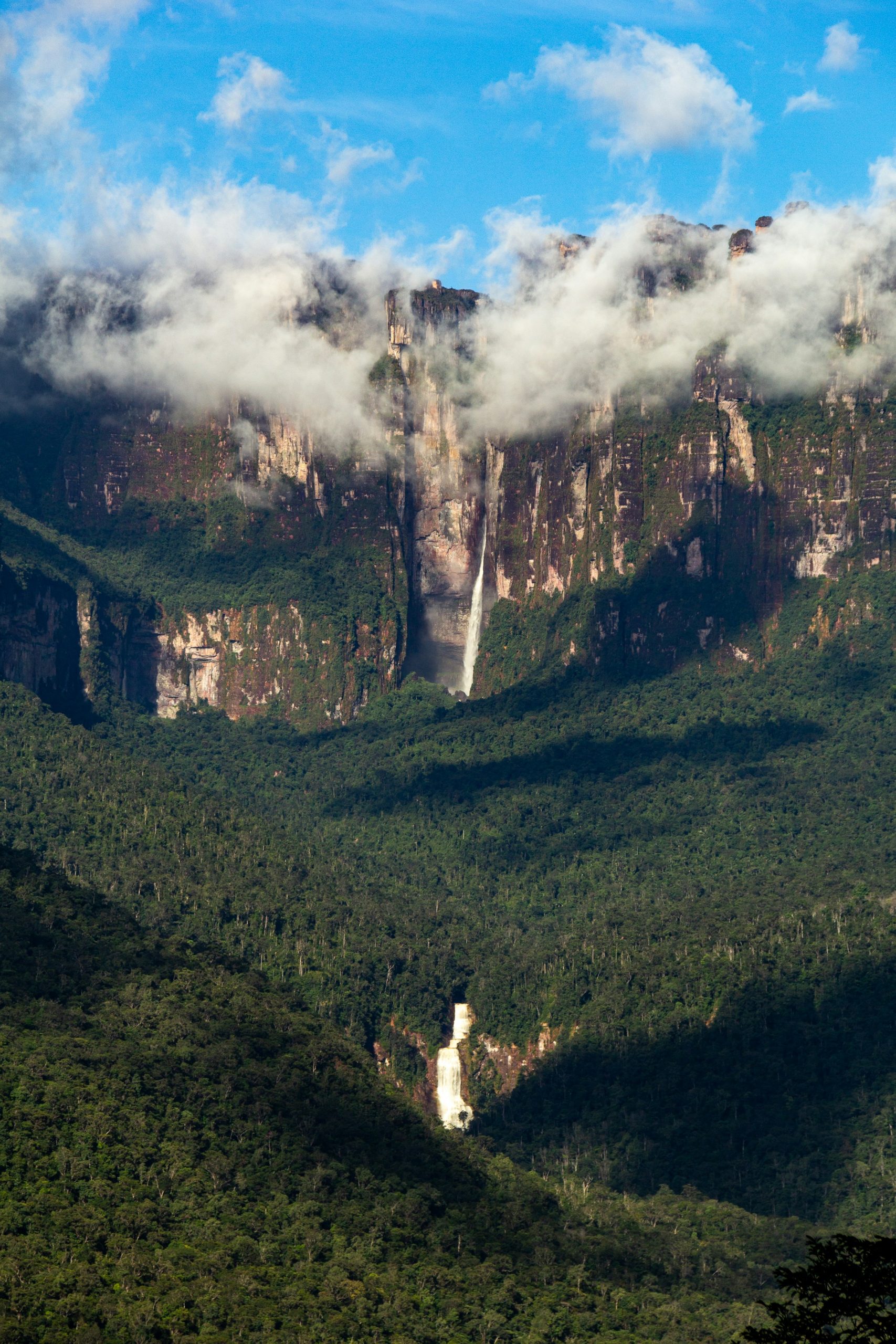
The most famous feature of the tepuis is not a summit but a waterfall. Angel Falls (Salto Ángel) drops off the edge of Auyán-tepui, whose name means “Devil’s Mountain,” in Canaima National Park.
It is the world’s tallest uninterrupted waterfall, with a total height of 979 meters (3,212 feet) and a single plunge of 807 meters (2,648 feet). The Pemón call it Kerepakupai Vená, which is usually translated as “waterfall of the deepest place.”
Its history is a matter of some dispute. The Venezuelan explorer Ernesto Sánchez La Cruz is thought to have seen the falls around 1910 to 1912 but did not publicize it, and some researchers say that what he saw may have been a different waterfall.
The world learned about it from the American pilot Jimmie Angel, who flew over it on November 16, 1933, while searching for a valuable ore bed, and who returned on October 9, 1937 to land his small plane, the El Río Caroní, on top of Auyán-tepui.
The plane was stuck on the summit, and the party had to find its own way down. The falls were named after him; the Venezuelan government adopted the name officially in 1939.
The height was only measured in 1949, in an expedition led by the American journalist Ruth Robertson with the support of the National Geographic Society, which also made the first successful ground expedition to the falls.
Canaima National Park, which covers about 3 million hectares (30,000 square kilometers), roughly the size of Belgium, became a UNESCO World Heritage Site in 1994.
Still Out of Reach
Angel Falls remains isolated. No road reaches Canaima. Visitors typically fly in on small planes, then travel upriver by motorized dugout canoe, a journey of four to five hours in the rainy season, and, in practice, only with a licensed tour operator. The falls themselves change with the season: in the dry months, they can shrink to a thin stream.
The more remote tepuis are visited rarely, if at all. Roraima, by contrast, is relatively accessible and is climbed by trekkers, typically on a six-day round trip from the Pemón village of Paraitepui, with a guide required.
Auyán-tepui sees more ascents, but most other summits are very rarely climbed, if ever, according to climbing guides. Many peaks are reached only by helicopter by researchers, and in some cases access is restricted by belief.
Kukenán, Roraima’s neighbor, is also known as Matawi-tepui, “place to die,” and local accounts say that climbing it is forbidden because it is sacred and its spirits are feared.
Some enormous sinkholes on tepui summits, such as Sarisariñama, were seen from the air before anyone reached the bottom.
The Lost World Today
The tepuis are, in other words, as hard to reach as ever. In 2026, they are harder than usual. The U.S. State Department rates Venezuela at Level 3, “Reconsider Travel,” and warns Americans not to travel to rural areas of Bolívar state, where the tepuis lie, because of crime and kidnapping.
The British Foreign Office advises against all travel within 40 kilometers (25 miles) of the borders with Brazil and Guyana, which includes the area where Roraima’s summit meets both, and against all but essential travel to the rest of the country, outside certain regions where it advises against all travel.
In June, two earthquakes of magnitude 7.2 and 7.5 struck the country’s coast, closing the main Caracas airport until September 1, when it reopened at limited capacity.
Operators still advertise expeditions to Angel Falls and Roraima. Anyone considering such a trip should read their government’s current advice, which can invalidate travel insurance if ignored.
Conan Doyle’s novel imagined a plateau where time had stopped. The reality is stranger. The tepuis are not frozen in time, but they are old, isolated and still being explored, and a century after the book appeared, they have kept something of their mystery.
Travel conditions in Venezuela change quickly. This article is not travel advice; check official government guidance before making any plans.
Sources:
- Kew Gardens, “Everard Im Thurn and the ‘lost world'”: kew.org/read-and-watch/everard-im-thurn-lost-world
- Dalziell, Rosamund, “The Curious Case of Sir Everard im Thurn and Sir Arthur Conan Doyle,” English Literature in Transition 45(2), 2002: muse.jhu.edu/article/367598/summary
- World Wildlife Fund, “Tepuis” ecoregion: ecoregions.worldwildlife.org/ecoregions/nt0169
- Live Science, “Mount Roraima: The ‘lost world’ isolated for millions of years”: livescience.com/planet-earth/geology/mount-roraima-the-lost-world-isolated-for-millions-of-years-that-indigenous-people-call-the-house-of-the-gods
- American Alpine Journal, expedition reports by Bruce Means and climbers:publications.americanalpineclub.org/articles/13201216163.pdf
- PBS Nature, “Eco-explorer: People”: pbs.org/wnet/nature/eco-explorer-people/1987
- La Patilla, “Tepuy Kukenán: El hermano del Roraima esconde un misterio” (2021): lapatilla.com/2021/06/23/tepuy-kukenan-el-hermano-del-roraima-esconde-un-misterio-entre-lo-sagrado-y-lo-prohibido-fotos/
- Guinness World Records, “Highest waterfall”: guinnessworldrecords.com/world-records/highest-waterfall
- Google Arts & Culture, “Angel Falls”: artsandculture.google.com/story/angel-falls/MAURAq-3L8_TCA?hl=en
- UK Foreign, Commonwealth & Development Office, “Venezuela travel advice” (updated Nov. 18, 2026): gov.uk/foreign-travel-advice/venezuela
- U.S. Department of State, “Venezuela Travel Advisory”: travel.state.gov/en/international-travel/travel-advisories/venezuela.html
- National Library of Medicine, “Ancient tepui summits harbor young rather than old lineages of endemic frogs“: https://pubmed.ncbi.nlm.nih.gov/23025594/